
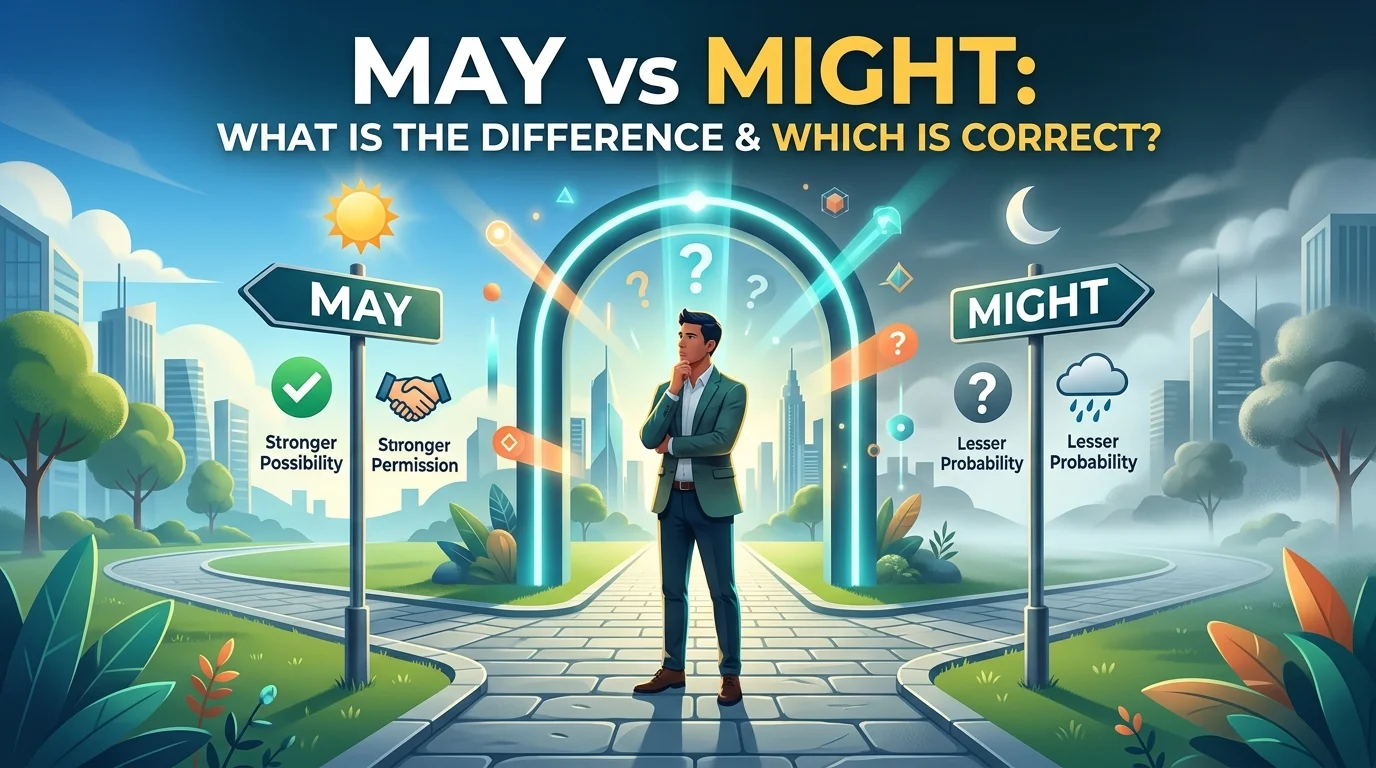
“May” and “might” are both modal verbs in English, and many learners confuse them because they often express possibility. However, they are not always interchangeable. Understanding the difference between “may” and “might” helps you speak and write more accurately, especially in formal writing, polite requests, and situations involving uncertainty.
Comparison Overview
“May” and “might” both talk about possibility, permission, and uncertainty. They are closely related in meaning, but they differ in strength, tone, and context. In many situations, “may” sounds more formal and stronger, while “might” often suggests weaker possibility or more uncertainty.
Definition of May
“May” is a modal verb used to express possibility, permission, or a wish.
Core meaning:
It usually means something is possible or allowed.
Purpose:
It helps speakers talk about what could happen or ask for permission politely.
Examples:
• It may rain tonight.
• May I enter the room?
Definition of Might
“Might” is a modal verb used to express a weaker possibility or uncertainty.
Core meaning:
It suggests something is possible, but less certain.
Purpose:
It helps speakers talk about doubtful or less likely situations.
Examples:
• It might rain later.
• She might come to the meeting.
Main Differences Between May and Might
| Feature | May | Might |
| Strength of possibility | Stronger possibility | Weaker possibility |
| Formality | More formal | Less formal, conversational |
| Permission | Commonly used | Rarely used |
| Past possibility | Less common | Common |
| Certainty level | More certain | Less certain |
Key difference:
“May” often shows a higher chance of something happening, while “might” shows lower probability.
Example:
• It may snow tomorrow. (more likely)
• It might snow tomorrow. (less likely)
Possibility and Probability Differences
When discussing possibility:
“May” = possible and fairly likely
“might” = possible but less likely
Examples:
• He may call tonight. (good chance)
• He might call tonight. (not sure)
Formal vs Informal Usage
“May” is often preferred in formal writing and professional situations.
Examples:
• Employees may access the system after approval.
• Students may use calculators during the exam.
“Might” is more common in casual conversation.
Examples:
• I might go out later.
• We might watch a movie.
Grammar Guide
Both “may” and “might” are modal verbs.
Structure:
Subject + may/might + base verb
Examples:
• She may travel tomorrow.
• He might visit us.
Important:
Never add “to” after them.
Wrong:
• She may to come.
Correct:
• She may come.
How Each Term Is Used in Sentences
For possibility:
• It may happen.
• It might happen.
For permission:
• May I leave now?
For polite suggestions:
• You might try again.
Common Mistakes Learners Make
Using “might” for permission:
Wrong: Might I use your phone?
Correct: May I use your phone?
Adding verb endings:
Wrong: She may goes.
Correct: She may go.
Confusing certainty:
Wrongly assuming both mean exactly the same.
Simple Rules to Remember
Use “may” when:
• asking permission
• writing formally
• probability feels stronger
Use “might” when:
• expressing uncertainty
• speaking casually
• probability feels weaker
Quick Tips for Writing and Speaking
In essays, prefer “may” for formal tone.
In conversation, “might” sounds natural.
If unsure about permission, choose “may.”
For doubtful situations, choose “might.”
When to Use Each One
Use “may”:
• asking permission
• official communication
• likely possibilities
• formal writing
Use “might”:
• uncertain guesses
• hypothetical situations
• less likely events
• casual conversation
Examples:
• You may begin the test.
• I might join later.
When NOT to Use Each One
Do not use “may”:
• when strong certainty exists
Wrong: The sun may rise tomorrow.
Correct: The sun will rise tomorrow.
Do not use “might”:
• for standard permission requests
Wrong: Might I borrow your pen?
Better: May I borrow your pen?
Which One to Use (Decision Guide)
Ask yourself:
Are you asking permission?
→ Use “may”
Are you expressing possibility?
→ If stronger chance: use “may”
→ If weaker chance: use “might”
Are you writing formally?
→ Use “may”
Are you speaking casually?
→ “Might” often sounds better
Real-World Practical Examples
May Examples
Education:
• Students may submit homework online.
Daily life:
• I may go shopping later.
Science:
• This medicine may reduce pain.
Business:
• Sales may increase next month.
Technology:
• The update may improve performance.
Might Examples
Education:
• She might choose biology next year.
Daily life:
• We might eat outside tonight.
Science:
• This chemical might react with water.
Business:
• The company might open a new office.
Conversation:
• He might call you tomorrow.
Self-Assessment (Fill in the Blanks)
- It ______ rain this evening because clouds are forming.
- I ______ visit my grandmother this weekend, but I am not sure.
- ______ I borrow your notebook for class?
- She ______ get the job because she is highly qualified.
- He ______ come later if traffic improves.
- Students ______ use dictionaries during the test.
- We ______ cancel the trip if the weather worsens.
- The results ______ change after further research.
- ______ I ask a question?
- They ______ arrive early, but it is uncertain.
- This medicine ______ help reduce fever.
- I ______ go to the gym after work.
- Guests ______ enter after showing ID.
- She ______ not agree with your idea.
- The machine ______ stop working without warning.
- You ______ need a jacket tonight.
- ______ I leave the meeting early?
- He ______ forget the appointment.
- Prices ______ rise next year.
- We ______ see improvements soon.
Answers
- may
- might
- May
- may
- might
- may
- might
- may
- May
- might
- may
- might
- may
- might
- might
- might
- May
- might
- may
- may
Final Verdict
“May” and “might” both express possibility, but they are not exactly the same. Use “may” when something is more likely, when asking permission, or when writing formally. Use “might” when something feels less certain or more hypothetical. If you remember that “may” sounds stronger and “might” sounds weaker, choosing the correct word becomes much easier.
Conclusion About May vs Might
In summary, “may” and “might” are closely related modal verbs that help express possibility, permission, and uncertainty in English. While both words often seem similar, the key difference lies in strength and confidence. “May” usually suggests a stronger or more likely possibility and is commonly used in formal contexts or when asking permission. On the other hand, “might” expresses a weaker, more uncertain possibility and is often preferred in casual speech or hypothetical situations. Learning how to distinguish between them can significantly improve your writing clarity and speaking accuracy. By understanding their subtle differences and practicing with real examples, you can choose the right word naturally in everyday communication, academic writing, and professional settings.
FAQs
What is the main difference between may and might?
“May” indicates a stronger possibility or formal permission, while “might” shows weaker or less certain possibility. Both express uncertainty, but “may” feels more confident and formal, whereas “might” sounds more tentative and is often used in casual conversation or hypothetical situations.
Can may and might be used interchangeably?
In many cases, yes, they can be interchangeable when expressing possibility. However, the meaning slightly changes in strength. “May” suggests a higher chance, while “might” suggests lower probability. In formal writing or permission contexts, they are not always interchangeable.
When should I use may in a sentence?
Use “may” when giving or asking permission, or when expressing a strong possibility. It is also common in formal writing. For example, “You may leave early” or “It may rain today” shows both authority and likelihood in a clear, structured way.
When should I use might in a sentence?
“Might” is used when something is uncertain or less likely. It is common in casual speech and hypothetical situations. For example, “I might go shopping later” shows doubt or flexibility, meaning the action is possible but not confirmed.
Is may more formal than might?
Yes, “may” is generally more formal than “might.” It is often used in official documents, polite requests, and academic writing. “Might” is more conversational and relaxed, making it better suited for everyday informal communication and uncertain predictions.
Does might refer to the past?
“Might” can sometimes refer to past possibilities, especially in reported speech or speculation. For example, “He said he might come” refers to a past statement. However, it is not strictly a past tense verb but a modal verb expressing uncertainty.
Can may express permission?
Yes, “may” is commonly used to express permission. For example, “You may enter the room” means you are allowed to enter. It is considered more polite and formal than alternatives like “can,” especially in academic or professional settings.
Why is might used for uncertainty?
“Might” is used for uncertainty because it expresses a lower degree of likelihood. It suggests that something could happen, but there is no strong expectation. This makes it useful for predictions, guesses, or situations where outcomes are unclear or unknown.
Which is more common in daily conversation?
In everyday speech, “might” is more common because people often talk about uncertain plans or possibilities. For example, “I might be late” sounds natural in casual conversation, while “may” is less frequently used unless formality or permission is involved.
How can I easily remember may vs might?
A simple way to remember is that “may” means more likely or permission, while “might” means less likely or uncertain. Think of “may” as stronger and more formal, and “might” as softer and more doubtful in everyday communication.

Sarah Mitchell is an experienced writer and grammar teacher with over 10 years of expertise in English language education. She helps learners improve their grammar, writing, and communication skills through clear explanations and practical examples. Sarah creates learner-friendly content focused on real-life English, making language learning simple, effective, and confidence-building.