
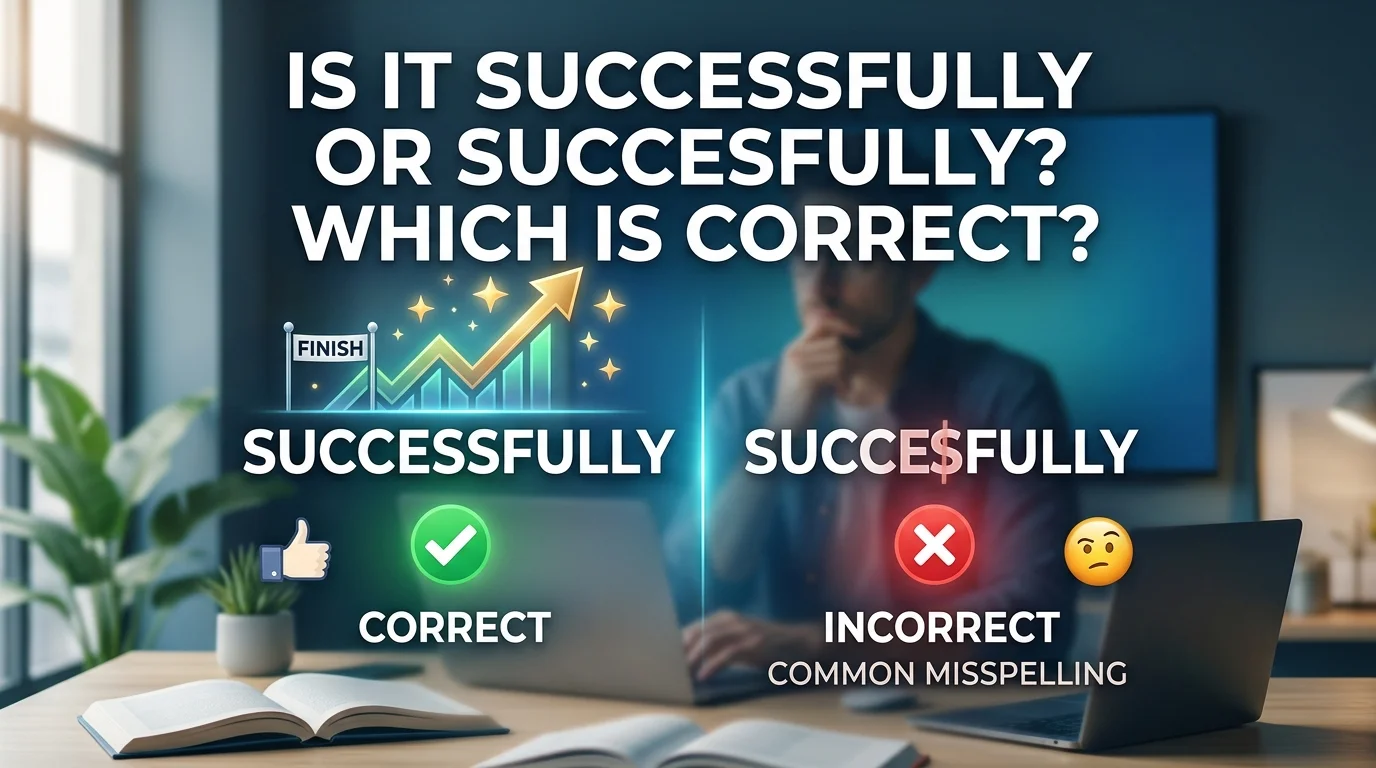
Many English learners and even native speakers confuse “successfully” and “succesfully” because they look very similar. However, only one is correct in standard English. Understanding the difference matters because using the wrong spelling can make your writing look unprofessional. This guide explains the difference clearly and helps you use the correct word confidently.
Comparison Overview
The comparison between successfully and succesfully is actually a spelling comparison rather than a meaning comparison.
Both words are intended to express the same idea: doing something in a successful way or achieving a desired result. However, only one is accepted in English dictionaries and grammar rules.
Quick overview:
| Term | Correct? | Meaning |
| Successfully | Yes | In a successful manner |
| Succesfully | No | Misspelling of “successfully” |
Definition of Successfully
Successfully is the correct adverb form of the adjective successful.
It means doing something in a way that achieves the desired result.
Examples:
- She successfully completed the exam.
- The company successfully launched its product.
- He successfully repaired the computer.
Core purpose:
It describes an action that ended with success.
Definition of Succesfully
Succesfully is an incorrect spelling.
It is a common spelling mistake caused by dropping one “s” from the correct word.
Why people make this mistake:
The base word success has double s, and when adding -fully, many writers accidentally remove one s.
Example of incorrect usage:
- ❌ She succesfully finished the project.
Correct version:
- ✅ She successfully finished the project.
Main Differences Between Successfully and Succesfully
The main difference is spelling accuracy.
| Feature | Successfully | Succesfully |
| Spelling | Correct | Incorrect |
| Dictionary recognized | Yes | No |
| Acceptable in formal writing | Yes | No |
| Used in exams | Yes | No |
| Professional writing | Yes | No |
Key point:
Both aim to express the same meaning, but only successfully should ever be used.
Why This Spelling Mistake Happens
This error happens because English spelling can be tricky.
Breakdown:
Success + fully = successfully
Notice:
- success → ends with ss
- fully → starts with f
- keep both s letters
Correct structure:
success + fully = successfully
Incorrect:
succes + fully = succesfully ❌
Grammar Guide
Successfully is an adverb.
It modifies verbs by describing how an action happened.
Example:
- She successfully passed the test.
Here, “successfully” explains how she passed.
How Each Term Is Used in Sentences
Correct:
- They successfully solved the problem.
- We successfully finished the meeting.
- He successfully submitted the form.
Incorrect:
- They succesfully solved the problem. ❌
Pattern:
Subject + verb + successfully + object
Example:
- I successfully completed my homework.
Common Mistakes Learners Make
- Dropping one “s”
- ❌ succesfully
- ✅ successfully
- Confusing adjective and adverb
- ❌ He was successfully student.
- ✅ He was a successful student.
- Typing too fast
- Common in emails and messages.
- Ignoring spell check warnings
- Many tools detect this error.
Simple Rules to Remember
Rule 1:
Think of the word success first.
Rule 2:
Keep both s letters.
Rule 3:
Add -fully after it.
Formula:
success + fully = successfully
Memory trick:
“If there is success, there are two s’s.”
Quick Tips for Writing and Speaking
- Always spell-check your documents.
- Memorize the base word: success.
- Read your writing aloud.
- Watch for double letters.
- Practice writing it several times.
When to Use Each One
Use successfully when:
- writing essays
- sending emails
- taking exams
- writing reports
- speaking formally
- posting professional content
Examples:
- She successfully defended her thesis.
- The app was successfully installed.
Use succesfully:
Never.
When NOT to Use Each One
Do not use successfully:
- as an adjective
Wrong:
- She is successfully. ❌
Correct:
- She is successful. ✅
Do not use succesfully:
- in any context
- formal writing
- school assignments
- business documents
- online articles
It is always wrong.
Which One to Use (Decision Guide)
Ask yourself:
Did I mean “in a successful way”?
If yes:
Use successfully ✅
Did I type “succesfully”?
Then fix it immediately ❌
Decision chart:
Meaning needed → “in a successful manner” → successfully
Never choose succesfully.
Real-World Practical Examples
Successfully Examples
- Education: She successfully passed her final exams.
- Daily life: He successfully cooked dinner for the family.
- Science: Researchers successfully tested the vaccine.
- Business: The startup successfully raised funding.
- Technology: The software successfully updated overnight.
Succesfully Examples
These are incorrect examples showing common mistakes:
- ❌ She succesfully passed her final exams.
- ❌ He succesfully opened the file.
- ❌ They succesfully solved the issue.
- ❌ We succesfully completed the project.
- ❌ The app succesfully installed.
All should be replaced with successfully.
Self-Assessment (Fill in the Blanks)
- She ______ completed her homework.
- The project was ______ finished on time.
- He ______ passed the interview.
- We ______ solved the problem.
- The software ______ installed.
- The team ______ won the match.
- I ______ submitted my assignment.
- The company ______ launched its product.
- They ______ reached the destination.
- The patient ______ recovered.
- The rocket ______ launched.
- She ______ defended her thesis.
- The system ______ restarted.
- He ______ opened the locked door.
- The event was ______ organized.
- We ______ completed the training.
- Scientists ______ tested the theory.
- The deal was ______ finalized.
- She ______ answered every question.
- They ______ finished the marathon.
Answers
- successfully
- successfully
- successfully
- successfully
- successfully
- successfully
- successfully
- successfully
- successfully
- successfully
- successfully
- successfully
- successfully
- successfully
- successfully
- successfully
- successfully
- successfully
- successfully
- successfully
Final Verdict
The answer is simple: “successfully” is the only correct spelling. “Succesfully” is a spelling mistake and should never be used in formal or informal writing. If you remember the root word success, keeping both s letters becomes much easier. Whenever you want to describe doing something with success, always choose successfully.
Conclusion About Successfully Or Succesfully
In conclusion, the difference between “successfully” and “succesfully” comes down to correct spelling rather than meaning. Both words are intended to express the idea of achieving something in a positive or effective way, but only “successfully” is recognized in standard English. The incorrect version, “succesfully,” often appears due to missing one of the double letters in the root word “success.” Understanding this small detail can significantly improve the quality of your writing, especially in academic, professional, and online communication. By remembering the structure of the base word and adding “fully” correctly, you can avoid a very common spelling mistake. With regular practice and attention, using the correct form becomes natural and effortless, helping your writing appear more polished, accurate, and credible in any context.
FAQs
What is the correct spelling, successfully or succesfully?
The correct spelling is “successfully.” It is the standard adverb form of “successful.” “Succesfully” is incorrect and considered a common spelling mistake. Always use “successfully” in writing, speaking, and exams to ensure accuracy and maintain proper English grammar standards.
Why is succesfully considered wrong?
“Succesfully” is wrong because it drops one “s” from the base word “success.” English spelling rules require both “s” letters to remain when forming “successfully.” Removing one changes it into a misspelling that is not recognized in dictionaries or formal writing.
What does successfully mean in simple words?
Successfully means doing something in a way that achieves the desired result or goal. It describes an action that ends well or is completed correctly. For example, if you pass an exam or finish a task properly, you have done it successfully.
How do you remember the spelling of successfully?
A simple way to remember is to think of the word “success” first. Keep both “s” letters, then add “fully.” This gives you “successfully.” Repeating the word and breaking it into parts helps avoid common spelling mistakes in writing.
Is succesfully used in British or American English?
No, “succesfully” is not used in either British or American English. It is a spelling error in all forms of English. The only accepted spelling worldwide is “successfully,” and it should be used in both formal and informal communication.
Can successfully be used in everyday conversation?
Yes, “successfully” is commonly used in both spoken and written English. People use it in daily conversations to describe completing tasks or achieving goals. For example, finishing a project or solving a problem can both be described as successfully done.
What part of speech is successfully?
Successfully is an adverb. It modifies verbs and explains how an action is performed. For example, in “She successfully completed the test,” the word describes how she completed the action, showing it was done with success.
Why do people often misspell successfully?
People often misspell “successfully” because of its double letters and complex structure. Typing quickly or not paying attention to the base word “success” can lead to dropping one “s,” resulting in the incorrect form “succesfully.”
Is successfully used in professional writing?
Yes, “successfully” is widely used in professional writing, including reports, emails, and academic papers. It is considered correct and formal, making it suitable for all types of professional communication where clarity and accuracy are important.
What is the easiest way to avoid this mistake?
The easiest way is to remember the root word “success” and always keep both “s” letters. Adding “fully” afterward forms the correct word. Proofreading your writing or using spell-check tools can also help avoid this common error.

Ethan Clarke is a language writer who specializes in breaking down similes, word meanings, and commonly confused terms. His work focuses on clear explanations, practical examples, and simple comparisons that help readers understand how English