
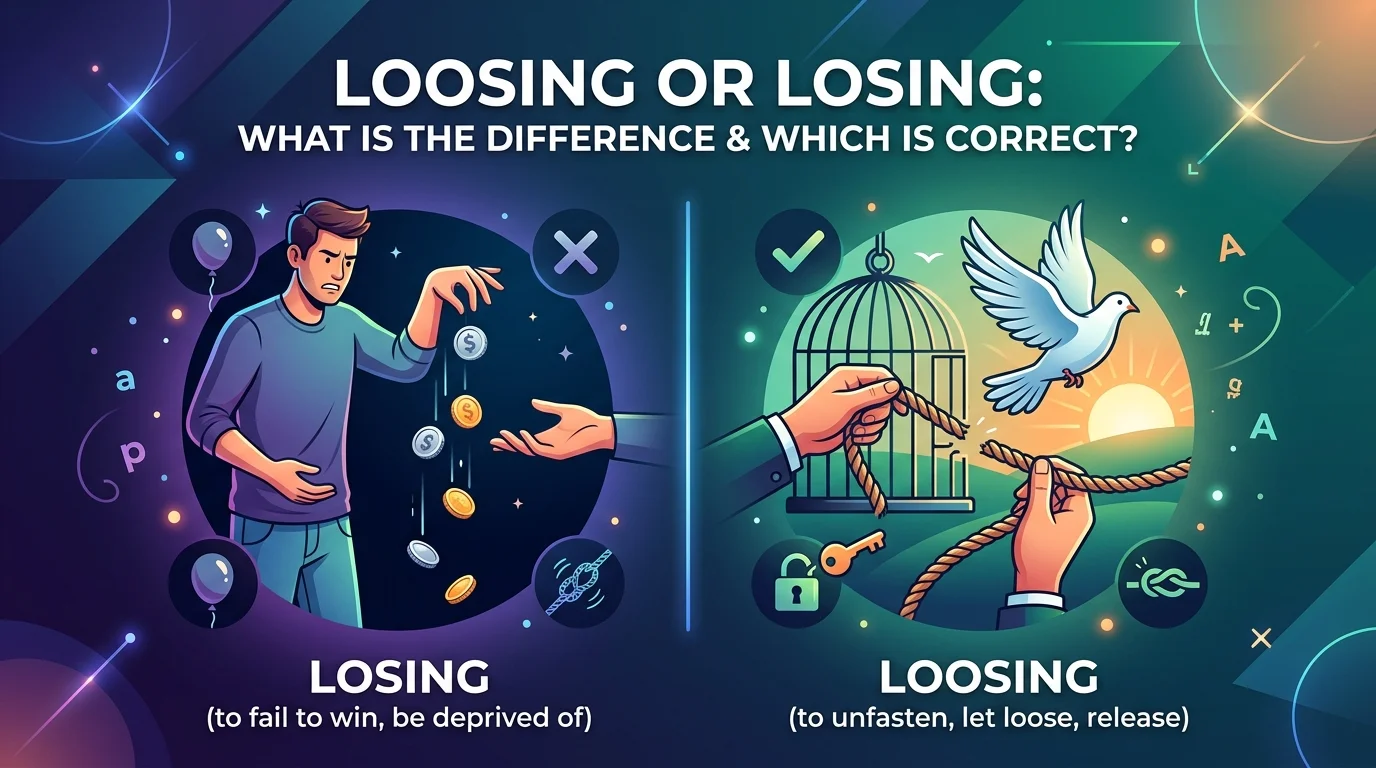
“Loosing” and “losing” look very similar, which is why many English learners and even native speakers confuse them. However, they have completely different meanings and uses. Understanding the difference helps you avoid common spelling mistakes and improves both your writing and speaking accuracy.
Comparison Overview
“Loosing” and “losing” are both forms of verbs, but they come from different base words and serve different purposes in English.
“Losing” comes from the verb “lose” and usually means failing to keep, win, or maintain something.
“Loosing” comes from the verb “loose” and means releasing, freeing, or letting something go.
Although they differ by just one letter, using the wrong one can completely change your sentence meaning.
Definition of Loosing
“Loosing” is the present participle of the verb “loose.”
It means to release, set free, untie, or let something go.
It is much less common in everyday English and mostly appears in formal, literary, or technical writing.
Examples:
• The soldier was loosing arrows at the target.
• They were loosing the dogs into the field.
Definition of Losing
“Losing” is the present participle of the verb “lose.”
It means failing to keep something, being defeated, or no longer having something.
This is the much more common word in daily English.
Examples:
• I am losing my keys again.
• Our team is losing the match.
Main Differences Between Loosing and Losing
| Feature | Loosing | Losing |
| Root word | Loose | Lose |
| Meaning | Releasing or setting free | Failing to keep or being defeated |
| Common usage | Rare | Very common |
| Grammar role | Verb form | Verb form |
| Example | Loosing arrows | Losing money |
The easiest way to remember it: “losing” relates to “lose,” while “loosing” relates to “loose.”
Pronunciation Difference
Although the spellings look similar, pronunciation can help.
“Losing” sounds like: loo-zing
“Loosing” sounds like: loo-sing
This small sound difference often causes spelling confusion.
Why People Confuse Loosing and Losing
There are three common reasons:
• Both words look almost identical.
• “Loose” and “lose” are already commonly confused.
• Autocorrect sometimes misses this error because both are real words.
Grammar Guide
Both are verbs, but they come from different base verbs.
“Lose” → “Losing”
“Loose” → “Loosing”
“Lose” means “to not have.”
“Loose” means “not tight” or “to release.”
How each term is used in sentences
“Loosing” sentence pattern:
Subject + is/was + loosing + object
Example: The hunter was loosing arrows.
“Losing” sentence pattern:
Subject + is/was + losing + object
Example: She is losing patience.
Common mistakes learners make
Wrong: I am loosing my phone.
Correct: I am losing my phone.
Wrong: The team is loosing badly.
Correct: The team is losing badly.
Wrong: He is losing the ropes.
Correct: He is loosing the ropes.
Simple rules to remember
If you mean “not winning,” use “losing.”
If you mean “releasing,” use “loosing.”
“Lose” has one “o,” so “losing” also keeps one “o.”
Quick tips for writing and speaking
Always ask: “Do I mean release or fail to keep?”
If it means “fail to keep,” choose “losing.”
In 99% of everyday writing, “losing” is the correct choice.
When to Use Each One
Use “loosing” when:
• Releasing animals
• Firing arrows
• Untying something
• Setting something free
Use “losing” when:
• Misplacing items
• Failing a game
• Decreasing something
• Forgetting something
When NOT to Use Each One
Do not use “loosing” when talking about:
• Losing money
• Losing weight
• Losing a match
• Losing your phone
Do not use “losing” when talking about:
• Releasing arrows
• Letting dogs loose
• Untying ropes
Which One to Use (Decision Guide)
Ask yourself:
Are you talking about failing to keep, win, or maintain something?
→ Use “losing.”
Are you talking about releasing or setting something free?
→ Use “loosing.”
For most everyday conversations, emails, and school writing, use “losing.”
Real-World Practical Examples
Loosing Examples
- The archer was loosing arrows during practice.
- The farmer was loosing cattle into the field.
- They began loosing the ropes from the boat.
- The trainer was loosing the dogs for exercise.
- The commander ordered loosing the horses.
Losing Examples
- I am losing my patience in class.
- She is losing weight after exercise.
- Our company is losing money this year.
- He keeps losing his wallet.
- The team is losing the championship game.
Self-Assessment (Fill in the Blanks)
- I am ______ my glasses again.
- The archer is ______ arrows.
- Our team is ______ badly.
- They are ______ the dogs into the yard.
- She is ______ confidence.
- The sailor is ______ the ropes.
- We are ______ time.
- The soldier was ______ arrows at dawn.
- He keeps ______ his keys.
- They are ______ the battle.
- The farmer is ______ the horses.
- I am ______ interest in the movie.
- She is ______ her notebook.
- The guards were ______ the animals.
- He is ______ money in business.
- The hunter was ______ the hounds.
- We are ______ focus today.
- They are ______ the competition.
- The captain is ______ the ropes.
- She keeps ______ important files.
Answers
- losing
- loosing
- losing
- loosing
- losing
- loosing
- losing
- loosing
- losing
- losing
- loosing
- losing
- losing
- loosing
- losing
- loosing
- losing
- losing
- loosing
- losing
Final Verdict
“Losing” is the correct word in most everyday situations and means failing to keep something, being defeated, or no longer having something. “Loosing” is a real word, but it is rare and means releasing or setting something free. If you are talking about everyday life, school, work, or sports, you almost always need “losing,” not “loosing.”
Conclusion About Loosing Or Losing
In simple terms, understanding “loosing” and “losing” helps you avoid one of the most common spelling mistakes in English. While they look almost identical, their meanings are very different. “Losing” refers to failing to keep, win, or maintain something and is widely used in everyday communication. “Loosing,” on the other hand, means releasing or setting something free and appears far less frequently in modern usage. Most confusion comes from the similar spelling of “lose” and “loose,” but remembering their root meanings makes everything easier. Once you clearly connect “losing” with loss and “loosing” with release, choosing the correct form becomes simple and natural in both writing and speech.
FAQs
What is the main difference between loosing and losing?
The main difference is meaning and usage. “Losing” comes from “lose” and refers to failing to keep or win something. “Loosing” comes from “loose” and means releasing or setting free. Although they look similar, they are used in completely different contexts, and “losing” is far more common in everyday English.
Is loosing ever correct in English?
Yes, “loosing” is grammatically correct, but it is rarely used in modern English. It mainly appears in specific contexts like releasing animals, arrows, or ropes. In most daily situations, people will almost always use “losing” instead. Understanding context is important to avoid mixing up these two similar-looking words.
Why do people confuse loosing and losing?
People confuse them because the words look almost identical and differ by only one letter. Another reason is the confusion between “loose” and “lose,” which also sound similar. This small spelling difference often leads to mistakes, especially in fast typing, informal writing, or when relying on autocorrect tools.
How can I remember the difference easily?
A simple trick is to remember that “lose” has one “o,” so “losing” also has one “o.” On the other hand, “loose” has two “o’s,” which connects to “loosing.” This visual memory rule helps learners quickly decide which word is correct in different writing situations.
Can losing and loosing change the meaning of a sentence?
Yes, using the wrong word can completely change the meaning of a sentence. “Losing” suggests failure or absence, while “loosing” suggests releasing or freeing something. Because of this difference, choosing the correct spelling is important for clear and accurate communication in both writing and speaking.
Which word is more commonly used in daily English?
“Losing” is far more common in everyday English. It appears in conversations, education, business writing, sports, and media. “Loosing” is rarely used outside specific contexts like historical or technical descriptions. Most English learners focus on mastering “losing” first because of its frequent usage.
What is the grammatical role of loosing and losing?
Both “loosing” and “losing” are present participle verb forms. “Losing” comes from the verb “lose,” while “loosing” comes from “loose.” They are used in continuous tenses or descriptive actions. Their grammatical roles are similar, but their meanings and base verbs are completely different.
How is losing used in everyday sentences?
“Losing” is used to describe situations where something is not being kept or won. For example, losing a game, losing money, or losing keys. It can also express emotional states like losing patience or confidence. It is one of the most frequently used verbs in English communication.
Where is loosing commonly used?
“Loosing” is commonly used when referring to physical release actions, such as loosing arrows, loosing animals, or loosing ropes. These uses are more formal or descriptive and are not common in everyday speech. It is mostly found in literary, historical, or specialized writing contexts.
What is the easiest way to avoid mistakes with these words?
The easiest way is to check the meaning before writing. If you mean failure, loss, or absence, use “losing.” If you mean releasing or setting free, use “loosing.” Practicing examples and reading correct usage in context also helps reduce confusion over time.

Ethan Clarke is a language writer who specializes in breaking down similes, word meanings, and commonly confused terms. His work focuses on clear explanations, practical examples, and simple comparisons that help readers understand how English