
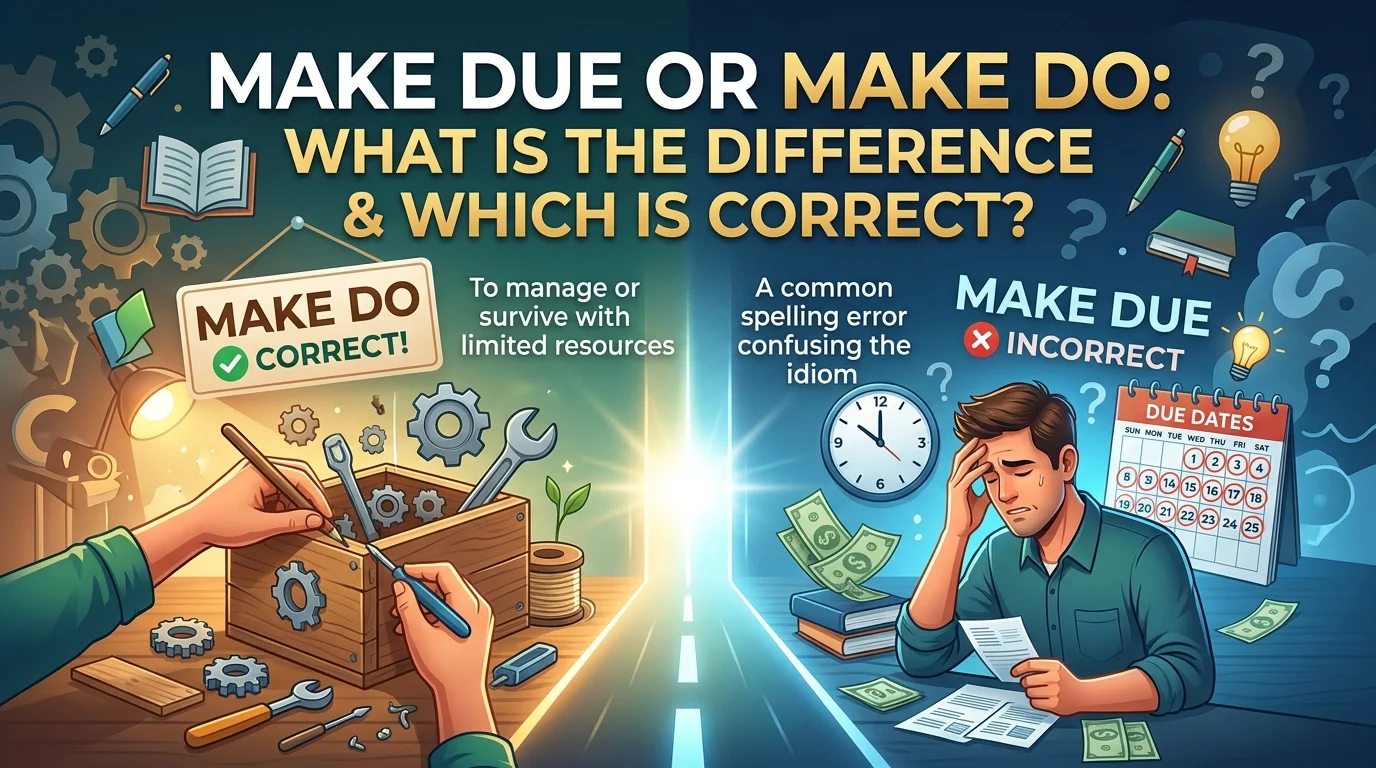
The phrases “make due” and “make do” often confuse English learners because they sound similar but carry very different meanings. One is commonly mistaken, while the other is the correct idiomatic expression used in everyday speech. Understanding the difference helps you avoid grammar errors and use natural, fluent English in both writing and conversation.
Comparison Overview
“Make do” is the correct idiomatic phrase used when someone manages with limited resources or less than ideal conditions. “Make due” is often a mistaken form influenced by the word “due,” but it is not standard in this context. Both appear similar in sound, but only one is widely accepted in English usage.
Definition of Make Due
“Make due” is an incorrect or nonstandard phrase that people sometimes use by mistake. It likely comes from confusion with the word “due,” which relates to deadlines or something expected. However, in standard English, “make due” is not used to express managing with limited resources or coping in difficult situations.
Definition of Make Do
“Make do” is a correct English idiom that means to manage or cope with what is available, even if it is not ideal. It is commonly used in everyday conversations to describe adapting to limitations and continuing a task or situation without perfect resources.
Main Differences Between Make Due and Make Do
The key difference lies in correctness and meaning. “Make do” is a recognized idiom meaning to manage with what you have. “Make due” is generally considered incorrect in this context and is often the result of confusion with similar sounding words. In usage, “make do” appears in everyday speech, while “make due” is rarely accepted in formal or informal English writing.
| Feature | Make Due | Make Do |
| Correctness | Incorrect in this context | Correct idiom |
| Meaning | No standard meaning | Manage with available resources |
| Usage | Rare, often mistaken | Common in daily English |
| Acceptance | Not standard | Widely accepted |
Grammar Guide
“Make do” functions as a phrasal verb idiom. It is not broken down literally but understood as a fixed expression meaning to manage.
How each term is used in sentences
Make do follows a simple structure: subject + make do + with + something.
Examples:
- We will make do with what we have.
- She made do with a small room.
- They are making do without electricity.
Common mistakes learners make
Many learners mistakenly write “make due” instead of “make do.” Another common error is adding unnecessary words or changing the structure, such as “make do with it up,” which is incorrect.
Simple rules to remember
If you are talking about managing with limited resources, always use “make do.” Avoid “due” in this context because it relates to time, deadlines, or expectations, not coping or adjusting.
Quick tips for writing and speaking
Think of “do” as “manage” in simple terms. Whenever you want to express “manage with what you have,” replace it mentally with “manage,” and you will naturally arrive at “make do.”
When to Use Each One
Use “make do” when describing situations where someone adapts to shortages, limitations, or imperfect conditions. Do not use “make due” for this meaning. Instead, reserve “due” for contexts involving deadlines, payments, or expected times.
When NOT to Use Each One
Avoid using “make due” in any sentence about coping or adjusting. It is not standard English in this context. Also avoid replacing “make do” with other similar sounding phrases that change the meaning entirely.
Which One to Use (Decision Guide)
If your sentence means “manage with what is available,” choose “make do.” If you are unsure, check whether you are talking about coping or adapting. If yes, then “make do” is the correct choice. Never use “make due” for this meaning.
Real-World Practical Examples
Make Due Examples
- We had to make due with outdated instructions.
- She tried to make due in a cramped workspace.
- They decided to make due during the shortage.
- I will make due until the new supplies arrive.
- He learned to make due in difficult conditions.
Make Do Examples
- We will make do with the old laptop for now.
- She had to make do with a broken chair.
- They made do without heating during winter.
- I can make do with a simple meal tonight.
- He is making do with limited resources at work.
Self-Assessment (Fill in the Blanks)
- I will ______ with what I have today.
- The correct phrase is ______ when talking about coping.
- She had to ______ in a small apartment.
- ______ is the standard idiom for managing resources.
- We can ______ until help arrives.
- The phrase ______ is often incorrect in this context.
- They learned to ______ during hard times.
- ______ means to adapt to limitations.
- I must ______ without extra tools.
- People often confuse ______ and make do.
- We will ______ with limited food supplies.
- The correct usage is always ______ in this situation.
- He had to ______ after losing equipment.
- ______ is not commonly accepted in standard English here.
- She can ______ with a small budget.
- The idiom ______ means to manage somehow.
- They decided to ______ instead of waiting.
- ______ is frequently a spelling mistake in this phrase.
- I will ______ with less comfort than expected.
- The right phrase for coping is ______.
Answers
- make do
- make do
- make do
- make do
- make do
- make due
- make do
- make do
- make do
- make due
- make do
- make do
- make do
- make due
- make do
- make do
- make do
- make due
- make do
- make do
Final Verdict
“Make do” is the correct and widely accepted idiom used in English when talking about managing with limited resources or less-than-ideal conditions. “Make due” is generally incorrect in this context and is often the result of confusion with similar sounding words. For clear, natural, and accurate English, always choose “make do.”
Conclusion About Make Due or Make Do
Understanding the difference between “make do” and “make due” helps you avoid one of the most common English usage mistakes. While they sound almost identical, only “make do” is the correct idiom used when describing situations where someone manages with limited resources or less than ideal conditions. It reflects adaptability, resilience, and practical thinking in everyday life. On the other hand, “make due” is often a spelling or hearing error and does not carry the same accepted meaning in standard English. By using “make do” correctly, your writing and speech become clearer, more natural, and more professional. Whether in conversation, academic writing, or workplace communication, mastering this small but important difference improves overall language accuracy and confidence in expression.
FAQs
What does make do mean in English?
Make do means to manage or cope with what is available, even if it is not ideal. It is used when someone adjusts to limited resources or imperfect conditions and continues a task without waiting for better options.
Is make due a correct phrase?
Make due is generally considered incorrect in this context. It is often a mistake made due to confusion with pronunciation. The correct idiom for managing with limited resources is make do, not make due.
Why do people confuse make do and make due?
People confuse them because they sound very similar when spoken. The word “due” is more familiar in English, so learners sometimes assume it fits here, even though the correct expression is make do.
Can I use make due in formal writing?
No, make due should be avoided in formal writing when referring to coping or managing. It is not recognized as a standard idiom. Always use make do to ensure grammatical accuracy and clarity.
What is the origin of make do?
Make do comes from older English usage where “do” meant to perform or manage. Over time, it evolved into an idiomatic phrase meaning to cope with what is available or to adapt to limitations.
How do I remember the correct phrase easily?
A simple trick is to link “do” with “manage.” Since make do means to manage with what you have, remembering “do equals manage” helps you avoid the incorrect form make due.
Is make do used in spoken English?
Yes, make do is very common in spoken English. People use it in everyday conversations when talking about adjusting to shortages, delays, or imperfect situations without complaint.
Does make do have a negative meaning?
Not necessarily. Make do is neutral and simply describes adapting to circumstances. It can sometimes imply inconvenience, but it often also shows flexibility and resourcefulness.
Can make do be used in business writing?
Yes, make do can be used in business writing when describing limitations or resource management. However, it should be used carefully in formal reports to maintain a professional tone.
What is the main difference between make do and make due?
The main difference is correctness and meaning. Make do is the correct idiom meaning to manage with limited resources, while make due is generally incorrect in this usage and should be avoided.