
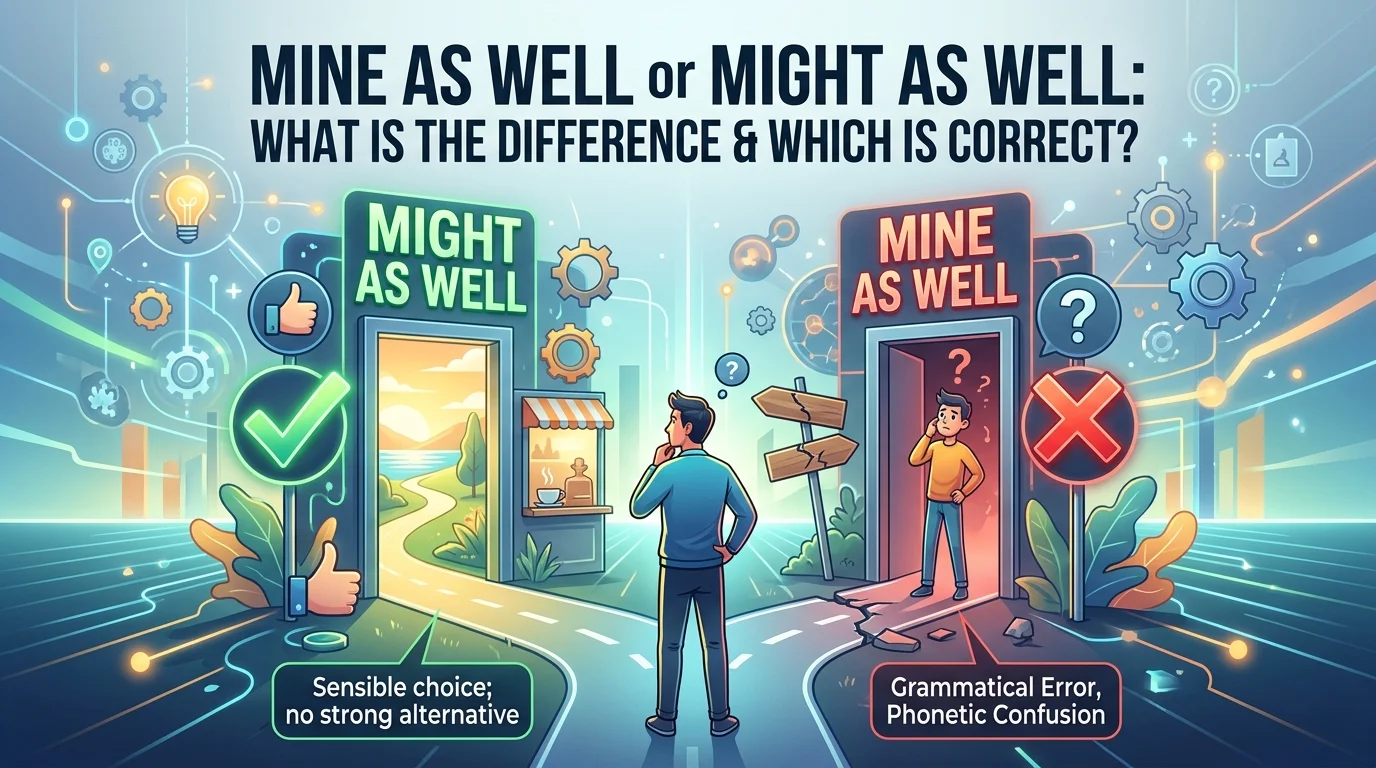
Understanding the difference between “mine as well” and “might as well” is important because these phrases are often confused in everyday conversation and writing. One is commonly incorrect in standard English, while the other is widely used to express suggestion, acceptance, or lack of a better option. This guide breaks down both expressions in a simple way so you can use them confidently.
Comparison Overview
“Mine as well” and “might as well” may sound similar when spoken quickly, but they have completely different meanings and usage. “Might as well” is a correct idiomatic expression used to suggest doing something because there is no better alternative. “Mine as well” is usually a grammatical mistake, often confused with possessive structures or misheard speech.
Definition of Mine As Well
“Mine as well” is not a standard English phrase in modern grammar. It is typically a mistaken form created when speakers confuse “mine” (a possessive pronoun) with “might.” In most contexts, it does not carry a correct idiomatic meaning and is considered incorrect in formal and informal writing.
In rare informal speech, people may accidentally say “mine as well” when they actually intend to say “might as well,” but grammatically it does not function as a proper expression.
Definition of Might As Well
“Might as well” is a correct English idiom used to suggest that something is worth doing because there is no better option or because the outcome will not change significantly either way. It expresses acceptance, mild recommendation, or practicality.
For example, if you are already waiting somewhere, you might say “We might as well sit down” to suggest making use of the situation.
Main Differences Between Mine As Well and Might As Well
The difference between these two expressions is mainly grammatical correctness and meaning.
“Mine as well” is not a valid idiom and does not express a standard idea in English. It is usually a mistaken phrase.
“Might as well” is a widely accepted idiomatic expression used in everyday communication to suggest an action based on convenience or lack of alternatives.
Comparison Table:
| Feature | Mine As Well | Might As Well |
| Grammar status | Incorrect usage | Correct idiomatic phrase |
| Meaning | No standard meaning | Suggests a reasonable action |
| Usage | Common mistake | Everyday English expression |
| Context | Mishearing or confusion | Decision-making or suggestion |
| Formal writing | Not accepted | Fully acceptable |
Grammar Guide
“Might as well” functions as a modal phrase in English. It combines “might,” which expresses possibility, with “as well,” which suggests equivalence or practicality. Together, they form an expression of suggestion or mild obligation.
“Mine as well” does not follow standard grammatical rules in this context because “mine” is a possessive pronoun and does not logically connect with “as well” in idiomatic usage.
How each term is used in sentences
“Might as well” is used when someone wants to suggest doing something because it is reasonable or there is no better option.
Example pattern:
Subject + might as well + base verb
Example: We might as well leave now.
“Mine as well” does not have a valid sentence pattern in standard English usage.
Common mistakes learners make
Many learners confuse “might as well” with “mine as well” due to similar pronunciation in fast speech. Another common mistake is using “mine as well” in writing, thinking it means “also mine,” which is incorrect in this context.
Simple rules to remember
If you are making a suggestion or accepting a situation, always use “might as well.”
If you are trying to express possession, use “mine,” but never combine it with “as well” in this idiomatic way.
Quick tips for writing and speaking
Focus on the sound “might” when you hear or say the phrase. If the sentence involves choosing an action based on convenience, “might as well” is almost always correct.
When to Use Each One
“Might as well” is used when you want to suggest doing something because it makes sense in the situation, especially when there is no strong reason not to do it.
“Mine as well” should not be used in standard English because it is not a recognized idiom.
When NOT to Use Each One
Do not use “mine as well” in any formal or informal writing because it is grammatically incorrect in this context.
Avoid using “might as well” when you are making strong decisions or giving firm instructions, as it sounds casual and suggests low commitment.
Which One to Use (Decision Guide)
If you are expressing a suggestion based on convenience or lack of alternatives, use “might as well.”
If you are trying to express possession or ownership, do not combine “mine” with “as well.” Instead, restructure the sentence properly.
In almost all conversational cases involving this confusion, “might as well” is the correct choice.
Real-World Practical Examples
Mine As Well Examples
Since “mine as well” is not grammatically correct in standard usage, these examples show incorrect forms to help you identify and avoid them:
- This book is mine as well as yours. (corrected form, not idiomatic usage)
- The idea is mine as well. (incorrect in meaning, should be “also mine”)
- That jacket is mine as well. (should be rephrased)
- The responsibility is mine as well. (better: also mine)
- This phone is mine as well. (incorrect phrasing)
Might As Well Examples
- We are already here, so we might as well wait for the movie.
- It is raining heavily, so we might as well stay indoors.
- Since the store is closing soon, we might as well leave now.
- You finished early, so you might as well help others.
- There is nothing else to do, so we might as well relax.
Self-Assessment (Fill in the Blanks)
- I guess we ______ go home since it is late.
- The correct phrase is ______ because it suggests a practical decision.
- People often mistakenly say ______ instead of the correct idiom.
- We are already here, so we ______ wait.
- ______ is not a correct English expression.
- You finished your work early, so you ______ help others.
- The phrase ______ is used for suggesting an action.
- ______ is commonly confused due to similar pronunciation.
- We ______ leave now because the bus is coming.
- ______ expresses a reasonable choice in a situation.
- Many learners incorrectly write ______ in place of the idiom.
- Since it is cold, we ______ stay inside.
- The correct usage is always ______ in such cases.
- ______ is not accepted in standard grammar.
- We ______ take a break since we are tired.
- The expression ______ shows casual decision-making.
- It is better to use ______ in everyday speech.
- ______ is a common mistake among English learners.
- We ______ continue walking because it is nearby.
- The correct idiom is ______ when suggesting an option.
Answers
- might as well
- might as well
- mine as well
- might as well
- mine as well
- might as well
- might as well
- mine as well
- might as well
- might as well
- mine as well
- might as well
- might as well
- mine as well
- might as well
- might as well
- might as well
- mine as well
- might as well
- might as well
Final Verdict
“Might as well” is the correct and widely accepted English expression used to suggest doing something in a practical or convenient way. It fits naturally in everyday speech and writing. “Mine as well,” on the other hand, is generally incorrect in this context and results from confusion with similar sounding words. If you want to communicate clearly and correctly, always choose “might as well” when making casual suggestions or expressing a reasonable course of action.
Conclusion About Mine As Well or Might As Well
Understanding the difference between Mine As Well or Might As Well helps you avoid a common English mistake and communicate more naturally in both speech and writing. While “mine as well” often appears due to mishearing or confusion, it is not a correct idiom in standard English. On the other hand, “might as well” is a useful expression that shows practical thinking, suggestion, or acceptance of a situation when there is no better option available. By learning how and when to use it, you can make your English sound more fluent and accurate. The key takeaway is simple: always choose “might as well” when you want to express a reasonable action or casual decision. With practice and awareness, you will easily avoid the common error and improve your everyday communication skills in a natural and confident way.
FAQs
What does Might As Well mean?
Might as well is an English idiom used to suggest doing something because it is practical or there is no better alternative. It often expresses mild recommendation, acceptance, or convenience in a situation. For example, if no other plans exist, a person might choose the easiest available option. It is commonly used in both spoken and informal written English.
Is Mine As Well correct English?
Mine as well is generally not considered correct in standard English when used as an idiom. It is often a mistaken form caused by confusion with “might as well.” However, “mine” can be correct in possessive contexts, but it should not be combined with “as well” to express suggestion or practical decision-making.
Why do people confuse Mine As Well and Might As Well?
People often confuse the two phrases because they sound similar in fast speech and informal conversation. When spoken quickly, “might as well” can be misheard as “mine as well.” Lack of familiarity with idiomatic English also contributes to the mistake, especially among learners who rely on sound rather than meaning and grammatical structure.
Can Might As Well be used in formal writing?
Might as well is usually considered informal or conversational rather than formal writing. It is commonly used in everyday speech, casual communication, and storytelling. In formal academic or professional writing, clearer alternatives like “it would be better to” or “it is advisable to” are often preferred depending on context and tone requirements.
How is Might As Well used in a sentence?
Correct usage of “might as well” appears in situations where a decision is made based on convenience or lack of alternatives. For example, if someone is already waiting in line, they might say they might as well stay. It helps express practical thinking and acceptance of the current situation.
Is Mine As Well ever acceptable?
Mine as well is not acceptable as an idiomatic expression in standard English. However, “mine” can be used correctly in sentences like “this is mine as well as yours,” where it indicates possession. The confusion arises when learners try to use it as a suggestion phrase, which is incorrect.
How can I remember the difference easily?
A simple way to remember the difference is to associate “might as well” with making a practical choice or suggestion. If you are deciding whether to do something because there is no better option, use it. “Mine” relates to ownership and does not fit into this decision-making expression.
Does Might As Well show certainty?
It does not show strong certainty. Instead, “might as well” expresses a casual or practical decision, often when the outcome is already acceptable or unavoidable. It suggests a reasonable action rather than a strict plan. The phrase reflects flexibility and acceptance rather than firm commitment or absolute certainty.
Is Might As Well okay in writing?
Yes, “might as well” is acceptable in informal and conversational writing such as blogs, messages, and storytelling. It helps create a natural tone. However, in formal documents, reports, or academic essays, it is better to use more precise expressions that clearly state intent without casual phrasing or implied suggestions.
What is the most common mistake with these phrases?
The most common mistake learners make is replacing “might as well” with “mine as well” because of similar pronunciation. Another error is using it in formal writing where it may sound too casual. Understanding the meaning and context helps avoid confusion and ensures correct usage in everyday communication.

Sophia Turner is a grammar-focused writer who covers similes, word-versus-word meanings, and correct English usage. Her content is designed for learners who want quick answers, logical explanations, and practical guidance for improving writing accuracy and style.