
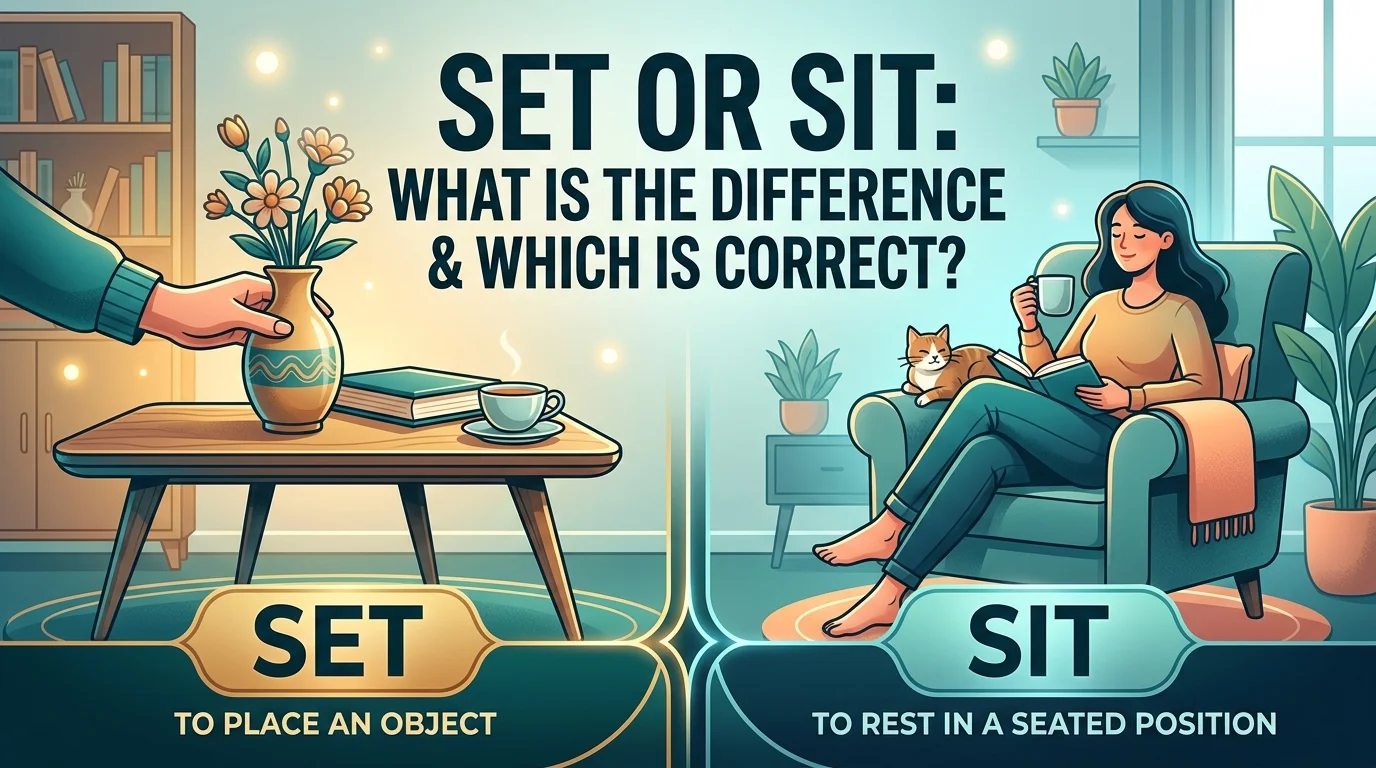
The words “set” and “sit” often confuse English learners because they look simple but are used in very different ways. Both appear in daily communication, writing, and speaking, yet their meanings, grammar roles, and usage rules are not interchangeable. This guide explains their differences clearly so you can use each word correctly and confidently.
Comparison Overview
“Set” and “sit” are both common English verbs, but they serve different grammatical and functional purposes. “Set” usually refers to placing something somewhere or adjusting something, while “sit” refers to the action of resting in a seated position. Understanding their usage helps avoid common grammatical mistakes in speaking and writing.
Definition of Set
“Set” is a versatile verb that generally means to place, put, or arrange something in a specific position. It can also mean to establish rules, adjust settings, or fix something in place. It is often used with objects.
Core meaning:
To put or place something somewhere or to establish something.
Definition of Sit
“Sit” is a verb that means to rest with the body supported by the buttocks or to be in a seated position. It describes a physical action performed by a person or animal.
Core meaning:
To be in a seated position or lower oneself into a sitting posture.
Main Differences Between Set and Sit
The key difference between “set” and “sit” lies in action and object involvement. “Set” is usually a transitive verb, meaning it needs an object (you set something). “Sit” is intransitive, meaning it does not take a direct object (you sit yourself).
“Set” often involves placing or arranging something, while “sit” describes a position or movement into a position.
Quick Comparison Table
| Feature | Set | Sit |
| Type | Transitive verb | Intransitive verb |
| Object needed | Yes | No |
| Meaning | Place or arrange something | Take a seated position |
| Usage focus | Things or objects | People or animals |
| Example | Set the book on the table | Sit on the chair |
Grammar Guide
Understanding grammar roles helps avoid confusion between these two words.
How each term is used in sentences
“Set” is used when an object is being placed or arranged:
- Set + object + place
Examples:
- She sets the glass on the table.
- He set the alarm for 7 AM.
“Sit” is used for a subject performing the action:
- Subject + sit + location
Examples:
- I sit near the window.
- They sat on the bench.
Common mistakes learners make
- Saying “sit the book on the table” instead of “set the book on the table”
- Saying “set on the chair” instead of “sit on the chair”
- Mixing past tense forms incorrectly (sit, sat, sat vs set, set, set)
Simple rules to remember
- If something is being placed, use “set”
- If someone is resting in a position, use “sit”
- “Set” needs an object, “sit” does not
Quick tips for writing and speaking
- Think “place = set”
- Think “position = sit”
- Use “set” for objects and “sit” for people
- Practice with real-life sentences daily
When to Use Each One
Use “set” when talking about arranging objects, adjusting devices, or establishing rules. Use “sit” when describing physical posture or seating actions.
Examples:
- Set the timer before cooking
- Sit down and relax after work
When NOT to Use Each One
Do not use “sit” when referring to placing objects. Do not use “set” when describing human posture.
Incorrect:
- Sit the cup on the table
- Set on the chair
Correct:
- Set the cup on the table
- Sit on the chair
Which One to Use (Decision Guide)
Ask yourself:
- Am I placing or arranging something? Use “set”
- Am I describing a seated position? Use “sit”
- Does the sentence need an object? Likely “set”
- Is it about body posture? Use “sit”
Real-World Practical Examples
Set Examples
- She set the phone on silent mode before the meeting.
- He set the books neatly on the shelf.
- They set up the classroom for the exam.
- I set the table for dinner.
- The technician set the computer settings.
Sit Examples
- She sits quietly during lectures.
- He sat near the door waiting for his turn.
- They sit together every morning for breakfast.
- I sit at my desk while working.
- The dog sits beside its owner.
Self-Assessment (Fill in the Blanks)
- I will ______ the plates on the table before guests arrive.
- She likes to ______ near the window while reading.
- He ______ the alarm for 6 AM yesterday.
- Please ______ down and listen carefully.
- They ______ the chairs in a circle.
- I usually ______ in the front row.
- The teacher asked us to ______ our phones aside.
- We ______ on the bench after walking.
- She ______ the book on the desk.
- The children ______ together during lunch.
- He ______ the clock correctly.
- I prefer to ______ near the fan.
- They ______ the table for dinner.
- She ______ beside her friend in class.
- Please ______ the glass carefully.
- We ______ under the tree for shade.
- He ______ the camera before the event.
- I ______ quietly during the ceremony.
- She ______ the laptop on the desk.
- They ______ in silence during the meeting.
Answers
- set
- sit
- set
- sit
- set
- sit
- set
- sat
- set
- sat
- set
- sit
- set
- sat
- set
- sat
- set
- sat
- set
- sat
Final Verdict
“Set” and “sit” may look similar, but they serve completely different roles in English grammar. “Set” is used for placing or arranging objects, while “sit” is used for describing a seated position or movement into that position. Once you understand the object rule and the posture rule, choosing between them becomes simple and natural in everyday communication.
Conclusion About Set or Sit
Understanding the difference between set and sit makes everyday English much clearer and easier to use correctly. These two simple words often confuse learners because they appear similar, but their functions are completely different in grammar and meaning. Set is mainly used when placing, arranging, or adjusting something, while sit describes the action of taking or being in a seated position. Once you recognize this core distinction, choosing the right word becomes natural in both speaking and writing.
The key to mastering set or sit is practice in real-life situations. When you see an object being placed, think set. When a person is lowering themselves into a chair or staying seated, think sit. With consistent use, these rules become automatic, helping you avoid common mistakes and communicate more confidently in English across daily conversations, academic writing, and professional settings.
FAQs
What is the main difference between set and sit?
The main difference is that set is used for placing or arranging something, usually an object, while sit refers to taking or being in a seated position. Set typically needs an object, but sit does not. This distinction helps learners use each word correctly in everyday English communication.
Can set and sit be used interchangeably?
No, set and sit cannot be used interchangeably because they have completely different meanings and grammatical roles. Set refers to positioning or arranging something, while sit refers to a physical posture. Using them incorrectly can change the meaning of a sentence or make it grammatically wrong.
Why do people confuse set and sit?
People confuse set and sit because the words sound similar and are both common in daily English. However, their usage rules are different. Set involves objects and actions of placement, while sit involves human or animal posture. Understanding context helps eliminate this confusion.
Is sit a transitive or intransitive verb?
Sit is an intransitive verb, meaning it does not require a direct object. It describes an action done by the subject, such as sitting on a chair or bench. This makes it different from set, which is usually a transitive verb needing an object.
What is the correct past tense of sit?
The correct past tense of sit is sat. For example, I sit today becomes I sat yesterday. The past participle is also sat. This is important because learners often confuse it with set, which has the same form in present, past, and past participle.
What is the correct past tense of set?
The past tense of set is also set. It does not change form across present, past, or past participle usage. For example, I set the table yesterday and I have set the table today both use the same word, which can be confusing for learners.
Can sit ever take an object?
Sit generally does not take a direct object. It is used to describe someone or something resting in a seated position. However, it can be followed by a location or preposition, such as sit on the chair or sit in the room, but not a direct object.
How do you remember when to use set or sit?
A simple way to remember is to connect set with placement and sit with posture. If something is being placed or arranged, use set. If someone is lowering themselves into a position or already seated, use sit. This mental rule helps reduce errors in daily usage.
Are set and sit commonly used in daily English?
Yes, both set and sit are very commonly used in daily English. Set is often used in contexts like setting objects, alarms, or rules, while sit is used in everyday actions like sitting on chairs, benches, or floors. Both are essential verbs in basic communication.
What are some examples of set and sit in sentences?
Examples of set include setting a book on a table or setting an alarm. Examples of sit include sitting on a chair or sitting beside a friend. These examples show how set relates to objects while sit relates to body position.

Sarah Mitchell is an experienced writer and grammar teacher with over 10 years of expertise in English language education. She helps learners improve their grammar, writing, and communication skills through clear explanations and practical examples. Sarah creates learner-friendly content focused on real-life English, making language learning simple, effective, and confidence-building.