
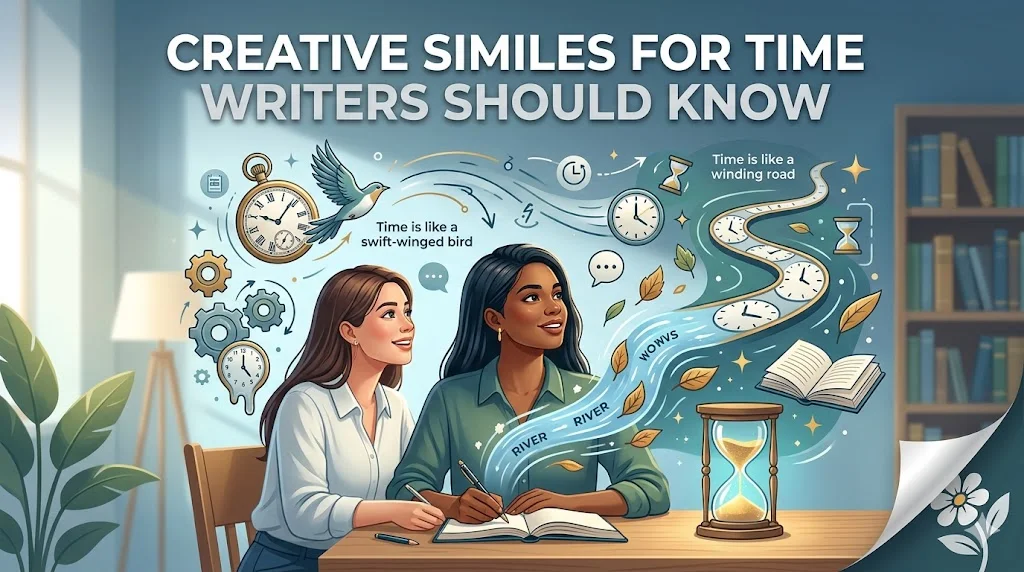
Time is an abstract concept that can be hard to describe, yet writers often bring it to life using similes. Similes are powerful tools that compare time to familiar objects or experiences, helping readers visualize its passage, feel its effects, and connect emotionally. Whether you’re writing poetry, fiction, or reflective essays, understanding and using similes for time can transform ordinary writing into memorable storytelling. In this article, you’ll discover 29 creative similes for time, their meanings, practical examples, expert insights, and tips to craft your own comparisons that resonate with readers.
What is a Simile?
A simile is a figure of speech that compares two different things using “like” or “as” to highlight a shared quality. Unlike metaphors, similes explicitly signal the comparison, making abstract ideas easier to understand. Writers use similes to add imagery, emotion, and clarity to their descriptions.
- Difference between simile and metaphor
- Enhances visualization and emotional connection
- Simplifies complex or abstract concepts
Examples: - “Her smile was like sunshine.”
- “Time slips away like sand through fingers.”
Understanding Similes and Figurative Language
Similes are a key component of figurative language. They allow writers to express abstract concepts, such as time, in relatable and engaging ways.
- Comparisons make literature more vivid
- Create imagery and evoke emotion
- Improve storytelling and descriptive writing
Examples: - “Life moves like a flowing river.”
- “Hope clings like dew on grass.”
29 Unique Similes for Time
Similes help writers describe time creatively. Each of the following similes illustrates a different aspect of time and can be adapted for poetry, storytelling, or essays.
Time flows like a river
Meaning: Constant, unending movement.
Usage: Highlights the continuous passage of moments.
Examples:
- “Time flows like a river, carrying memories downstream.”
- “Her days passed quickly, flowing like a river in spring.”
Time steals moments like a silent thief
Meaning: Time quietly takes away opportunities.
Usage: Emphasizes unnoticed passage of time.
Examples:
- “Time steals moments like a silent thief, leaving only memories.”
- “We must cherish each day, for time takes it all away.”
Time fades like a passing shadow
Meaning: Fleeting and temporary.
Usage: Suggests briefness or impermanence.
Examples:
- “Joy faded like a passing shadow over the old town.”
- “Time fades like a passing shadow, leaving only echoes.”
Time slips away like sand through fingers
Meaning: Time disappears quickly.
Usage: Highlights moments lost despite efforts to hold them.
Examples:
- “Summer slipped away like sand through fingers.”
- “He realized that his youth was slipping away like sand.”
Time guides us like a patient teacher
Meaning: Promotes learning and growth over time.
Usage: Shows how experiences teach lessons.
Examples:
- “Time guides us like a patient teacher, shaping our choices.”
- “Life’s mistakes, over years, teach us, guided by time.”
Time moves like the wind
Meaning: Fast, unseen, and unpredictable.
Usage: Portrays swiftness or invisibility.
Examples:
- “Time moves like the wind, unnoticed but relentless.”
- “Moments of joy flew past like the wind.”
Time reflects life like a mirror
Meaning: Shows experiences and growth.
Usage: Demonstrates how life’s events are visible through time.
Examples:
- “Time reflects life like a mirror, revealing changes we’ve made.”
- “Our choices reflect in time like a mirror reflecting our actions.”
Time rises like a ladder toward the future
Meaning: Progression and advancement.
Usage: Suggests development or moving forward.
Examples:
- “Each day, time rises like a ladder toward the future.”
- “He climbed life’s challenges as time rose like a ladder.”
Time supports us like a loyal friend
Meaning: Comfort and companionship.
Usage: Highlights reliability and steady presence.
Examples:
- “Time supports us like a loyal friend in hardships.”
- “Even in sorrow, time stands by like a faithful companion.”
Time crashes like a storm
Meaning: Intense, overwhelming periods.
Usage: Emphasizes chaos or sudden change.
Examples:
- “Grief struck, and time crashed like a storm.”
- “Deadlines approached, and time crashed like a storm.”
Time grows like a seed in the soil
Meaning: Gradual development.
Usage: Illustrates growth over long periods.
Examples:
- “Ideas grow like seeds, nurtured by time.”
- “Friendships flourish as time grows like a seed in soil.”
Time heals wounds like gentle medicine
Meaning: Emotional recovery over time.
Usage: Highlights patience in healing.
Examples:
- “Heartbreak fades as time heals wounds like gentle medicine.”
- “Years passed, and time healed old wounds quietly.”
Time flies like an arrow
Meaning: Swift, linear progression.
Usage: Shows how quickly moments pass.
Examples:
- “School days flew by, time flying like an arrow.”
- “Life is short; time flies like an arrow.”
Time fits together like a puzzle
Meaning: Life events form a bigger picture.
Usage: Emphasizes interconnected experiences.
Examples:
- “Memories fit together like a puzzle over time.”
- “Challenges and successes, slowly, fit like puzzle pieces.”
Time shines like precious gold
Meaning: Valuable and treasured.
Usage: Highlights importance and worth.
Examples:
- “Moments with loved ones shine like precious gold.”
- “Time spent wisely shines brighter than wealth.”
Time echoes like a distant song
Meaning: Memories linger.
Usage: Suggests nostalgia or lasting impressions.
Examples:
- “Her laughter echoes like a distant song across the years.”
- “Childhood memories echo in time like a soft melody.”
Time connects life like a bridge
Meaning: Transition between stages.
Usage: Illustrates continuity or connection.
Examples:
- “Education connects life like a bridge between youth and adulthood.”
- “Time connects generations like a bridge over rivers.”
Time burns like fire
Meaning: Intense and transformative.
Usage: Shows rapid change or powerful impact.
Examples:
- “The decision changed everything; time burned like fire.”
- “Passion drove him, and time burned like fire around him.”
Time turns like a wheel
Meaning: Cycles and recurring events.
Usage: Emphasizes repetition or cycles of life.
Examples:
- “Seasons turn, and time moves like a wheel.”
- “History repeats itself, as time turns like a wheel.”
Time stretches like an endless road
Meaning: Long journeys or life paths.
Usage: Highlights duration and persistence.
Examples:
- “The project felt endless, time stretching like a road.”
- “Life sometimes stretches like an endless road ahead.”
Time grows like a garden
Meaning: Nurturing and development.
Usage: Suggests care and gradual improvement.
Examples:
- “Skills grow like a garden over time.”
- “Relationships flourish as time grows like a garden.”
Time melts like a candle
Meaning: Gradual disappearance.
Usage: Shows slow passing of moments.
Examples:
- “Evenings melted like candles, leaving night in their wake.”
- “Time melts quietly, unnoticed like wax dripping from a candle.”
Time wanders like a traveler
Meaning: Unpredictable and roaming.
Usage: Illustrates exploration or randomness.
Examples:
- “Time wanders like a traveler, taking paths unknown.”
- “He watched moments wander like a traveler through life.”
Time stands strong like a mountain
Meaning: Permanent and enduring.
Usage: Shows stability over years or generations.
Examples:
- “Tradition stands firm, as time stands strong like a mountain.”
- “Despite chaos, time remains, steadfast like a mountain.”
Time strikes like lightning
Meaning: Sudden change or realization.
Usage: Highlights unexpected events.
Examples:
- “Insight struck him, time like lightning in his mind.”
- “Disaster arrived suddenly, time striking like lightning.”
Time unfolds like a theater stage
Meaning: Life events reveal themselves over time.
Usage: Shows sequence and drama of life.
Examples:
- “Life unfolds like a theater stage, revealing new acts daily.”
- “Stories emerge slowly as time unfolds like a stage.”
Time moves like flowing water
Meaning: Continuous, unstoppable motion.
Usage: Emphasizes unceasing progress.
Examples:
- “Moments move gently, time flowing like water.”
- “Time flows steadily, like a river without end.”
Time expands like a vast ocean
Meaning: Deep, mysterious, and infinite.
Usage: Suggests vastness or complexity.
Examples:
- “Thoughts spread widely, time expanding like the ocean.”
- “Possibilities seemed endless, time vast as an ocean.”
Time opens like a book of memories
Meaning: Reveals stories and experiences.
Usage: Highlights reflection and storytelling.
Examples:
- “Every photograph opens like a book of memories through time.”
- “Life’s lessons unfold, time opening pages like a book.”
Similes for Time — Meaning and Writing Use (Table)
| Simile | Meaning | Best Used In Writing |
| Time flows like a river | Continuous movement | Narrative writing |
| Time slips like sand | Time passing quickly | Reflective essays |
| Time shines like gold | Time is valuable | Motivational writing |
| Time turns like a wheel | Cycles of life | Philosophical writing |
| Time burns like fire | Powerful transformation | Dramatic storytelling |
Linguistic Insight: Why Writers Compare Time to Objects
- Abstract concepts become tangible through imagery
- Similes activate imagination and emotional connection
- Widely used in poetry, storytelling, and speeches
Examples: - “Time moves like the wind” evokes speed and invisibility
- “Time shines like gold” emphasizes value and preciousness
Expert Writing Tips for Creating Similes About Time
- Observe nature and daily life for inspiration
- Base similes on emotions and personal experiences
- Avoid clichés; strive for originality
Examples: - “Time hums like a quiet tune at dawn”
- “Time stretches like sunlight over the hills”
How to Use Similes for Time in Your Writing
- In poetry, use similes for rhythm and imagery
- In narrative storytelling, convey passage of time naturally
- In descriptive essays, illustrate abstract concepts clearly
Examples: - “Her youth slipped away like petals in the wind.”
- “Time guides us like a teacher through each lesson.”
Common Mistakes When Writing Similes About Time
- Overusing clichés such as “time flies” repeatedly
- Mixing metaphors and similes in the same sentence
- Using unclear or confusing comparisons
Examples: - Incorrect: “Time is like a fire that walks slowly.”
- Correct: “Time burns like fire, changing everything in its path.”
Self-Assessment: Test Your Understanding
- Identify which sentence contains a simile.
- Rewrite a sentence using a new simile for time.
- Choose the best simile for a poem about childhood memories.
Answers:
- “Time flies like an arrow” – simile present
- Example rewrite: “Time drifts like clouds across the sky.”
- Suitable simile: “Time opens like a book of memories.”
Final Thoughts
Similes for time are essential tools for writers, helping to transform abstract concepts into vivid, relatable images. By comparing time to familiar objects and experiences, writers can evoke emotion, create imagery, and make their writing more memorable. The 29 similes presented here—from “time flows like a river” to “time opens like a book of memories”—cover a wide spectrum of meaning, including movement, value, reflection, and transformation. Writers should experiment with these comparisons, adapt them to their style, and even create their own unique similes. Understanding the subtle differences between each simile helps to choose the perfect comparison for poetry, storytelling, essays, or reflective writing. The best similes highlight specific aspects of time, whether it is fleeting, nurturing, powerful, or endless. By using similes thoughtfully, writers can strengthen their voice, engage readers, and convey complex ideas with simplicity. Mastering time-related similes also improves descriptive skills, making abstract concepts tangible while keeping the narrative fluid and relatable. Embrace creativity, observe life closely, and let time’s many facets inspire your writing, ensuring each piece resonates deeply with your audience.
Frequently Asked Questions
What are the most common similes for time?
Popular similes include “time flies like an arrow,” “time slips like sand,” “time flows like a river,” and “time moves like the wind.” They are frequently used because they effectively convey the passage, speed, and transient nature of time in relatable ways.
Why do writers compare time to natural elements?
Writers use natural elements like rivers, wind, and fire to illustrate time because they are familiar and evoke sensory imagery. Comparing time to these elements helps readers understand abstract concepts emotionally and visually.
Can students create their own similes for time?
Yes, students can craft similes by observing nature, emotions, or experiences. Combining creativity with simple comparisons, like “time drifts like leaves on a pond,” allows beginners to practice figurative language effectively.
What is the difference between a metaphor and a simile about time?
A simile explicitly uses “like” or “as” to compare, e.g., “time flies like an arrow.” A metaphor states it directly without comparison words, e.g., “time is an arrow.” Similes are often easier for beginners to visualize and understand.
Are similes useful in academic writing?
Similes can be effective in academic writing when illustrating complex ideas or making abstract concepts clear. They should be used sparingly and appropriately to enhance comprehension without compromising formality.
Which similes about time work best in poetry?
Similes that evoke strong imagery and emotion work best, such as “time flows like a river” or “time melts like a candle.” They create rhythm, imagery, and emotional resonance suitable for poetic expression.
Why is “time flies like an arrow” a famous simile?
It’s widely recognized because it vividly conveys speed and brevity in a simple, memorable image. The simile resonates culturally and emphasizes how quickly life or moments can pass.
How can similes improve storytelling?
Similes enhance storytelling by creating clear images, evoking emotions, and making abstract concepts tangible. They help readers visualize scenes and connect emotionally with characters and events.
Do similes help beginner writers improve vocabulary?
Yes, crafting similes encourages experimentation with descriptive words and phrases. It expands vocabulary, strengthens observation skills, and enhances creative thinking in writing.
What makes a simile powerful in literature?
A simile is powerful when it is clear, original, emotionally evocative, and enhances understanding. It should connect abstract ideas with relatable imagery in a memorable way.
Can similes show the speed of time?
Yes, similes like “time flies like an arrow” or “time moves like the wind” effectively illustrate how quickly time passes, making the abstract concept more vivid.
Can similes describe the emotional effect of time?
Absolutely. For example, “time heals wounds like gentle medicine” conveys how experiences or patience influence emotional recovery over time.
Are time similes useful in storytelling for all ages?
Yes, similes for time are universally relatable and can simplify abstract concepts for readers of any age while enhancing narrative quality.
How do similes make reflective essays engaging?
Similes bring depth and vivid imagery to reflective essays, helping writers express emotions and abstract ideas in an engaging and relatable way.
Can I use multiple similes about time in one piece?
Yes, multiple similes can enrich writing, but they should not overwhelm the reader. Each should serve a clear purpose and match the context.
Are similes the same as metaphors in writing?
No. Similes use “like” or “as” to make comparisons explicit, whereas metaphors imply comparisons without these words. Both enhance imagery but serve slightly different functions.
How do cultural references affect similes for time?
Cultural familiarity can make similes more relatable. For instance, “time flows like the Nile” may resonate more in certain regions due to the symbolic meaning of the river.
Can similes for time be humorous?
Yes, playful similes like “time sneaks like a cat on tiptoe” add humor while still illustrating the concept of time creatively.
How can I practice creating similes for time?
Observe daily life, nature, and emotions. Compare time to objects, experiences, or sensations. Keep a journal of your observations and turn them into fresh similes.
Do similes improve reader engagement?
Yes, they make writing more vivid and relatable, helping readers visualize, feel, and connect with the text, increasing engagement and memorability.

Sarah Mitchell is an experienced writer and grammar teacher with over 10 years of expertise in English language education. She helps learners improve their grammar, writing, and communication skills through clear explanations and practical examples. Sarah creates learner-friendly content focused on real-life English, making language learning simple, effective, and confidence-building.