
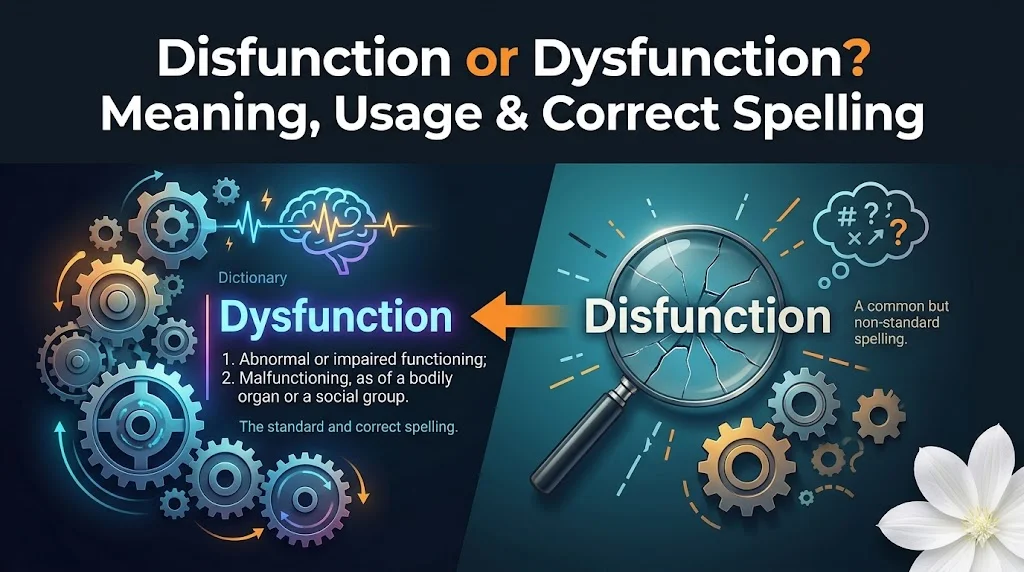
When it comes to English spelling, small differences can make a big impact on clarity and professionalism. One common confusion is between “disfunction” and “dysfunction.” While they may look similar, only one is correct. Understanding the difference matters for anyone who writes professionally, academically, or even casually. In this guide, you will learn why “dysfunction” is correct, how to use it properly, why “disfunction” is incorrect, and how to avoid this common spelling mistake. By the end, you’ll be confident in identifying the right term, applying it in different contexts, and understanding its origins and related expressions.
Definition
Dysfunction refers to impaired or abnormal functioning in a system, organ, or relationship. “Disfunction” is an incorrect spelling that does not appear in standard dictionaries. Correct usage ensures clarity, credibility, and professionalism.
Examples:
- Correct: The patient suffers from kidney dysfunction.
- Incorrect: The patient suffers from kidney disfunction.
Understanding the Origins of “Dysfunction”
The word “dysfunction” comes from the Greek prefix “dys-,” meaning “bad” or “abnormal,” combined with “function,” meaning the way something works. This prefix helps convey the sense of improper or impaired operation in both medical and social contexts.
Examples of “dys-” in English:
- Dyslexia – a learning disorder affecting reading
- Dysgraphia – difficulty in writing
- Dysregulated – improperly regulated or controlled
Why “Disfunction” Looks Right — But Isn’t
Many people assume “dis-” is correct because it is a common prefix in English, often meaning “not” or “opposite of.” However, in this case, “dys-” is the accurate prefix because it specifically refers to abnormal or impaired function. Using “disfunction” is incorrect and should be avoided.
Why “disfunction” never gained traction
Disfunction does not appear in standard dictionaries and has never been widely accepted in formal English. Its use is considered a spelling error, and it lacks historical or linguistic support.
The Prevalence of “Dysfunction” in Modern English
Dysfunction is widely used in medical literature, social sciences, and everyday language. It is recognized and accepted across academic, clinical, and professional contexts. Using the correct form strengthens readability and credibility.
Common Fields That Use “Dysfunction”
- Medicine: organ dysfunction, sexual dysfunction
- Psychology: cognitive or emotional dysfunction
- Business and organizations: dysfunctional teams or processes
Usage in Context: Medical, Social & Organizational
Dysfunction applies to various situations where something does not operate properly. It can describe biological, psychological, social, or structural issues.
Medical Contexts
In medicine, dysfunction refers to organs or systems not functioning correctly.
Examples:
- Heart dysfunction can lead to fatigue and shortness of breath.
- Sexual dysfunction affects relationships and wellbeing.
Social and Organizational Contexts
Dysfunction can describe relationships, families, teams, or organizations that fail to operate harmoniously.
Examples:
- The family struggled with communication dysfunction.
- Workplace dysfunction led to decreased productivity.
Comparison Table: Disfunction vs Dysfunction
| Aspect | Dysfunction | Disfunction |
| Correctness | Correct | Incorrect |
| Prefix | dys- (abnormal) | dis- (wrong usage) |
| Usage | Formal & informal | Not accepted |
| Dictionary status | Recognized | Not recognized |
| Context | Medical, social | None |
Linguistic Insight: Prefix “Dis-” vs “Dys-”
The “dis-” prefix generally negates meaning, while “dys-” indicates something is abnormal or impaired. For example:
- Disagree = not agree
- Dysfunction = abnormal function
Common Misconceptions About “Disfunction”
Many learners think “disfunction” is correct because “dis-” is common in English. Others may mispronounce it or assume it is formal. Always use “dysfunction” to avoid errors.
“Dysfunction” vs. “Dysfunctional”: Knowing the Difference
Dysfunction is a noun describing impaired functioning, while dysfunctional is an adjective describing something as being impaired or problematic.
Examples:
- Noun: Dysfunction in the heart can cause fatigue.
- Adjective: The team is dysfunctional due to poor leadership.
Correct Usage in Writing and Speech
Using “dysfunction” correctly enhances clarity and professionalism. Place it in sentences where you refer to impaired function, and avoid “disfunction” entirely.
Examples:
- Correct: Kidney dysfunction requires immediate attention.
- Correct: The dysfunctional system caused errors.
How to Correct “Disfunction” in Your Writing
Identify instances of “disfunction” in your text and replace them with “dysfunction.” Use grammar and spell-check tools to catch these errors.
Steps to Correct:
- Scan for spelling errors
- Replace disfunction with dysfunction
- Verify usage in context
Related Words and Expressions
- Disorder – a problem with normal functioning
- Impairment – a limitation or deficiency
- Abnormality – deviation from the norm
- Malfunction – failure to work properly
Expert Opinion: Why Correct Spelling Matters
Accurate spelling reflects professionalism and credibility. Misusing terms like “disfunction” can harm readability and trust. Correct usage improves communication and strengthens authority in writing.
Self-Assessment Quiz
- Choose the correct spelling: dysfunction / disfunction
- Identify the correct prefix: dys- / dis-
- Correct the sentence: “The patient suffers from heart disfunction.”
Answers
- Correct spelling: dysfunction
- Correct prefix: dys-
- Corrected sentence: “The patient suffers from heart dysfunction.”
Conclusion: Keep It Functional — Not “Disfunctional”
Disfunction vs dysfunction is a common spelling challenge, but understanding the correct form improves clarity and professionalism. “Dysfunction” is the proper term, reflecting abnormal or impaired function across medical, social, and organizational contexts. Avoid “disfunction,” as it is never accepted in dictionaries. Using the correct term ensures readers understand your message clearly and signals expertise in writing. By mastering this small but critical distinction, you strengthen grammar skills, improve credibility, and communicate confidently. Accurate spelling, especially for terms like dysfunction, demonstrates attention to detail, enhances readability, and builds trust with readers. Regular practice and careful proofreading make correct usage automatic, ensuring your writing is precise and authoritative every time.
FAQs
What is the correct spelling: dysfunction or disfunction?
Dysfunction is correct. Disfunction is incorrect and not recognized in English dictionaries.
Why is it dysfunction and not disfunction?
The prefix “dys-” means abnormal or impaired, which is the intended meaning. “Dis-” is incorrect here.
Can dysfunction refer to social problems?
Yes, it can describe dysfunctional families, teams, or organizations where normal operation is impaired.
What is the difference between dysfunction and dysfunctional?
Dysfunction is a noun, indicating impaired function. Dysfunctional is an adjective describing something as problematic or impaired.
Is disfunction ever acceptable in English?
No, disfunction is always incorrect. Always use dysfunction.
How do you use dysfunction in a sentence?
Example: “Kidney dysfunction requires medical attention.” It indicates impaired function.
What fields commonly use dysfunction?
Medicine, psychology, social sciences, and organizational studies frequently use the term.
What are synonyms for dysfunction?
Synonyms include disorder, impairment, abnormality, and malfunction.
Why does correct spelling matter in writing?
Correct spelling ensures clarity, professionalism, credibility, and improved search engine ranking.
How can I remember the correct spelling?
Remember that “dys-” signifies something abnormal, matching the meaning of dysfunction.
Can dysfunction be used informally?
Yes, it appears in everyday language to describe problems or failures.
Is dysfunction a formal term?
It is appropriate in both formal and informal contexts.
Does dysfunction only refer to health issues?
No, it applies to systems, relationships, and organizations, not just health.
How to fix disfunction in text?
Replace it with dysfunction and verify context using spell-check tools.
What is the adjective form of dysfunction?
Dysfunctional. Example: “A dysfunctional system causes errors.”
Are there common misconceptions about disfunction?
Yes, many assume it is correct due to the “dis-” prefix, but it is always incorrect.
How to check if I’m using dysfunction correctly?
Consult reliable dictionaries and consider the context—medical, social, or organizational.
Can dysfunction describe relationships?
Yes, it can indicate impaired or problematic family or team dynamics.
Why is “dys-” preferred over “dis-” here?
“Dys-” specifically denotes abnormal or impaired function, matching the meaning of dysfunction.
Is there a quick tip to remember?
Think of “dys-” as “bad or abnormal function,” which helps recall the correct spelling.

Sarah Mitchell is an experienced writer and grammar teacher with over 10 years of expertise in English language education. She helps learners improve their grammar, writing, and communication skills through clear explanations and practical examples. Sarah creates learner-friendly content focused on real-life English, making language learning simple, effective, and confidence-building.