
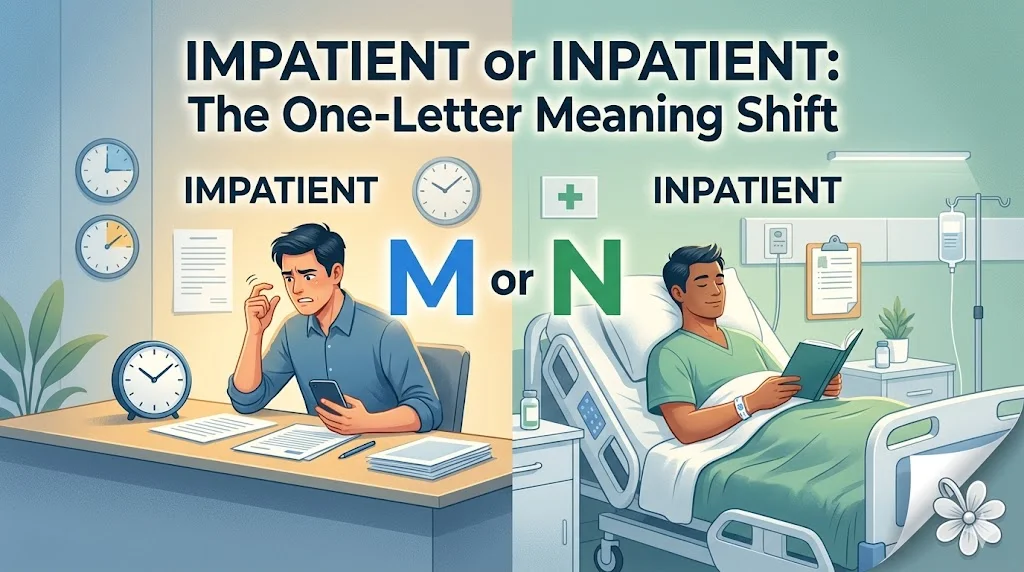
Impatient refers to an emotional state where someone struggles to wait or tolerate delays. Inpatient describes a person who stays in a hospital for treatment. The single letter “i” versus “in” signals a shift from feelings to medical care. Remember: impatient = emotion, inpatient = healthcare. Examples include: “She grew impatient waiting for the bus” and “The inpatient was scheduled for overnight observation.”
The Word “Impatient”: When Waiting Isn’t Your Strength
Definition & Part of Speech
Impatient is an adjective describing someone who feels restless or frustrated when delayed. It indicates emotional reaction rather than physical state. Example: “He was impatient during the long line at the grocery store.”
Core Meaning and Emotional Tone
Impatience reflects irritation or eagerness. It often appears in everyday scenarios like waiting in traffic, at a checkout, or for someone to reply. Example: “Her impatience showed as she tapped her foot constantly.”
Common Behavioral and Emotional Signs of Impatience
Watch for interrupting others, fidgeting, sighing frequently, or rushing through tasks. Example: “Mark’s impatience made him check his phone every few seconds.”
Expressions and Idioms Featuring “Impatient”
Phrases include “impatient as a cat” or “impatient to get started.” Example: “She was as impatient as a child on Christmas morning.”
Etymology: The Roots of “Impatient”
Originating from Latin “impatiens” meaning “unable to endure,” it evolved to describe emotional frustration in English.
The Word “Inpatient”: When Care Means Staying Inside
Definition & Grammatical Role
Inpatient is a noun referring to someone admitted to a hospital. It differs from outpatient, who receives care without staying overnight. Example: “The inpatient required constant monitoring.”
Meaning in Modern Healthcare
Inpatients stay in hospitals for procedures, observation, or recovery. Length of stay can vary from hours to weeks. Example: “Hospital inpatients often receive specialized care unavailable in clinics.”
Real-World Examples of “Inpatient” Usage
Medical reports frequently mention inpatients: “The inpatient showed improvement after 48 hours.”
Historical & Linguistic Roots
Formed by combining “in” + “patient,” the term highlights being a patient inside the hospital.
“Impatient” vs “Inpatient”: Spot the Difference
Contextual Comparison Table
| Feature | Impatient | Inpatient |
| Meaning | Emotional state | Hospitalized patient |
| Part of Speech | Adjective | Noun |
| Context | Feelings or behavior | Healthcare |
| Example | She became impatient waiting | The inpatient stayed overnight |
Example Sentences in Direct Contrast
“Impatient”: “He was impatient waiting for the results.”
“Inpatient”: “The inpatient was admitted for surgery.”
Quick Grammar Tip: One Means Feelings, One Means Healing
Impatient relates to emotion; inpatient relates to medical care. Always check the context before writing.
Common Mistakes and Misconceptions
Confusing Emotional vs Medical Contexts
People mix them due to similar spelling. Example: “She was inpatient waiting for news” should be “impatient.”
Relying Too Much on Spell-Check
Spell-check won’t catch context errors. Both words may be spelled correctly but used incorrectly.
Assuming They’re Related
Despite similar spelling, they have separate origins and meanings.
Linguistic Insight: Why One Letter Changes Everything
This is an example of a minimal pair in English, where a single letter alters the meaning entirely. Understanding this improves reading comprehension and writing accuracy.
How to Remember the Difference Easily
Mnemonics That Stick
Think: “I’m patient” → impatient (emotion), “in patient” → inpatient (hospital).
Visualization Trick
Picture a restless person fidgeting for impatient, a hospital bed for inpatient.
Mini Quiz
- She was ___ waiting for the train. (Answer: impatient)
- The ___ stayed overnight for observation. (Answer: inpatient)
Self Assessment Section
Identify which word fits:
- ___ behavior shows frustration.
- The ___ was under observation for two days.
Answers:
- Impatient
- Inpatient
Fun Fact: The One-Letter Irony
A single letter “i” transforms meaning from feeling restless to receiving hospital care.
Final Thoughts
Impatient and inpatient illustrate the power of a single letter in English. Impatient always refers to emotion, restlessness, or frustration, while inpatient exclusively denotes someone receiving hospital care. Confusing these words can lead to misunderstandings in writing or speech, but remembering their distinct contexts makes usage easy. Using mnemonics, visualization, and practice exercises ensures clarity. Always pause to consider whether the context is emotional or medical before choosing the word. By mastering this difference, your communication becomes precise, professional, and credible, whether you’re writing emails, medical reports, or casual messages. Understanding this one-letter distinction reinforces attention to detail, enriches your vocabulary, and prevents embarrassing mistakes. Recognizing how subtle spelling shifts meaning enhances both comprehension and confidence in English usage. Correct usage signals expertise and care, and it makes your writing accessible and trustworthy. Next time you write or read these words, you’ll instantly know which one belongs, making your communication clearer and more authoritative.
FAQs
What’s the difference between “impatient” and “inpatient”?
Impatient describes someone who feels frustrated or restless when waiting. Inpatient refers to someone staying in a hospital for treatment.
Can “impatient” be used in medical contexts?
No, impatient is an emotional adjective. It’s not used to describe hospital patients.
Is “inpatient” always used as a noun?
Yes, inpatient refers to a person admitted to a hospital and is used as a noun.
Can a person be both inpatient and impatient?
Yes, a hospitalized patient (inpatient) can feel frustrated (impatient) during their stay.
Why do people confuse impatient and inpatient?
The words look similar and sound alike, but their meanings are very different. Context matters.
How do you pronounce impatient vs inpatient?
Impatient: /ɪmˈpeɪʃənt/, Inpatient: /ˈɪnˌpeɪʃənt/.
What is the opposite of impatient?
Patient. It describes someone who can wait calmly without frustration.
What is inpatient care?
Inpatient care refers to treatment that requires staying in a hospital, usually overnight or longer.
Is inpatient written as one word or two?
It is written as one word: inpatient.
What is the easiest way to remember the difference?
Use “I’m patient” for impatient (emotion) and “in patient” for inpatient (hospital).
Can impatience affect relationships?
Yes, frequent impatience can lead to misunderstandings and tension in personal or professional interactions.
Are there other minimal pairs like impatient/inpatient?
Yes, English has many minimal pairs where a single letter changes meaning, such as affect/effect.
Does inpatient always require medical supervision?
Yes, inpatients are admitted for monitoring and care under professional supervision.
Can impatient be positive?
Occasionally, impatience can motivate action or urgency, but it is mostly seen as negative.
Are spell-check tools reliable for these words?
Not always. Spell-check may not detect context errors, only spelling.
What happens if you misuse inpatient in writing?
It can cause confusion, making it seem like someone is emotional rather than receiving hospital care.
Can impatient be used formally?
Yes, it can appear in professional writing when describing behavior or reactions.
Is inpatient used in mental health contexts?
Yes, psychiatric facilities also refer to admitted patients as inpatients.
How can children learn the difference?
Through examples, mnemonics, and visualization exercises that connect the word to context.
Does pronunciation always help distinguish them?
Yes, subtle pronunciation differences can help, but context is the most reliable clue.

Sarah Mitchell is an experienced writer and grammar teacher with over 10 years of expertise in English language education. She helps learners improve their grammar, writing, and communication skills through clear explanations and practical examples. Sarah creates learner-friendly content focused on real-life English, making language learning simple, effective, and confidence-building.