
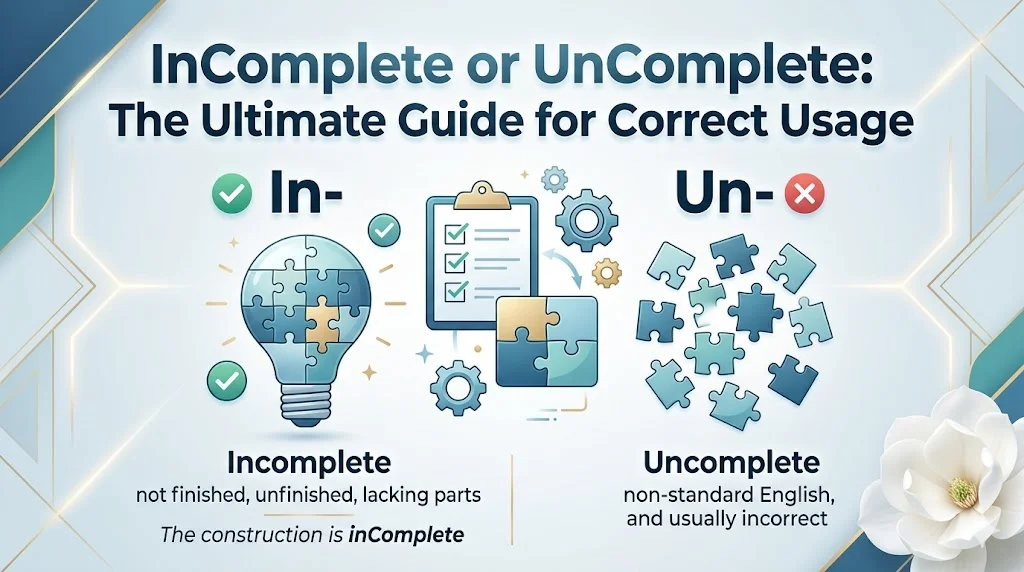
Choosing the right word in English can be tricky, especially when similar terms like “incomplete” and “uncomplete” come up. Many learners confuse these two, which can affect both formal writing and everyday communication. Understanding which term is correct not only improves your grammar but also boosts confidence in speaking and writing. In this guide, you will learn the precise meanings of “incomplete” and “uncomplete,” how to use them correctly, common mistakes to avoid, and expert advice to help you master these words. By the end, you’ll be able to identify the correct word instantly, use it naturally in sentences, and understand why one is standard English while the other is not.
Definition of “Incomplete” and “Uncomplete”
“Incomplete” is the correct and widely accepted term in English, meaning something is unfinished or missing parts. “Uncomplete” is extremely rare and considered incorrect in modern usage. Understanding the distinction is important for clear communication.
Examples:
- The report was incomplete because several sections were missing.
- He realized his homework was incomplete and needed revisions.
InComplete or UnComplete: Key Differences
The main difference lies in correctness and acceptance. “Incomplete” is standard English, recognized in dictionaries, while “uncomplete” is rarely used and often viewed as incorrect.
Comparison Table of Incomplete vs Uncomplete
| Feature | Incomplete | Uncomplete |
| Meaning | Not finished or lacking parts | Not standard English |
| Correctness | Correct and accepted | Incorrect / rare usage |
| Usage | Formal & informal contexts | Very limited / historical |
| Example | The project is incomplete. | The project is uncomplete. (incorrect) |
Why “Incomplete” Is the Correct Word
The prefix “in-” means “not,” which makes “incomplete” grammatically correct. Dictionaries recognize it, and it is used consistently in modern English across both spoken and written forms.
Examples:
- The puzzle is incomplete without the last piece.
- Her explanation was incomplete, leaving some questions unanswered.
Why “Uncomplete” Is Incorrect or Rare
“Uncomplete” misuses the prefix “un-” and lacks dictionary support. It appears occasionally in historical texts but should be avoided in contemporary writing.
Examples:
- Incorrect: His assignment was uncomplete.
- Correct: His assignment was incomplete.
Common Mistakes and Confusions
Many learners confuse the prefixes “in-” and “un-,” leading to incorrect usage of “uncomplete.” Using the wrong word in formal writing can reduce clarity and credibility.
Examples:
- Incorrect: The form is uncomplete.
- Correct: The form is incomplete.
Examples of “Incomplete” in Sentences
- The construction work is incomplete due to delays.
- She handed in an incomplete essay, missing the final paragraph.
Can “Uncomplete” Ever Be Used?
While “uncomplete” might appear in rare historical contexts, it is not recommended in modern English. Using it may confuse readers or make writing appear non-standard.
Example:
- Rare historical usage: The manuscript was uncomplete in several chapters.
Linguistic Insight: Prefix “In-” vs “Un-”
The prefix “in-” means “not,” and it is standard for adjectives like incomplete, inaccurate, invisible. “Un-” also means “not,” but it is typically used with verbs or participles, like undo or untie. Using the correct prefix ensures grammatical accuracy.
Examples:
- Inaccurate data → Correct
- Undo the changes → Correct
- Uncomplete the form → Incorrect
Expert Opinion on Correct Usage
Linguists and grammar experts unanimously prefer “incomplete” in all modern contexts. Dictionaries, style guides, and academic writing consistently use “incomplete” rather than “uncomplete.”
Self-Assessment: Test Your Understanding
Choose the correct word:
- The assignment is ________.
- His explanation was ________.
Answers to Self-Assessment
- Incomplete – It correctly follows standard English usage.
- Incomplete – “Uncomplete” is not accepted in modern English.
Conclusion About InComplete or UnComplete
Understanding the difference between “incomplete” and “uncomplete” is crucial for proper English usage. “Incomplete” is the only correct form widely recognized in dictionaries and modern writing, while “uncomplete” is considered rare or incorrect. Recognizing prefixes like “in-” and “un-” improves your grammar accuracy and confidence. By practicing with real examples and paying attention to context, you can ensure your sentences are clear, professional, and correct. Choosing the correct word strengthens your communication, whether in formal writing, academic tasks, or everyday conversations. With consistent practice and awareness, using “incomplete” correctly will become natural, helping you convey ideas effectively and professionally.
Frequently Asked Questions
Is uncomplete a real word in English
No, “uncomplete” is not a standard word in modern English. It may appear rarely in historical contexts, but it is generally considered incorrect.
What is the correct word, incomplete or uncomplete
The correct word is “incomplete.” It follows standard grammar rules and is widely recognized in dictionaries.
Why do people say uncomplete instead of incomplete
Confusion with the prefix “un-” leads some to say “uncomplete,” but the correct form is “incomplete.”
Can I use uncomplete in formal writing
No, using “uncomplete” in formal writing is incorrect. Always use “incomplete” for professional and academic contexts.
What does incomplete mean in simple terms
Incomplete means something is not finished or is missing parts.
Are there other words like incomplete
Yes, words such as unfinished, partial, or lacking can sometimes replace incomplete depending on context.
How can I remember the correct word
Associate “incomplete” with other “in-” words like incorrect or invisible to reinforce proper usage.
Is incomplete used in everyday conversation
Yes, it is commonly used in daily speech as well as formal writing.
Does incomplete have different meanings
It mainly means not finished but can also imply missing details or components.
Why is learning this difference important
It ensures clear, professional communication and improves grammar accuracy.
How do dictionaries define incomplete
Dictionaries define it as “not having all parts or elements; unfinished.”
Can uncomplete ever be correct
In modern English, it is not correct and should be avoided.
What prefix makes incomplete correct
The prefix “in-” makes it grammatically correct, meaning “not.”
Can incomplete be used in academic writing
Yes, it is the correct term for academic contexts when something is unfinished.
Is uncomplete considered archaic
Yes, it may appear in old texts but is not standard today.
How to correct sentences with uncomplete
Replace “uncomplete” with “incomplete” to make the sentence grammatically accurate.
Is incomplete a noun or adjective
Incomplete is an adjective describing something that is not finished.
Can uncomplete cause confusion
Yes, using “uncomplete” can confuse readers or sound unprofessional.
Are there similar prefix mistakes
Yes, confusing “in-” and “un-” often leads to errors like incorrect/unincorrect or inpossible/unpossible.
How to practice using incomplete correctly
Write sentences, read examples, and replace uncomplete with incomplete to reinforce usage.

Amelia Wright focuses on making figurative language easy to understand. Her writing explains similes, metaphors, and word meanings using relatable examples. She aims to help readers recognize subtle differences in usage and apply them correctly in both academic and casual writing.