
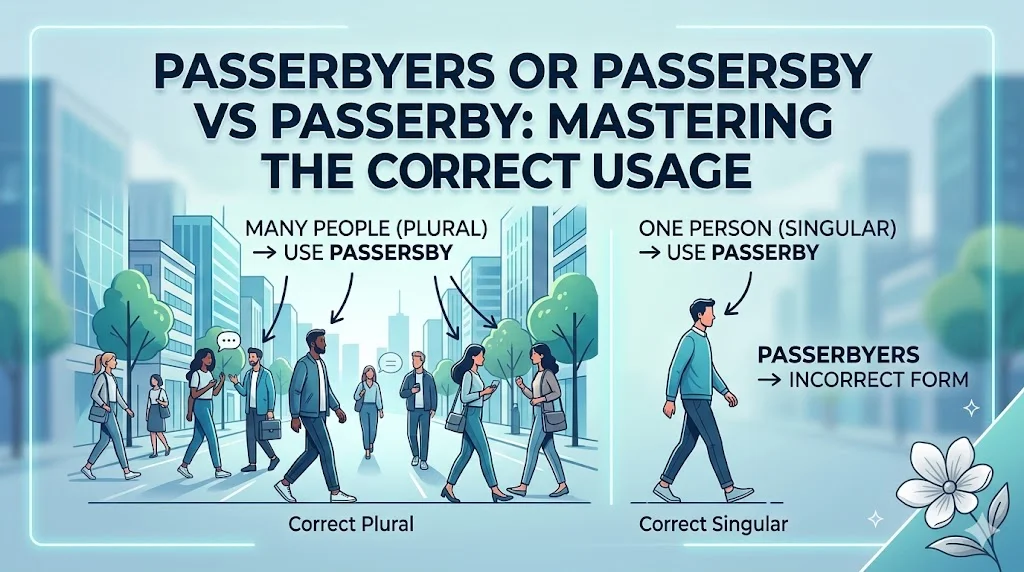
Understanding the difference between “passerby,” “passersby,” and the incorrect “passerbyers” is essential for anyone learning English. Many beginners and even native speakers get confused because the pluralization of compound nouns in English often breaks normal patterns. In this guide, you will learn the proper singular and plural forms, why “passerbyers” is incorrect, and how to use each term confidently in everyday writing and speech. By the end, you’ll understand not just the rule, but the reasoning behind it, making it easier to remember and apply in real-life contexts.
Definition
A “passerby” refers to a single person who passes by a location or event. The plural form is “passersby,” where the main noun “passer” changes, not the word “by.” “Passerbyers” is a common mistake seen online and in casual writing. This distinction is crucial for proper grammar usage and clear communication.
Understanding “Passerby”: Meaning and Origin
A “passerby” is a compound noun made of “passer” and “by.” It is used to describe someone walking past a place or situation.
Examples:
- A passerby helped the lost child find their way.
- Several passersby watched the street performer in awe.
🏛️ Origin and Etymology
“Passerby” originated from the combination of “passer” (one who passes) and “by” (movement past a point). Early English literature often used the hyphenated form “passer-by.” Over time, the hyphen was dropped in modern usage, though older texts still retain it.
How to Pluralize “Passerby” (and Why It Feels Wrong)
The plural form is “passersby,” applying the plural to the main noun “passer” while keeping “by” unchanged. This irregular pattern feels unnatural because English speakers expect regular -s endings.
Examples:
- Singular: A passerby waved at the parade.
- Plural: Many passersby waved at the parade.
- Incorrect: Passerbyers waved at the parade.
Why It Feels Strange
English learners often expect plurals to simply add -s to the end of a word. Since “passersby” breaks that pattern, it can feel awkward even to experienced writers. It is a remnant of older grammatical rules for compound nouns.
Passerby vs Passersby vs Passerbyers: Quick Comparison
| Word | Grammar Status | Meaning | Example Usage |
| Passerby | Correct Singular | One person passing | A passerby stopped to help. |
| Passersby | Correct Plural | Multiple people passing | Passersby clapped at the performance. |
| Passerbyers | Incorrect | Nonstandard internet form | Avoid usage. |
“Passerbyers”: The Internet’s Favorite Wrong Word
Many people mistakenly use “passerbyers” because it seems to follow regular plural rules. Social media and casual writing amplify this error, but dictionaries do not recognize it as standard English.
Why People Say “Passerbyers”
Speakers apply the common plural -ers pattern without realizing that “passerby” is a compound noun. Pronunciation and analogy with simpler nouns lead to the widespread mistake.
Quick Check
Rule reminder:
- Singular: passerby
- Plural: passersby
- Never use: passerbyers
Common Misuses and Why They Happen
Mistakes arise from misapplying regular plural rules, confusing hyphenated forms, or mimicking online usage. Learners often see “passerbyers” or “passerbys” and assume they are correct.
Examples:
- Incorrect: Many passerbyers gathered.
- Correct: Many passersby gathered.
🔍 Top Reasons for Misuse
- Expectation of regular plural endings (-s, -es)
- Influence from internet spelling trends
- Misunderstanding compound noun grammar
Hyphenation and Modern English: “Passer-by” vs “Passerby”
Older texts often used “passer-by,” but modern English generally favors the closed compound “passerby.” Style guides vary, but the closed form is standard in dictionaries today.
🇺🇸 American vs 🇬🇧 British Usage
American English almost always uses “passerby” without a hyphen. British English may retain “passer-by” in formal texts, but both forms are understood.
Evolution Timeline
| Era | Common Form | Notes |
| 1600s | Passer-by | Hyphenated, early literature |
| 1800s | Passer-by | Still common in British texts |
| 1900s–Present | Passerby | Modern standard, both US & UK |
Correct Usage in Real Sentences
✅ Singular: “Passerby”
- A passerby stopped to lend a hand.
- I asked a passerby for directions.
- The passerby didn’t notice the spilled coffee.
✅ Plural: “Passersby”
- Passersby cheered as the parade went by.
- Several passersby joined the street cleanup.
- The police thanked the passersby for their help.
Real-World Usage: “Passersby” in Action
“Passersby” frequently appears in news reports, storytelling, and public observations. It conveys multiple individuals moving through a scene or witnessing an event.
Examples:
- Passersby filmed the incident on their phones.
- Many passersby stopped to admire the mural.
Why “Passersby” Survives Despite Simplification
Despite its irregularity, “passersby” persists due to historical grammar rules, dictionary standards, and its widespread recognition. Writers continue to use it in both formal and informal contexts.
Linguistic Insight
Compound nouns like “passerby” pluralize the main noun, a pattern seen in words like “attorneys general” or “mothers-in-law.”
Why It Persists
Cultural inertia, authoritative dictionaries, and consistent usage in print media reinforce its survival.
Synonyms and Alternatives for “Passersby”
| Word | Context | Formality Level |
| Pedestrians | Street context | Neutral |
| Onlookers | Observational situations | Neutral |
| Bystanders | Event scenes | Slightly formal |
| Observers | Analytical contexts | Formal |
Quick Recap: The Rule You’ll Never Forget
- Singular: passerby
- Plural: passersby
- Avoid: passerbyers
This rule ensures clarity and aligns with English compound noun grammar. Remember, the main noun changes form, not the preposition.
Self Assessment
- Identify the correct plural of passerby.
- Spot the incorrect usage: passerbyers or passersby?
- Write a sentence using “passersby.”
Answers to Self Assessment
- Passersby
- Passerbyers is incorrect
- Example: Several passersby waved at the street performer.
Conclusion
The singular “passerby” and plural “passersby” follow a specific compound noun rule, while “passerbyers” is a nonstandard error. Understanding this distinction helps learners write accurately and confidently. By remembering that the main noun receives the plural form, you can apply the rule to similar compound nouns and avoid common mistakes. Correct usage ensures clarity, professionalism, and trustworthiness in both casual and formal English contexts. With this knowledge, you can confidently use “passerby” and “passersby” in any situation, keeping your writing precise and reader-friendly.
You might also like
- 🔁 Resetted or Reset? The Correct Grammar Explained with Real Examples (2025 Guide)
- ✅ Correct or Correctly? The Ultimate Grammar Guide for 2025 ✍️
- ✈️ Flew or Flown: The Complete Grammar Guide to Mastering “Fly” in English (2025)
Post navigation
Leave a Reply Cancel reply
Final Thoughts
Understanding the correct usage of “passerby” and “passers-by” is not just about memorizing forms but grasping the logic behind English compound nouns. The singular “passerby” identifies one individual moving past, while “passersby” is used when referring to multiple individuals. Many learners stumble over this because it breaks the conventional -s plural pattern, leading to the erroneous “passerbyers.” Recognizing that the plural applies to the main noun within the compound clarifies the structure and makes the rule memorable.
Compound noun pluralization is an essential grammar concept that affects numerous words, including “attorneys general” or “mothers-in-law.” By learning the rule with “passersby,” students can generalize it to other irregular forms, strengthening their overall grammar confidence. Consistently applying correct forms in writing and speech not only enhances clarity but also establishes credibility with readers and listeners. Avoiding mistakes like “passerbyers” shows attentiveness to detail, reinforcing both personal authority and professionalism. Practice using sentences that naturally feature singular and plural forms, and soon correct usage will become second nature. Understanding historical origins, observing real-world examples, and using memory tricks can all help cement this knowledge. Mastery of “passerby” and “passersby” contributes to more precise, elegant, and effective communication in everyday English.
FAQs
What is the singular form of passersby?
The singular form is “passerby,” which refers to one person passing by a location or event. It is a compound noun where “passer” is the main noun.
Why is passersby the correct plural form?
“Passersby” pluralizes the main noun “passer” while keeping “by” unchanged. This irregular pattern follows traditional compound noun rules in English.
Is passerbyers a real word?
No, “passerbyers” is incorrect. It is a common internet mistake and is not recognized by dictionaries.
Can I use passerbys instead of passersby?
No, “passerbys” is nonstandard. The correct plural is “passersby” in all formal and informal contexts.
Are hyphenated forms like passer-by still used?
Yes, “passer-by” appears in older British texts but is largely replaced by the closed compound “passerby” in modern writing.
Why do compound nouns pluralize differently?
Compound nouns often pluralize the main noun (e.g., “attorneys general”) rather than the secondary word, following historical grammar conventions.
Is passersby used in formal writing?
Yes, “passersby” is correct in both formal and informal English. It is accepted in literature, journalism, and professional writing.
What are some alternatives to passersby?
Synonyms include pedestrians, onlookers, bystanders, and observers. Each term fits slightly different contexts and formality levels.
How can I remember the plural rule easily?
Focus on the main noun within the compound. “Passer” becomes “passers,” while “by” remains the same, forming “passersby.”
Do dictionaries recognize passerby as one word?
Yes, modern dictionaries list “passerby” as a closed compound noun without a hyphen, though older forms used “passer-by.”
How do I use passerby in a sentence?
Example: A passerby helped the tourist find the museum.
Can passersby refer to animals or objects?
No, it specifically refers to people moving past a location or scene.
Why does “passersby” feel awkward to some?
It is irregular and breaks the expected -s plural pattern, which can make it sound unusual to learners.
Can “passersby” be used in headlines?
Yes, it is concise and commonly used in news headlines for clarity and brevity.
Are there other irregular compound nouns like passerby?
Yes, examples include “mothers-in-law,” “attorneys general,” and “brothers-in-law,” all following the same pluralization principle.
What is the historical origin of passerby?
It comes from “passer” + “by,” with early usage often hyphenated as “passer-by” in English literature.
Can children learn passerby rules easily?
Yes, through repeated examples, simple sentences, and highlighting the main noun’s plural form.
How do writers avoid mistakes with passerby?
By remembering the plural applies to the main noun and avoiding “passerbyers” or “passerbys.”
Does pronunciation affect the plural form?
Slightly, as some may mistakenly add -ers, but standard English maintains “passersby.”
Are there memory tricks for irregular plurals like passersby?
Yes, think of the main noun first and add plural only to it, not the secondary word.

Ethan Clarke is a language writer who specializes in breaking down similes, word meanings, and commonly confused terms. His work focuses on clear explanations, practical examples, and simple comparisons that help readers understand how English