
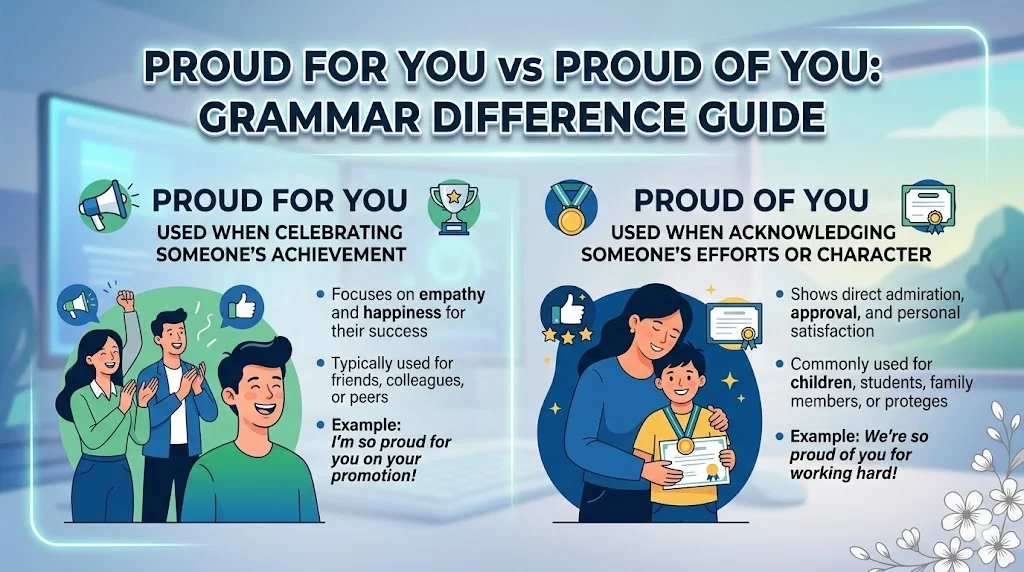
Many English learners confuse “proud for you” and “proud of you” because both express positive feelings, but the small preposition difference changes the meaning and tone. Using the wrong one can make your message sound awkward or unnatural. In this guide, you’ll learn why “proud of you” is standard, when “proud for you” might appear, and how to express pride naturally in everyday conversations.
Definition of “Proud of You” vs “Proud for You”
“Proud of you” expresses admiration for someone’s achievements or qualities. It is standard in English and shows personal recognition. “Proud for you” is rarely used and often sounds awkward, usually implying happiness on someone else’s behalf rather than personal pride.
Comparison Table for “Proud of” vs “Proud for” Usage
| Phrase | Grammar Correctness | Meaning | Natural Usage | Example |
| Proud of you | Correct | Feeling admiration | Very common | I’m proud of you for graduating. |
| Proud for you | Rare/awkward | Feeling happiness on someone’s behalf | Very uncommon | I’m proud for you after your success. |
What “Proud of You” Really Means
“Proud of you” expresses genuine admiration and emotional connection. It recognizes achievement and reinforces bonds in family, education, or friendships. Using it correctly helps convey sincerity and respect.
Common Situations for “Proud of You”
- Parents congratulating children on milestones
- Teachers praising student efforts
- Friends celebrating accomplishments
Examples: - I’m proud of you for completing the project.
- She said, “I’m proud of you” after his performance.
Emotional Meaning
“Proud of you” conveys admiration, respect, and personal pride. It validates effort and achievement, creating a positive emotional impact.
Example sentences:
- I’m proud of you for standing up for yourself.
- He felt proud of you when you solved the problem independently.
What “Proud for You” Means (and Why It Sounds Awkward)
“Proud for you” often appears in learner English but feels unnatural. It emphasizes happiness on someone’s behalf rather than personal admiration, which is why native speakers rarely use it.
When “Proud for You” Might Work
It may be acceptable in indirect or empathetic contexts, often in casual conversation or regional variations.
Example:
- I’m proud for you that things worked out, even though I wasn’t there.
The Grammar Behind “Proud of” vs “Proud for”
Adjectives like “proud” usually pair with specific prepositions. “Of” is standard because it directly connects pride to the person or achievement, while “for” is less common and often considered awkward.
The Role of Prepositions
Prepositions shape meaning. “Proud of” links pride to the subject’s achievement. Similar patterns exist in phrases like “happy about” or “afraid of.”
Linguistic Explanation
“Of” is the collocation native speakers expect. It evolved from historical usage patterns where pride is directly linked to the object of admiration.
Why “Proud for You” Sounds Awkward to Native Speakers
Native speakers intuitively prefer “proud of” due to rhythm, familiar speech patterns, and standard collocation expectations. “Proud for” breaks this pattern, making it sound less natural.
Native Speaker Intuition
Exposure to English patterns helps speakers immediately recognize correct usage. Non-native learners might create “proud for you” by literal translation from their own language.
Emotional and Cultural Nuances of “Proud of You”
“Proud of you” strengthens bonds and conveys emotional support. Cultural norms influence how openly pride is expressed; in some societies, verbal praise is less common, but the meaning remains the same.
Emotional Contexts
Used in celebrations, achievements, and recognition moments to create positive emotional impact.
Examples:
- Graduation ceremonies, awards, personal milestones
Cultural Note
English often favors explicit verbal praise, unlike some cultures where pride is shown non-verbally.
When “Proud for You” Might Be Acceptable
Rarely used in empathetic or indirect contexts to express happiness for someone’s success rather than personal admiration.
Suitable Contexts
- Casual conversation among peers
- Indirect emotional support
- Situations emphasizing outcomes rather than personal pride
Common Mistakes (and How to Fix Them)
Many learners mistakenly say “proud for you” or “proud about you.” Using “proud of you” consistently ensures clarity and correctness.
Frequent Errors
- Incorrect: I’m proud for you.
- Correct: I’m proud of you.
Quick Checklist
- Always use “of” to show personal pride
- Use “for” only for indirect happiness if context allows
- Avoid “about” after “proud”
Expert Linguistic Insights
Research shows “proud of” dominates native speaker usage. Historical texts and modern corpora confirm the collocation’s standard status.
Historical Note
Since the 17th century, “proud of” has been the correct phrase in English, evolving naturally through literature and spoken usage.
How to Express Pride Naturally (Alternatives That Sound Fluent)
To Express Admiration
- I admire your dedication.
- You’ve done an amazing job.
To Express Happiness for Someone
- I’m so happy for your success.
- That’s wonderful news!
To Show Emotional Connection
- I’m really impressed by you.
- Your effort inspires me.
Emotional Impact: How “Proud of You” Strengthens Relationships
Using “proud of you” reinforces trust, validates achievement, and strengthens emotional bonds between speakers.
Why It Works
Positive reinforcement encourages confidence and mutual respect.
Real-Life Case Study
A teacher telling a student, “I’m proud of you,” motivates continued effort and builds a lasting teacher-student bond.
Self-Assessment Quiz
- Which is correct: “I’m proud for you” or “I’m proud of you”?
- Can “proud for you” be used casually?
- Which phrase shows admiration?
- Is “proud about you” correct?
- Choose the best alternative to “proud of you” expressing happiness.
Answers to Self-Assessment
- I’m proud of you – correct preposition usage
- Yes, in rare informal contexts
- Proud of you
- No, always use “of”
- I’m so happy for your success
Final Thoughts
Understanding the difference between “proud of you” and “proud for you” is crucial for expressing emotion correctly in English. “Proud of you” directly links pride to someone’s actions or qualities and is widely accepted in all English contexts. “Proud for you” may appear in casual or indirect situations but generally sounds awkward to native speakers. Using “proud of you” builds trust, strengthens relationships, and ensures your admiration is clearly conveyed. Remembering the correct preposition and using natural alternatives when needed helps communicate pride effectively. Expressing pride with the right phrase reflects both grammatical accuracy and emotional intelligence, making your English sound fluent and genuine. By consistently applying “proud of you” in conversations, you show respect, awareness, and linguistic competence, helping you connect meaningfully with others in personal and professional settings. Confident, clear, and heartfelt communication starts with simple, correct phrases, and mastering this small difference creates a lasting impact in your interactions.
FAQs
What’s the main difference between “proud of you” and “proud for you”?
“Proud of you” expresses personal admiration and is grammatically correct. “Proud for you” is rarely used and usually indicates happiness on someone’s behalf rather than direct pride.
Is “proud for you” ever correct?
It can be acceptable in casual, empathetic contexts or regional speech, but it remains uncommon and often sounds awkward.
Why does “proud for you” sound strange to native speakers?
Native speakers expect “proud of” due to common collocations and speech patterns. “Proud for” breaks the natural rhythm and feels unusual.
Can I say “proud about you”?
No, “about” is not used after “proud.” The correct preposition is “of.”
What is the correct phrase in English conversations?
“Proud of you” is the standard phrase used to convey admiration and emotional pride in everyday conversations.
Do native speakers ever use “proud for you”?
Occasionally in informal contexts or for emphasis on happiness rather than pride, but it is very rare.
Is “proud of you” formal or informal?
It is versatile, appropriate in both formal and informal situations, from classrooms to family conversations.
Can teachers say “I’m proud of you”?
Yes, it is commonly used by teachers to motivate and acknowledge student achievements.
What other phrases show pride in English?
Alternatives include “I admire you,” “I’m impressed,” and “I’m so happy for you,” depending on context.
What’s the easiest way to remember the difference?
Remember: “of” for personal pride and admiration, “for” only if expressing happiness on someone else’s behalf.
Can “proud of you” be used in emails?
Yes, it works in professional or personal emails to recognize accomplishments or efforts.
Is it correct to say “we are proud of you”?
Yes, using plural subjects works naturally to convey collective admiration.
How do you express pride in achievements without using “proud of you”?
Say “Your work is impressive” or “You did a fantastic job” to express admiration naturally.
Can “proud for you” ever replace “proud of you” in formal writing?
No, “proud for you” is considered non-standard and should be avoided in formal contexts.
Why do learners say “proud for you” so often?
They often translate directly from their native language, where “for” may be used similarly.
Does “proud of you” imply any obligation?
No, it purely expresses admiration and recognition, not expectation or duty.
Is “proud of you” suitable for social media posts?
Yes, it is commonly used to acknowledge achievements publicly.
Can “proud of you” be used for pets or objects?
Generally, it refers to people, though figurative or humorous use is possible.
What emotional effect does “proud of you” have on the listener?
It fosters confidence, strengthens relationships, and validates effort and achievement.
Can “proud of you” improve communication with peers?
Yes, using it appropriately reinforces trust, emotional connection, and mutual respect in social interactions.

Daniel Brooks is an English educator with a passion for explaining similes and word comparisons in plain language. He covers topics like versus meanings, correct usage, and figurative language to help writers avoid common mistakes and improve clarity in everyday writing.
