
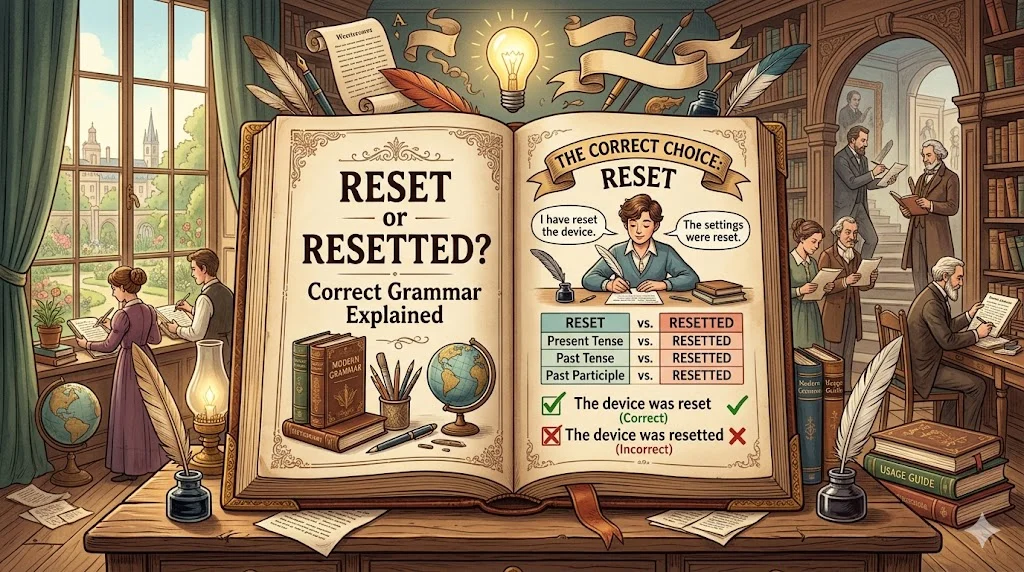
Understanding whether to use “reset” or “resetted” can be tricky for many English learners. The confusion often arises because most verbs form their past tense by adding “-ed,” making “resetted” seem logical. However, “reset” is an irregular verb that does not change in the past tense. Knowing the correct usage is essential for clear writing and speaking, whether you’re composing emails, troubleshooting technology, or writing academic work. In this article, you’ll learn the exact definition of “reset,” why “resetted” is incorrect, how to use it in different contexts, and practical memory tips to remember the rule. By the end, you’ll confidently use “reset” in any tense, understand related irregular verbs, and avoid common grammar mistakes that confuse beginners.
Definition of “Reset” in English Grammar
“Reset” is a verb meaning to set again or restore to an initial condition. It can also be used as a noun to describe the act of resetting something. While it functions like regular verbs in everyday communication, its past and past participle forms remain identical to the present tense, which often confuses learners. Examples:
- I need to reset my password.
- The system underwent a reset last night.
Understanding What “Reset” Really Means
“Reset” is used in both literal and figurative contexts. Literally, it applies to devices, machines, and technology when returning to an initial state. Figuratively, it can describe restarting processes, routines, or habits. Common contexts include computing, electronics, therapy, and personal productivity. Examples:
- After the software crashed, I reset the program.
- She decided to reset her daily schedule to be more productive.
🧠 Etymology Snapshot
“Reset” comes from the base verb “set” with the prefix “re-,” meaning “again.” Over time, English adopted it in technology and everyday contexts. Its meaning evolved but retained the zero-change pattern of “set.”
The Grammar Rule: “Reset” Is an Irregular Verb
Unlike regular verbs that add “-ed,” “reset” remains unchanged in past and past participle forms. Recognizing irregular verbs is crucial for proper grammar. Examples:
- Present: I reset the timer every morning.
- Past: Yesterday, I reset the timer.
- Past participle: Have you reset your password yet?
🧩 Why It Follows the “Set” Rule
“Reset” inherits the grammatical pattern of “set,” which also doesn’t change across tenses. Both verbs are irregular and maintain identical forms in present, past, and past participle, simplifying conjugation once memorized.
The Correct Past Tense of “Reset”
| Verb Form | Word | Example Sentence |
| Present | Reset | I reset the alarm every morning. |
| Past | Reset | Yesterday, I reset the alarm after it rang. |
| Past Participle | Reset | I have reset the alarm three times this week. |
Reset vs. Resetted: The Real Grammar Clarification
| Word | Grammar Status | Example | Correctness |
| Reset | Correct | I reset my laptop yesterday. | ✅ Correct |
| Resetted | Incorrect | I resetted my laptop yesterday. | ❌ Incorrect |
“Resetted” may seem right because of the common “-ed” past tense rule, but dictionaries and grammar guides confirm it is nonstandard. Always use “reset” for all tenses.
Why “Resetted” Sounds Right (But Isn’t)
Many learners naturally add “-ed” because most English verbs follow this pattern. This cognitive expectation makes “resetted” appear correct, but it violates the irregular verb rule. Accepting this pattern ensures precise, professional writing. Examples:
- Incorrect: I resetted the router.
- Correct: I reset the router.
Pronunciation of “Reset” in All Tenses
The word is pronounced /riːˈset/ regardless of tense. Stress is on the second syllable, and pronunciation remains consistent whether present, past, or past participle. Examples:
- I reset /riːˈset/ the device.
- Have you reset /riːˈset/ the settings yet?
Common Grammar Mistakes with “Reset” and How to Avoid Them
❌ Mistake 1: Using “Resetted” Instead of “Reset”
Incorrect usage: “I resetted my phone.”
Correct usage: “I reset my phone.” Always use the unchanged form.
❌ Mistake 2: Misunderstanding the Tense of “Reset”
Some learners assume past tense requires “-ed.” Remember: reset = reset = reset. Example: “Yesterday, I reset the password.”
❌ Mistake 3: Mixing Verb and Noun Forms
Confusion can arise when “reset” is used as a noun.
- Noun: The system performed a reset.
- Verb: I need to reset the system.
Similar Irregular Verbs That Never Change Form
| Verb | Past | Past Participle | Example |
| Set | Set | Set | I set the table yesterday. |
| Cut | Cut | Cut | He cut the paper carefully. |
| Put | Put | Put | She put the book on the shelf. |
| Hit | Hit | Hit | The baseball player hit the ball. |
Linguistic Insight: Why Some Verbs Never Change
Zero-change verbs like “reset” survive due to historical evolution and language simplification. They often trace back to Old and Middle English where these verbs retained a single form across tenses.
How to Remember the Rule Easily
💡 Mnemonic:
“Reset stays set, don’t fret!”
✏️ Practice Tip:
Write three sentences in past, present, and past participle using “reset.”
🧘 Analogy:
Think of reset like a stopwatch button—it always functions the same way no matter when you press it.
Real-World Examples in Different Contexts
- Technology: I reset my router after the connection failed.
- Daily life: She reset her morning routine to include exercise.
- Professional: The technician reset the server during maintenance.
Expanding Your Grammar: Similar Irregular Verbs to Learn
| Verb | Past | Past Participle | Example |
| Set | Set | Set | I set the alarm clock. |
| Cut | Cut | Cut | He cut the vegetables. |
| Put | Put | Put | I put the files in order. |
| Hit | Hit | Hit | She hit the target easily. |
Common Usage Case Study
Case Study: Technology Support Example
A customer resets their device to troubleshoot a software glitch. Correct usage ensures clarity:
- Correct: “I reset my phone to fix the error.”
- Incorrect: “I resetted my phone to fix the error.”
Quick Recap: What You’ve Learned
- “Reset” is an irregular verb; past tense = reset.
- “Resetted” is incorrect and nonstandard.
- Zero-change verbs include set, put, cut, hit.
- Using reset correctly improves clarity in writing and speaking.
Self-Assessment Quiz
- Fill in the blank: Yesterday, I ______ my password. (Answer: reset)
- Identify the error: “I resetted my alarm.” (Answer: Use reset)
- True or False: Reset changes in past tense. (Answer: False)
- Choose correct: She ______ the system before work. (Answer: reset)
- Multiple choice: Which is a zero-change verb? a) Set b) Walk c) Jump (Answer: Set)
Final Thoughts
Understanding “reset” as an irregular verb is crucial for accurate English usage. The word remains the same in present, past, and past participle forms, eliminating the need for “resetted,” which is grammatically incorrect. This zero-change pattern aligns with verbs like set, put, cut, and hit, which maintain consistency across all tenses. Beginners often struggle because most verbs follow the “-ed” past tense rule, but learning the exception for reset prevents common mistakes in writing, emails, technology troubleshooting, and professional communication. Using reset correctly not only demonstrates strong grammar skills but also enhances clarity and professionalism in speech and writing. Remembering the mnemonic “Reset stays set, don’t fret!” or practicing with sentences in all tenses can reinforce the rule efficiently. By recognizing this pattern and applying it consistently, learners can avoid confusion, confidently handle irregular verbs, and communicate effectively in both formal and casual contexts. Proper mastery of reset grammar solidifies foundational knowledge in English and supports learning additional zero-change verbs, making your language skills more precise and reliable.
FAQs
What is the past tense of “reset”?
The past tense of reset is the same as its present form: reset. No “-ed” is added, so it remains consistent across tenses.
Is “resetted” ever correct?
No, “resetted” is incorrect in standard English. Dictionaries do not recognize it as valid; only “reset” should be used.
Why doesn’t “reset” change in the past tense?
Reset is an irregular verb that follows the zero-change pattern like “set.” This is a historical and linguistic convention in English.
How can I remember the correct form?
Use a simple mnemonic like “Reset stays set, don’t fret!” or practice writing sentences in past, present, and past participle forms.
Are there other verbs like “reset”?
Yes, verbs such as set, put, cut, and hit follow the same zero-change pattern in English.
Is “reseted” a correct spelling?
No, “reseted” is a common mistake. The correct form for all tenses is “reset.”
Can “reset” be used as a noun?
Yes, reset can function as a noun meaning the act of resetting something. Example: “The system underwent a reset.”
Do grammar checkers recognize “resetted”?
Most grammar tools flag “resetted” as incorrect and suggest “reset” instead.
Is “reset” used differently in British and American English?
No, both follow the same irregular verb pattern; past tense is always reset.
Why do many people write “resetted”?
Learners expect verbs to add “-ed” for past tense, leading to this common mistake.
How do I use “reset” in professional writing?
Always use reset in all tenses and avoid “resetted.” Example: “The technician reset the server.”
Can “reset” be reflexive?
Yes, in certain contexts: “I reset myself to focus better.”
Does “reset” apply only to technology?
No, it can describe routines, habits, or figurative restarts in daily life.
How do you pronounce “reset”?
Reset is pronounced /riːˈset/ with stress on the second syllable in all tenses.
Is “reset” always a transitive verb?
It can be transitive or intransitive depending on context: “I reset the clock” (transitive) vs. “The system reset automatically” (intransitive).
Can “reset” appear in idioms?
Figuratively, yes: “It’s time to reset your mindset” is a common idiomatic use.
How do you explain “reset” to beginners?
Explain it as “set again,” and emphasize that it doesn’t change in past tense.
Can “reset” take objects?
Yes, you can reset devices, schedules, routines, or systems.
Does “reset” ever take “-ing”?
Yes, for continuous tense: “I am resetting the router right now.”
How is “reset” different from “restart”?
Reset restores to the original state, while restart may simply begin again without clearing settings.
Can “reset” be plural as a noun?
Yes, e.g., “Multiple resets were performed on the system.”

Sarah Mitchell is an experienced writer and grammar teacher with over 10 years of expertise in English language education. She helps learners improve their grammar, writing, and communication skills through clear explanations and practical examples. Sarah creates learner-friendly content focused on real-life English, making language learning simple, effective, and confidence-building.