
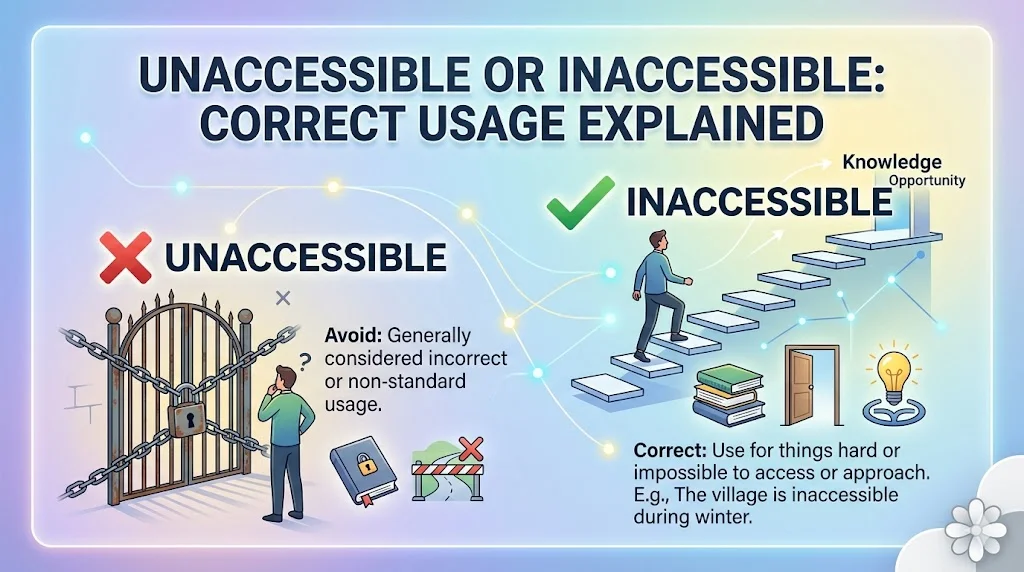
When learning English, some words can be tricky because they look similar but are not equally correct. “Unaccessible” and “inaccessible” are a perfect example. Many writers and learners confuse these two terms, but only one is considered standard English. Understanding the correct usage matters for writing clearly, avoiding grammar mistakes, and sounding professional. In this guide, you’ll learn the difference between “unaccessible” and “inaccessible,” why one is preferred, how to use it in different contexts, and practical tips to avoid common errors. By the end, you’ll confidently choose the right word in any situation.
Definition
“Inaccessible” is the standard English adjective used to describe something that cannot be reached, entered, or obtained. “Unaccessible” occasionally appears in older texts or as a modern typo but is not widely recognized in dictionaries. Knowing which term to use ensures correct and professional writing.
Example: The remote mountain cabin was completely inaccessible during the winter.
Prefix Power: Understanding “Un” vs “In”
English uses negative prefixes like “un-” and “in-” to change a word’s meaning. “In-” often comes from Latin roots and appears in formal or academic words, which is why “inaccessible” follows standard patterns. Using the correct prefix maintains clarity and aligns with English word formation rules.
- “Un-” is common in casual words like unhappy or unsafe.
- “In-” is used in words like inactive, invisible, and incorrect.
Example: The documents were inaccessible due to a password restriction.
Linguistic Insight: How Negative Prefixes Shape English Words
Many English words adopted from Latin use “in-” to signal negation. Patterns appear in academic and technical vocabulary: invisible, inactive, inaccurate. Recognizing these patterns helps learners predict correct spelling.
Example: The confidential files remained inaccessible to outsiders.
Historical Origins: How “Inaccessible” Became Standard
“Inaccessible” comes from Latin roots meaning “not able to be approached.” English dictionaries standardized it in modern usage, while “unaccessible” remained rare. The word’s long history explains why it is recognized as correct today.
- Root: Latin “accessibilis” + in-
- Early English adoption in legal and literary texts
- Standardized spelling recognized by Oxford and Merriam-Webster
Unaccessible vs Inaccessible Comparison Table
| Feature | Unaccessible | Inaccessible |
| Dictionary recognition | Rare, mostly outdated | Standard, widely recognized |
| Grammar acceptance | Incorrect in formal writing | Correct, standard usage |
| Usage frequency | Very low | High |
| Correct spelling | ❌ | ✅ |
| Example usage | He found the path unaccessible. | The mountain trail was inaccessible. |
The Grammar Verdict: Which Word Is Correct?
“Inaccessible” is the correct word in standard English. It is recognized by all major dictionaries, used in formal writing, and accepted in academic and professional contexts. “Unaccessible” is incorrect and should be avoided.
Compare These Examples
- Correct: The website was inaccessible during maintenance.
- Incorrect: The website was unaccessible during maintenance.
- Correct: The private office is inaccessible without authorization.
- Incorrect: The private office is unaccessible without authorization.
Why “Unaccessible” Still Appears
Some writers still use “unaccessible” due to historical usage, spelling mistakes, or autocorrect suggestions. Regional variations and informal writing also contribute to its appearance.
1. Historical Usage
Older texts sometimes used “unaccessible,” reflecting early English spelling inconsistencies.
2. Modern Typos
Typing errors often produce “unaccessible” instead of “inaccessible.”
3. Autocorrect and Predictive Text
Digital keyboards may mistakenly suggest “unaccessible.”
4. Regional Influence
Certain dialects or informal writing may favor uncommon forms.
Correct Usage in Real Contexts
Formal Writing
Use “inaccessible” in academic papers, reports, and official communications.
Example: The financial records were inaccessible to unauthorized personnel.
Informal Writing
Even in casual emails or messages, “inaccessible” remains correct.
Example: The concert tickets were inaccessible online due to high demand.
Digital & Tech Context
Used in websites, apps, or accessibility discussions.
Example: Some features are inaccessible to users without premium accounts.
Clarifying Meaning: What “Inaccessible” Really Means
Physical
Places that cannot be reached, such as remote mountains or locked rooms.
Digital
Websites, accounts, or files that cannot be accessed.
Figurative
Ideas, feelings, or opportunities that are difficult or impossible to obtain.
Example: His emotions were inaccessible to his friends.
Synonyms and Near Equivalents
| Synonym | Context | Meaning Difference |
| Unreachable | Physical or digital | Focuses on distance or barriers |
| Unavailable | General access | Can refer to items, people, or data |
| Remote | Physical or figurative | Emphasizes isolation |
| Unattainable | Abstract or goals | Suggests impossibility |
Common Mistakes to Avoid
- Writing “unaccessible” instead of “inaccessible”
- Misusing the word in informal contexts as if it were a casual synonym
- Overgeneralizing prefix rules without checking dictionary standards
Regional & Dialectal Insights
- American and British English both prefer “inaccessible.”
- Global English usage follows dictionary standards, making “unaccessible” rare and informal.
Quick Reference Guide
| Question | Answer |
| Correct word | Inaccessible |
| Incorrect variant | Unaccessible |
| Meaning | Not able to be reached or obtained |
| Best contexts | Formal, informal, technical, digital |
Self Assessment
- Which spelling is correct in standard English?
- Choose the correct sentence: “The files were unaccessible” or “The files were inaccessible”?
- What does “inaccessible” mean in a digital context?
Answers:
- Inaccessible
- The files were inaccessible
- Cannot be accessed or reached
Final Thoughts
Understanding the difference between “unaccessible” and “inaccessible” is crucial for clear and professional writing. Only “inaccessible” is recognized by dictionaries and widely accepted in formal, informal, and technical contexts. While “unaccessible” still appears occasionally due to typos, predictive text, or historical usage, it is not correct in modern English. By following the prefix rules and recognizing standard forms, you can avoid common mistakes and use “inaccessible” confidently. This word applies to physical, digital, and figurative contexts, making it versatile and precise. Synonyms such as unreachable, unavailable, and unattainable can help diversify your writing, but the correct base form remains “inaccessible.” Remembering this distinction improves your grammar, writing clarity, and credibility in both professional and casual communication. Always choose standard, dictionary-recognized forms, and you’ll eliminate confusion while expressing ideas clearly. Using “inaccessible” correctly signals attention to detail and language proficiency, reinforcing your authority as a writer and ensuring your message is understood exactly as intended. Mastering this small but significant difference makes a big impact on your English skills and confidence in writing.
FAQs
What is the difference between “unaccessible” and “inaccessible”?
“Inaccessible” is correct English for describing something that cannot be reached or obtained. “Unaccessible” is rarely used and not recognized by most dictionaries.
Why is “inaccessible” preferred over “unaccessible”?
Dictionaries and grammar guides recognize “inaccessible” as the standard form. “Unaccessible” is considered incorrect or outdated.
Is “unaccessible” ever correct?
Only in historical texts or very informal writing. Modern usage treats it as a mistake.
What does “inaccessible” mean?
It means something cannot be reached, entered, obtained, or understood, depending on context.
What are synonyms for “inaccessible”?
Unreachable, unavailable, remote, unattainable, and off-limits are common alternatives.
Is “inaccessible” used in technology and web accessibility?
Yes. It often describes websites, apps, or files that cannot be accessed by users.
Why do people accidentally write “unaccessible”?
Spelling confusion, incorrect prefix usage, and predictive text can cause mistakes.
How can I remember the correct spelling?
Focus on the Latin-based prefix “in-” used in formal English words like inactive or invisible.
Is “inaccessible” used differently in British and American English?
No significant difference exists; both follow dictionary standards.
Can “inaccessible” describe people or emotions?
Yes. Figuratively, it describes people who are hard to reach emotionally or ideas that are difficult to grasp.
Can “inaccessible” refer to abstract concepts?
Yes, it can describe ideas, knowledge, or opportunities that are difficult or impossible to obtain.
How do I avoid using “unaccessible”?
Check dictionaries, follow prefix rules, and proofread for common typos.
Is “inaccessible” formal or informal?
It is correct in both formal and informal contexts, making it versatile.
Can “inaccessible” describe remote locations?
Yes, physical locations that are hard to reach are often described as inaccessible.
Are there digital-specific uses of “inaccessible”?
Yes. Files, websites, and accounts that cannot be accessed are labeled inaccessible.
How does “inaccessible” compare to “unreachable”?
“Inaccessible” is broader and can be physical, digital, or figurative, while “unreachable” often focuses on physical distance.
Is “inaccessible” common in academic writing?
Yes. It appears frequently in scholarly and professional texts.
Can “inaccessible” describe legal or restricted areas?
Yes. Courts, offices, or sensitive areas can be described as inaccessible without permission.
Are there regional spelling differences?
No, “inaccessible” is universally accepted in English-speaking regions.
Does using “unaccessible” affect credibility?
Yes. It is considered a spelling error and may reduce perceived professionalism.

Daniel Brooks is an English educator with a passion for explaining similes and word comparisons in plain language. He covers topics like versus meanings, correct usage, and figurative language to help writers avoid common mistakes and improve clarity in everyday writing.