
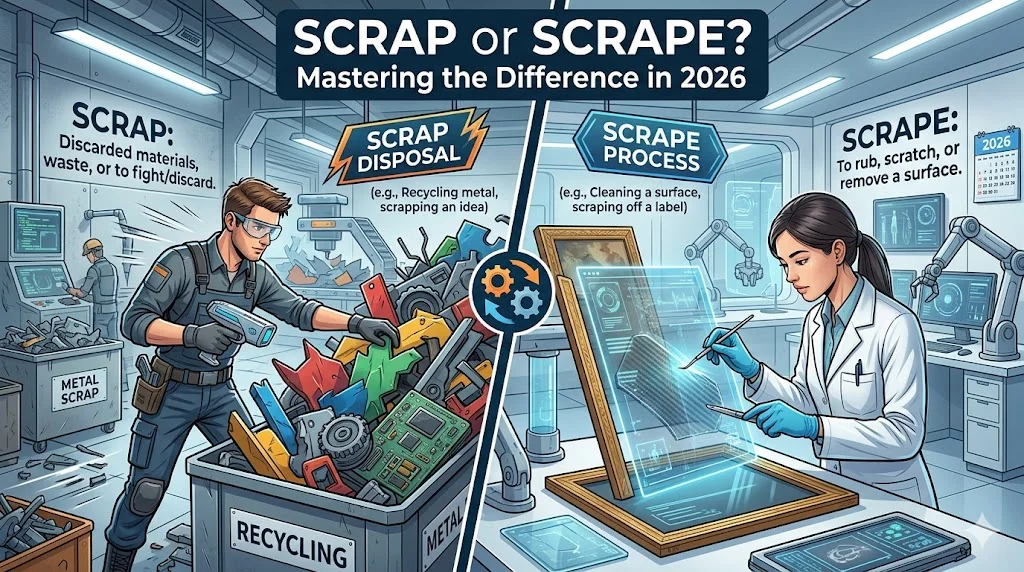
Understanding the difference between “scrap” and “scrape” may seem trivial, but it is surprisingly important in both everyday communication and professional writing. Many people confuse these two words because they sound similar, yet their meanings are very different. Using the wrong word can create misunderstandings or make writing appear careless. In this guide, you will learn the precise definitions of “scrap” and “scrape,” see clear examples of each in action, explore their historical origins, understand common mistakes, and gain practical tips to use them confidently. By the end, you will know exactly when to use each word and how to avoid confusion, whether you’re writing a casual message, a technical report, or social media post. This article also includes real-world case studies, memory aids, and self-assessment exercises to ensure you fully grasp the distinction.
Core Definitions: Scrap vs Scrape
“Scrap” generally means to discard, dispose of, or sell something for parts, while “scrape” refers to physically scratching, rubbing, or removing a surface layer. Understanding this distinction helps you use each word correctly in conversation and writing.
What Does “Scrap” Mean?
“Scrap” can be a verb or noun. As a verb, it means to discard or remove something that is no longer useful. As a noun, it refers to leftover pieces or materials.
Examples:
- The factory decided to scrap the old machines.
- I collected metal scraps for recycling.
- We had to scrap the plan due to budget cuts.
What Does “Scrape” Mean?
“Scrape” is usually a verb referring to removing material by rubbing or scratching, often causing minor damage. It is also used figuratively in idioms.
Examples:
- She accidentally scraped her knee on the sidewalk.
- I had to scrape the ice off my car windshield.
- He barely scraped by on his final exam.
Quick Comparison Table
| Word | Part of Speech | Meaning | Example Sentence |
| Scrap | Noun/Verb | Discard, remove, recycle | The old car was scrapped for parts. |
| Scrape | Verb | Scratch, rub off, minor damage | I scraped the paint off the wall. |
Linguistic Roots: Etymology and Evolution
Understanding the origins of these words can enhance your knowledge and authority in language use.
The Origin of “Scrap”
“Scrap” comes from Middle English, originally referring to small pieces of waste or fragments. Over time, it evolved to include the act of discarding unwanted items.
The Origin of “Scrape”
“Scrape” traces back to Old English “scrapan,” meaning to scratch or tear. Its meaning has remained largely physical but extended to figurative uses, like “scrape by.”
Visualizing the Actions: What Do They Represent?
Scrap represents disposal or rejection, often final. Scrape represents physical contact, friction, or minor damage. Imagining a rusty car being scrapped versus a spoon scraping a pan can help cement the difference.
Common Misconceptions and Real-World Mistakes
Many confuse these words due to similar sounds. Autocorrect or hasty typing can change “scrap” to “scrape” and vice versa. Using “scrape” for recycling or “scrap” for minor scratches is incorrect.
Examples:
- Wrong: I scraped my old laptop.
- Correct: I scrapped my old laptop.
- Wrong: He scrapped his knee on the pavement.
- Correct: He scraped his knee on the pavement.
Real-World Applications: When and How to Use Each Word
Scrap in Context
Used in industry, planning, or recycling.
- The company decided to scrap outdated policies.
- We scrapped the broken furniture for metal.
Scrape in Context
Used for physical contact, minor damage, or figurative expressions.
- He scraped the wall while moving the table.
- She scraped through her exams by studying hard.
Case Studies: How They Differ in Action
Case Study 1: Construction & Industry Example
Scrap: Old steel beams are scrapped for recycling.
Scrape: A worker scraped paint off metal before welding.
Case Study 2: Everyday Life Example
Scrap: Discarding a broken toaster.
Scrape: Scraping toast crumbs off the counter.
The Role of Technology: Autocorrect and AI Grammar Tools
Why These Mistakes Happen
Homophones, autocorrect, and context misunderstanding often lead to errors. For example, “scrap” might auto-change to “scrape” in text messages.
How to Prevent These Errors
Proofread carefully, use context-aware AI tools, and remember simple mnemonics: scrap = discard; scrape = scratch.
Practical Tips to Remember the Difference
- Scrap: Think “discard” or “throw away.”
- Scrape: Think “scratch” or “rub.”
- Visual cue: Scrapping a car vs scraping ice from a windshield.
Self-Assessment Section
- Choose the correct word: I had to ___ my old bike. (scrap/scrape)
- Fill in: She ___ the frost off her car this morning.
- Multiple choice: Which word refers to minor damage?
Final Thoughts
Understanding the difference between “scrap” and “scrape” is crucial for clear communication. “Scrap” involves discarding or recycling items, while “scrape” involves scratching, rubbing, or minor damage. By learning their definitions, origins, and common uses, you can avoid mistakes in both casual and professional contexts. Real-life examples, case studies, and practical tips reinforce the distinction, making your writing accurate and confident. Whether talking about recycling materials, minor accidents, or figurative situations, keeping these words separate ensures clarity. Using memory aids, visualizations, and contextual examples strengthens retention. Autocorrect and AI tools can help, but understanding the difference yourself is the best way to communicate precisely. By practicing with self-assessment exercises and paying attention to common errors, you can confidently choose “scrap” when discarding and “scrape” when dealing with scratches or surface actions. Clear knowledge of these terms not only improves language skills but also enhances credibility and professionalism in writing. With this guide, you will never confuse these two words again.
FAQs
What does “scrap” mean as a verb?
“Scrap” as a verb means to discard, remove, or get rid of something no longer needed or useful, such as old machinery or plans.
What does “scrape” mean in daily usage?
“Scrape” usually refers to scratching, rubbing, or removing something physically, like ice from a car or minor skin injuries.
Can “scrap” and “scrape” be used interchangeably?
No, “scrap” and “scrape” have distinct meanings. Using one in place of the other is incorrect.
How can I avoid confusing “scrap” with “scrape”?
Remember that scrap = discard and scrape = scratch. Using memory aids, visual cues, and examples helps.
What are common mistakes with “scrap” and “scrape”?
Mistakes include writing “scrape” when meaning to discard or using “scrap” for minor scratches. Autocorrect often contributes to errors.
Is “scrape” used figuratively in expressions?
Yes, such as “scrape by,” meaning to barely succeed or survive a situation.
Can “scrap” be both noun and verb?
Yes, it can refer to leftover materials as a noun or the act of discarding as a verb.
How do autocorrect tools affect scrap/scrape mistakes?
Autocorrect may replace the intended word based on frequency or context, leading to accidental misuse.
What are easy memory tips to remember the difference?
Scrap = discard or recycle; scrape = scratch or rub. Visualizing actions helps reinforce this.
Are there regional differences in using scrap or scrape?
Minor differences may exist in usage frequency, but meanings remain consistent across English-speaking regions.
Can I use “scrap” in informal conversation?
Yes, phrases like “scrap that idea” are commonly used in casual speech.
Is “scrape” only physical or can it be metaphorical?
It can be metaphorical, such as “scraping by” in exams or finances.
Can “scrap” refer to food or materials?
Yes, leftover food pieces or metal fragments can be called scraps.
Does “scrape” imply damage?
Usually minor damage or surface friction, but context determines severity.
Are there idioms using “scrap”?
Yes, “scrap a plan” or “scrap metal” are common idiomatic expressions.
How is “scrape” used in technology contexts?
In computing, “scrape” can mean extracting data from websites.
Can “scrap” be used in legal documents?
Yes, legal contexts may use “scrap” for cancelling contracts or plans.
How do I teach the difference to students?
Use clear examples, real-life scenarios, and interactive exercises to reinforce understanding.
Is pronunciation important for distinction?
Yes, “scrap” (/skræp/) vs “scrape” (/skreɪp/) helps listeners distinguish the meaning.
Are there professional fields where these words are frequently used?
Yes, manufacturing, construction, and recycling often use “scrap,” while “scrape” appears in everyday and safety contexts.

Sophia Turner is a grammar-focused writer who covers similes, word-versus-word meanings, and correct English usage. Her content is designed for learners who want quick answers, logical explanations, and practical guidance for improving writing accuracy and style.

1 thought on “Scrap or Scrape? Mastering the Difference in 2026”