
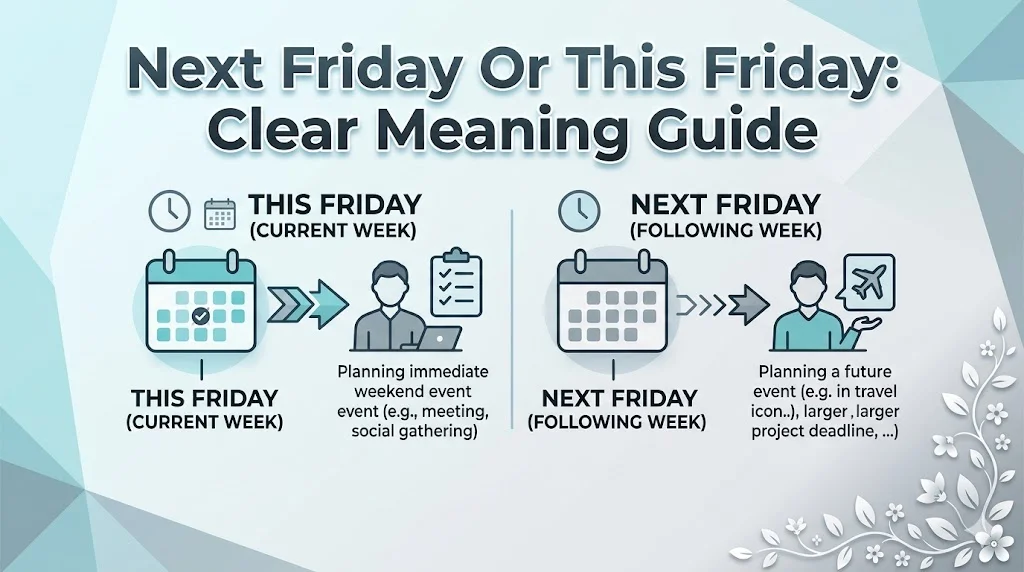
“This Friday” usually refers to the Friday of the current week, while “next Friday” refers to the Friday of the following week. These simple phrases cause confusion because weekly references can vary depending on context, region, or speaker habits. Use “this” for the current week and “next” for the upcoming week to clarify meaning. Examples help beginners quickly grasp the difference.
Understanding the Core Difference Between “Next Friday” and “This Friday”
“This Friday” points to the closest Friday in the current week, while “next Friday” refers to the Friday after that. Context matters, especially if today is Thursday or Friday itself. Misinterpretation is common when people assume everyone shares the same understanding of week boundaries.
Quick Comparison Table: Next Friday vs This Friday
| Phrase | Meaning | Time Reference | Example Sentence |
| This Friday | Friday of the current week | Current week | “We’ll meet this Friday at 3 PM.” |
| Next Friday | Friday of the following week | Following week | “The deadline is next Friday.” |
The Root of the Confusion
People often misunderstand these phrases because English weekly references are flexible. Some speakers count the current day as part of “next week,” while others strictly follow calendar weeks. Informal conversations amplify the ambiguity. Understanding the source of confusion helps prevent scheduling errors and improves clarity in communication.
Grammar and Linguistic Insight
“This” and “next” are demonstrative determiners that indicate timing relative to the speaker’s perspective. “This” points to the current timeframe, while “next” refers to the subsequent occurrence. Recognizing these linguistic cues helps English learners and native speakers correctly interpret temporal references.
Expert Perspective on Time Expressions
Linguists emphasize that context drives interpretation. Experts recommend always specifying the exact date when possible to avoid misunderstandings. Professional communication and event planning often rely on clear temporal markers rather than assuming mutual understanding of phrases like “next Friday.”
“This Friday” Explained Clearly
“This Friday” generally refers to the Friday of the same week as the current day. It’s widely used for casual plans and workplace reminders. Confusion arises if the conversation happens late in the week, near Friday or over the weekend, because the listener might interpret the phrase as the following week’s Friday.
Example Dialogues
Friend: “Are we meeting this Friday?”
You: “Yes, I’ll see you on the 17th.”
Workplace: “Please submit your report this Friday.”
Colleague: “Got it, that’s the 17th, right?”
“Next Friday” – What It Really Means
“Next Friday” typically refers to the Friday after the current week. It’s used when planning ahead, scheduling appointments, or setting deadlines beyond the immediate week. This forward-looking phrasing reduces ambiguity when clearly paired with calendar dates.
Example Sentences
“The project review is next Friday, not this Friday.”
“Let’s schedule our team call for next Friday morning.”
Pro Tip
Always clarify by adding the date: “this Friday, the 17th” or “next Friday, the 24th.” This removes all potential confusion.
Real-World Scenarios
Scenario 1: It’s Monday – “This Friday” refers to the Friday in 4 days, “Next Friday” to the one after.
Scenario 2: It’s Thursday – “This Friday” tomorrow, “Next Friday” seven days later.
Scenario 3: It’s Already Friday – Context matters; “this Friday” may mean today or the next week depending on the speaker.
Regional and Cultural Differences
American English often treats “next Friday” as the following week’s Friday, while British English sometimes uses it interchangeably. Being aware of these variations helps avoid miscommunication in international settings.
Quick Tip
Specify the date or say “this coming Friday” for clarity, especially in cross-cultural communication.
How to Communicate Clearly
Use precise dates whenever possible. Adding phrases like “this coming Friday” or “Friday next week” minimizes confusion. Written reminders, calendar invites, and confirmation messages ensure everyone interprets the schedule correctly.
Clear Communication Tips
- Confirm the exact date verbally or in writing
- Avoid assuming shared understanding
- Use calendar references in professional settings
Common Alternative Phrases
- This coming Friday
- Friday next week
- The Friday after this one
Common Mistakes People Make
Assuming listeners interpret “this Friday” or “next Friday” the same way.
Not clarifying week references.
Mixing casual and professional contexts without precision.
Visual Aids
A weekly timeline helps visualize the difference between “this Friday” and “next Friday,” making abstract concepts tangible.
Weekly Timeline Example
| Day | Phrase Used | Meaning |
| Monday | This Friday | Friday of the current week |
| Monday | Next Friday | Friday of the following week |
Common Misunderstanding: The “Weekend Shift”
Near the weekend, “this Friday” may be interpreted as the following week by some speakers. Being aware of the “weekend shift” prevents misinterpretation when scheduling events.
Real-Life Case Study
A team scheduled a meeting for “next Friday” without specifying the date. Half the team assumed the current week, half the following week. The confusion delayed the meeting. Specifying the exact date resolved the problem and emphasized the importance of clear time communication.
Self Assessment
- If today is Tuesday, which Friday does “this Friday” refer to?
- If today is Thursday, which Friday does “next Friday” refer to?
- Which phrase is safer to use with an exact calendar date?
Answers:
- Friday of the current week
- Friday of the following week
- Either phrase clarified with the date
Final Thoughts
Understanding the difference between “this Friday” and “next Friday” is crucial for effective communication. “This Friday” points to the current week’s Friday, while “next Friday” indicates the following week’s Friday. Context, cultural interpretation, and proximity to the weekend can affect understanding. To avoid confusion, always clarify with exact dates or additional phrases like “this coming Friday” or “Friday next week.” Clear communication reduces scheduling errors, ensures everyone is on the same page, and maintains professionalism in both casual and work settings. By mastering these temporal expressions, you can confidently plan events, communicate deadlines, and navigate English date references without ambiguity. Remember, clarity is always better than assumption, and adding a simple date prevents misunderstandings and builds trust in communication.
FAQs
What does “this Friday” mean?
“This Friday” refers to the Friday of the current week, typically the closest Friday to the present day.
What does “next Friday” mean?
“Next Friday” refers to the Friday of the following week, not the current week.
Does “this Friday” include today if it’s Friday?
Depending on context, “this Friday” may refer to today or the upcoming Friday, so clarification is recommended.
How can I avoid confusion between “next Friday” and “this Friday”?
Specify the exact date or use phrases like “this coming Friday” or “Friday next week” to remove ambiguity.
Do regional differences affect the meaning?
Yes. American English usually treats “next Friday” as the following week, while British English may use it more flexibly.
Is “this coming Friday” clearer than “next Friday”?
Yes. It specifies the immediate upcoming Friday, reducing misinterpretation.
Why do people misunderstand these phrases?
Ambiguous weekly references, informal speech, and assumptions about shared understanding lead to confusion.
Should I use exact dates instead of phrases?
Using exact dates is the safest way to avoid ambiguity and ensure everyone interprets timing correctly.
Is “next Friday” always the following week?
Typically yes, but context and regional habits can shift interpretation, so clarification is advised.
What is the safest way to schedule events using these phrases?
Always pair phrases with the calendar date, confirming in writing if possible.
If today is Thursday, which Friday is “this Friday”?
“This Friday” is tomorrow, the closest Friday in the current week.
If today is Thursday, which Friday is “next Friday”?
“Next Friday” is the Friday of the following week.
Can “next Friday” ever mean the same as “this Friday”?
In informal speech, some may use it interchangeably, but this often causes confusion.
Why is it important to clarify Friday references?
Misunderstandings can disrupt meetings, deadlines, and personal plans, so clarity prevents errors.
How do workplace teams handle this confusion?
Teams often include exact dates in emails or calendar invites to ensure clarity.
Does “this Friday” change meaning over the weekend?
Yes, after Friday, some interpret it as the following week’s Friday.
How can international teams avoid confusion?
Use explicit dates and phrases like “Friday the 17th” for cross-cultural clarity.
Are there software tools to help clarify dates?
Calendar apps and scheduling tools automatically display exact dates, minimizing ambiguity.
Can text messages cause more confusion?
Yes, without context, phrases like “next Friday” can be misinterpreted, so add the date.
Is it necessary to explain “this Friday” in casual conversation?
It’s recommended when clarity is important, especially for planning events or meetings.

Sophia Turner is a grammar-focused writer who covers similes, word-versus-word meanings, and correct English usage. Her content is designed for learners who want quick answers, logical explanations, and practical guidance for improving writing accuracy and style.