
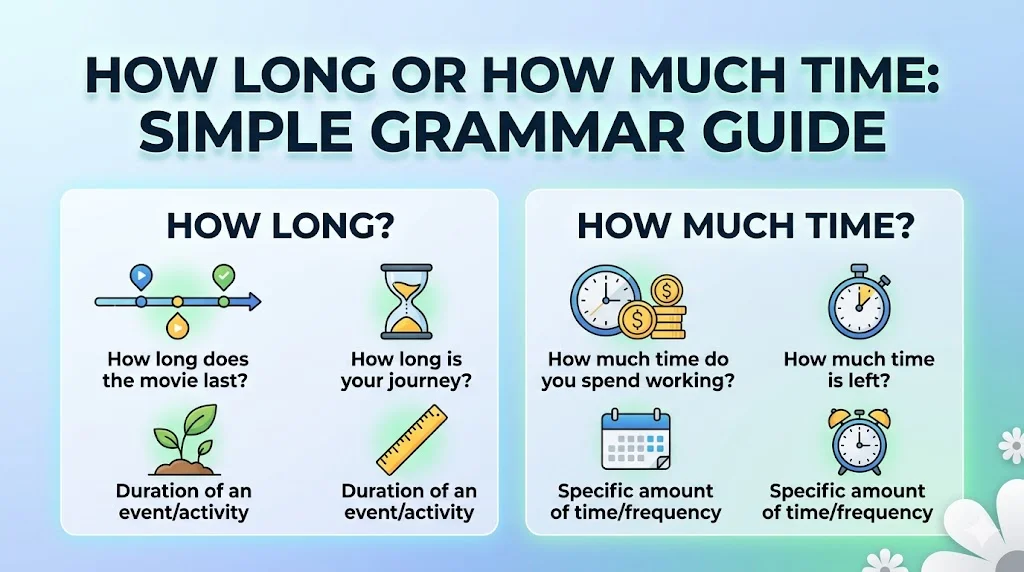
“How long” asks about the duration of an action or event, focusing on how much time something lasts. “How much time” emphasizes the amount of time available or required for a task. Both are used to talk about time, but one highlights duration, while the other highlights measurable quantity.
Example:
- How long did the movie last?
- How much time do we have to finish the project?
Understanding Duration in English
In English, duration questions ask how long something continues. Learners often confuse these forms because both involve time, but one is more natural for casual conversation while the other is precise for planning.
Example:
- How long have you lived here?
- How much time is needed to bake the cake?
Example
- How long will the train journey take?
- How much time do I have before the meeting?
- How long did she study for the exam?
- How much time is left to complete the homework?
“How Long” — Meaning, Usage & Structure
“How long” focuses on the length of an action or experience. It is used with verbs and common activities in everyday conversation.
What “How Long” Really Means
It asks about the duration of an event or activity.
Example: How long did you wait at the bus stop?
Common Grammatical Structures
- How long + auxiliary verb: How long has he been working?
- How long + present perfect: How long have they lived here?
- How long + future: How long will the flight last?
Typical Usage Scenarios
- Travel: How long is the journey to Paris?
- Activities: How long does it take to cook pasta?
- Experiences: How long have you been learning English?
Common Mistakes with “How Long”
- Using the wrong tense: How long you lived here?
- Confusing with “how much time”: How much time did you live here?
Cultural and Conversational Nuance
- Informal: How long have you been waiting?
- Polite/Formal: Could you tell me how long the meeting will last?
“How Much Time” — Meaning, Usage & Structure
“How much time” emphasizes the measurable quantity of time available or needed.
What “How Much Time” Conveys
Focuses on planning or estimating time.
Example: How much time do we have to finish the assignment?
Grammatical Construction
- How much time + do/does: How much time do we have left?
- How much time + is needed: How much time is needed for the experiment?
Common Uses in Context
- Work planning: How much time is required to complete the report?
- Scheduling: How much time do we have before the meeting starts?
- Study tasks: How much time should I spend on revision?
Nuanced Use Cases
- Slightly more formal situations
- Emphasizing quantity rather than duration
Common Mistakes with “How Much Time”
- Using it for actions that have already occurred: How much time did the concert last? (better: How long did the concert last?)
- Overuse in casual conversation
Comparing “How Long” vs “How Much Time”
Side-by-Side Comparison Table
| Feature | How Long | How Much Time |
| Meaning | Duration of an activity | Quantity of time needed |
| Typical context | Trips, activities | Planning tasks |
| Grammar pattern | How long + verb | How much time + noun phrase |
| Tone | Natural conversational | Slightly formal |
| Example | How long did the meeting last? | How much time do we have? |
Subtle Differences in Meaning
“How long” emphasizes duration, often conversational. “How much time” emphasizes measurable quantity and is slightly more formal.
Example:
- How long did you run? (duration)
- How much time do I have to run? (available time)
Visual Context
Use timelines or scenarios:
- How long → duration from start to end
- How much time → amount of time allocated
Linguistic Insight: Why English Uses Both Forms
English distinguishes duration and measurable quantity using different question forms. “How long” asks about length of experience; “how much time” asks about quantity for planning or measurement.
Expert Opinion: Grammar and Usage Advice
- Use “how long” for conversational, daily interactions
- Use “how much time” for planning, formal, or professional contexts
Practical Applications in Daily Life
In Casual Conversations
- How long will it take to get to the store?
- How long have you been waiting for the bus?
In Professional Settings
- How much time do we have to finish the report?
- How long will the presentation last?
In Academic Environments
- How long does the lecture run?
- How much time is needed for the assignment?
Real-Life Examples & Exercises
Practice Sentences
- How long did you study yesterday?
- How much time do we have to complete the project?
Rewriting Exercise
- Convert: How much time will it take? → How long will it take?
From Real Life
- Travel: How long is the flight?
- Work: How much time do I have to finish this task?
- School: How long will the exam last?
Quick Reference Tables
Verb Pairing Table
| Verb | Natural Phrase | Example |
| take | how long | How long does it take? |
| have | how much time | How much time do we have? |
| last | how long | How long will the show last? |
| need | how much time | How much time do you need? |
Common Collocations
| Phrase | Typical Collocation |
| How long | how long does it take |
| How long | how long have you lived |
| How much time | how much time do we have |
| How much time | how much time is required |
Self-Assessment Quiz
- How long ___ you been waiting?
- How much time ___ we have for the test?
- Convert: How long will the meeting last? → How much time do we have?
- Identify the error: How long you lived here?
- Choose the correct: How much time/How long did it take to cook dinner?
Answers to Self-Assessment
- have
- do
- How much time do we have for the meeting?
- Correct form: How long did you live here?
- How long did it take to cook dinner?
Summary & Key Takeaways
- “How long” → duration, natural in conversation
- “How much time” → quantity, formal or planning context
- Pay attention to tense and context
- Use examples to internalize differences
Final Thoughts
Understanding “how long” and “how much time” is essential for clear communication in English. While both phrases deal with time, the key difference is that “how long” focuses on the duration of an activity or experience, whereas “how much time” emphasizes the quantity of time available or required. Using these correctly makes your speech sound natural and precise. In casual conversations, “how long” is usually preferred, while in professional or academic contexts, “how much time” often fits better. Practice by observing real-life situations: notice how native speakers ask questions about time in travel, work, or classroom settings. Creating sentences with both forms will strengthen your understanding and help you avoid common mistakes. Always consider the context, tense, and tone when choosing between the two. With consistent practice, you’ll confidently know which phrase to use, improving both comprehension and expression in English. Remember, mastering this small detail can make a big difference in clarity and fluency, giving you confidence in asking about time in any situation.
FAQs
What is the difference between “how long” and “how much time”?
“How long” asks about the duration of an activity, while “how much time” asks about the quantity of time available or needed.
Can “how long” and “how much time” be used interchangeably?
Sometimes, but usually only in casual contexts. “How long” is for duration, and “how much time” for measurable amounts.
Is “how long” used only for time?
No, it can also refer to distance, length, or extent in some contexts.
Which phrase sounds more formal?
“How much time” often sounds slightly more formal and suitable for planning or professional contexts.
When should learners avoid using “how much time”?
Avoid using it for actions that have already occurred; “how long” is more natural.
Do native speakers prefer “how long”?
Yes, in casual conversations, “how long” is far more common.
Can “how much time” appear in academic writing?
Yes, especially when quantifying time needed or available for tasks or experiments.
How do I practice using these phrases?
Create example sentences, observe native speakers, and rewrite questions using both phrases.
What tense usually follows “how long”?
Present perfect, past, or future tense, depending on context.
What is the easiest rule to remember?
Duration → “how long”; Quantity → “how much time.”
How long is used for ongoing actions?
Yes, for actions continuing into the present or repeated activities.
How much time is used for planning future tasks?
Correct, it emphasizes the time required to complete something.
Can I ask “how long” for a meeting?
Yes, to inquire about its duration.
Can I ask “how much time” for a meeting?
Yes, to ask about the total time allocated for the meeting.
Is “how long” suitable for informal emails?
Yes, very natural in casual writing.
Is “how much time” suitable for formal emails?
Yes, appropriate for official requests or scheduling.
How to correct “How long you lived here?”
Change to: “How long did you live here?”
Which phrase is better for exams?
“How long” for duration of study or exams; “how much time” for allocation questions.
Can both phrases be used in the same sentence?
Yes, e.g., “How long will it take, and how much time do we have?”
How to remember the difference easily?
Think: “long” = duration, “much time” = quantity.
How to make learning fun?
Practice with real-life scenarios, quizzes, and dialogues.

Sophia Turner is a grammar-focused writer who covers similes, word-versus-word meanings, and correct English usage. Her content is designed for learners who want quick answers, logical explanations, and practical guidance for improving writing accuracy and style.