
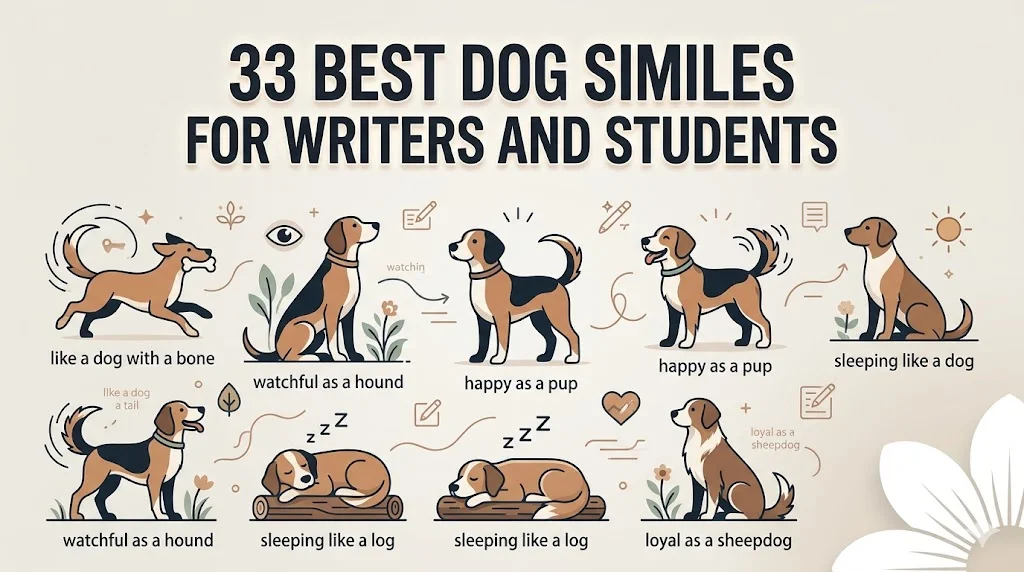
Dogs are more than just pets—they’re symbols of loyalty, energy, and emotion. Using dog similes in writing can help convey these qualities vividly. For writers and students, similes are a powerful tool to make descriptions clear and relatable. This guide explores 33 dog similes, their meanings, examples, and tips for using them effectively in your writing. By the end, you’ll know how to incorporate dog comparisons to create stronger imagery and connect with readers.
What is a Simile?
A simile is a figure of speech that compares two different things using the words “like” or “as.” It helps writers explain feelings, actions, or qualities in a way that’s easy to visualize. Unlike a metaphor, which implies the comparison directly, similes make the link explicit. Common examples include “as brave as a lion” or “hungry like a wolf.”
33 Dog Similes with Meanings and Examples
As loyal as a dog
Meaning: Extreme loyalty and faithfulness
Explanation: Highlights someone’s unwavering trust or devotion.
Examples:
- She stayed as loyal as a dog, even through hard times.
- His friendship was as loyal as a dog’s.
Hungry like a stray dog
Meaning: Intense hunger or desperation
Explanation: Emphasizes strong craving or need.
Examples:
- After the marathon, he was hungry like a stray dog.
- The abandoned puppy looked hungry like a stray dog.
As playful as a puppy
Meaning: Energetic, joyful, innocent behavior
Explanation: Shows excitement or lightheartedness.
Examples:
- The children were as playful as puppies in the park.
- She felt as playful as a puppy when meeting new friends.
Barking like a mad dog
Meaning: Loud, uncontrollable noise or anger
Explanation: Describes extreme vocal expression or agitation.
Examples:
- The neighbors were barking like mad dogs at the argument.
- His frustration was evident, barking like a mad dog.
As tired as a dog
Meaning: Complete exhaustion
Explanation: Conveys fatigue after hard work or activity.
Examples:
- After the hike, she was as tired as a dog.
- The dog looked as tired as its owner after the run.
Growling like a watchdog
Meaning: Protective or warning behavior
Explanation: Signals alertness or guarding instincts.
Examples:
- He was growling like a watchdog when strangers approached.
- The cat hissed, growling like a watchdog defending its territory.
As loyal as a hound
Meaning: Deep devotion
Explanation: Similar to other loyalty similes, often used for pets or friends.
Examples:
- The servant was as loyal as a hound to the king.
- She remained as loyal as a hound to her childhood friend.
Running like a greyhound
Meaning: Very fast running
Explanation: Emphasizes speed or agility.
Examples:
- He was running like a greyhound to catch the bus.
- The athlete sprinted like a greyhound on the track.
As dirty as a street dog
Meaning: Messy or unclean
Explanation: Used literally for filth or metaphorically for disheveled appearance.
Examples:
- After the mud fight, they were as dirty as street dogs.
- His clothes were as dirty as a street dog’s after the hike.
Barking like a guard dog
Meaning: Warning or alerting behavior
Explanation: Refers to someone being vigilant or outspoken.
Examples:
- The teacher was barking like a guard dog when rules were broken.
- She was barking like a guard dog to protect her younger siblings.
As restless as a dog chasing its tail
Meaning: Unable to stay still or focus
Explanation: Shows agitation, nervousness, or impatience.
Examples:
- He was as restless as a dog chasing its tail before the exam.
- The puppy was as restless as a dog chasing its tail in the yard.
Shivering like a wet dog
Meaning: Cold, scared, or uncomfortable
Explanation: Visualizes trembling due to fear or coldness.
Examples:
- He shivered like a wet dog in the winter wind.
- The kitten was shivering like a wet dog after the rain.
As watchful as a sheepdog
Meaning: Very alert and protective
Explanation: Often used for caretakers or guardians.
Examples:
- She was as watchful as a sheepdog during the night shift.
- The soldier remained as watchful as a sheepdog on duty.
Howling like a lonely dog
Meaning: Expressing sadness or longing
Explanation: Describes emotional outcry or isolation.
Examples:
- He was howling like a lonely dog after losing his best friend.
- The wolf howled, howling like a lonely dog under the moon.
As brave as a police dog
Meaning: Courageous and fearless
Explanation: Highlights bravery in challenging situations.
Examples:
- The firefighter was as brave as a police dog entering the building.
- She faced the crowd as brave as a police dog.
Panting like a dog in summer
Meaning: Overheated or exhausted
Explanation: Shows physical strain or heat discomfort.
Examples:
- He was panting like a dog in summer after the jog.
- The dog was panting like a dog in summer on the hot sidewalk.
As happy as a dog with a bone
Meaning: Pure joy or contentment
Explanation: Shows satisfaction or excitement.
Examples:
- She was as happy as a dog with a bone when her project succeeded.
- The child grinned as happy as a dog with a bone on Christmas morning.
Whining like a hungry puppy
Meaning: Complaining or expressing need
Explanation: Describes impatience or desire.
Examples:
- The toddler was whining like a hungry puppy for candy.
- He was whining like a hungry puppy until his request was granted.
As protective as a mother dog
Meaning: Guarding and nurturing behavior
Explanation: Shows care or defense of loved ones.
Examples:
- She was as protective as a mother dog toward her younger siblings.
- The mother was as protective as a mother dog over her child.
Digging like a terrier
Meaning: Persistent effort or curiosity
Explanation: Shows active, determined behavior.
Examples:
- He was digging like a terrier to find the truth.
- The dog dug like a terrier through the garden soil.
As noisy as a pack of dogs
Meaning: Very loud and disruptive
Explanation: Indicates chaos or multiple voices.
Examples:
- The classroom was as noisy as a pack of dogs after recess.
- The market was as noisy as a pack of dogs at midday.
Sniffing like a curious dog
Meaning: Investigative or inquisitive behavior
Explanation: Shows interest or attention to detail.
Examples:
- She was sniffing like a curious dog at the antique shop.
- The puppy sniffed like a curious dog exploring the yard.
As stubborn as a bulldog
Meaning: Very determined, unwilling to change
Explanation: Highlights persistence or obstinacy.
Examples:
- He was as stubborn as a bulldog refusing to apologize.
- The toddler was as stubborn as a bulldog about bedtime.
Sleeping like a tired dog
Meaning: Deep sleep due to exhaustion
Explanation: Shows complete rest.
Examples:
- After the hike, she was sleeping like a tired dog.
- The puppy slept like a tired dog all afternoon.
As faithful as man’s best friend
Meaning: Loyal and dependable
Explanation: Emphasizes trustworthiness and commitment.
Examples:
- He remained as faithful as man’s best friend during hard times.
- The dog is as faithful as man’s best friend to its owner.
Yapping like a small dog
Meaning: Constant, irritating noise
Explanation: Shows annoyance or trivial complaints.
Examples:
- The neighbors were yapping like small dogs all evening.
- She kept yapping like a small dog about the smallest details.
As eager as a hunting dog
Meaning: Excited and ready to act
Explanation: Shows enthusiasm and readiness.
Examples:
- He was as eager as a hunting dog on the first day of school.
- The puppy was as eager as a hunting dog at the park.
Limping like an old dog
Meaning: Slow or weakened movement
Explanation: Indicates fatigue, injury, or aging.
Examples:
- He walked limping like an old dog after the long trip.
- The old dog was limping like an old dog around the yard.
As friendly as a golden retriever
Meaning: Warm, approachable, kind
Explanation: Highlights sociable and welcoming nature.
Examples:
- She was as friendly as a golden retriever to everyone in class.
- The new neighbor was as friendly as a golden retriever.
Chained like a yard dog
Meaning: Restricted or constrained
Explanation: Shows lack of freedom or being trapped.
Examples:
- He felt chained like a yard dog by his responsibilities.
- The dog remained chained like a yard dog in the backyard.
As devoted as a guide dog
Meaning: Reliable and dedicated
Explanation: Emphasizes commitment and helpfulness.
Examples:
- She was as devoted as a guide dog to her volunteer work.
- The dog remained as devoted as a guide dog to its blind owner.
Growling like a cornered dog
Meaning: Defensive and threatened
Explanation: Shows warning, fear, or aggression.
Examples:
- He responded growling like a cornered dog to criticism.
- The animal was growling like a cornered dog when approached.
As patient as a sleeping dog
Meaning: Calm and unbothered
Explanation: Emphasizes composure and tolerance.
Examples:
- She waited as patient as a sleeping dog for the exam results.
- He was as patient as a sleeping dog while teaching the children.
Dog Similes Comparison Table
| Simile | Meaning | Tone | Best Use Case |
| As loyal as a dog | Strong loyalty | Positive | Relationships |
| Hungry like a stray dog | Extreme hunger | Negative | Survival scenes |
| As playful as a puppy | Energetic joy | Positive | Children writing |
| Barking like a mad dog | Anger or chaos | Negative | Emotional expression |
| As brave as a police dog | Courage | Positive | Heroic actions |
Linguistic Insight: Why Dog Similes Work
Dog similes are effective because dogs are universally familiar and carry strong emotional associations. They instantly evoke traits like loyalty, energy, or protectiveness. Writers leverage these associations to create vivid, relatable imagery. Using dogs in similes also taps into cultural symbolism, making descriptions more engaging and easier for readers to understand.
Expert Writing Tips for Using Dog Similes
- Match the simile to the context for clarity.
- Avoid overused clichés; be creative with comparisons.
- Use dog similes to add emotion, but balance with other descriptive tools.
- Combine with action or setting for richer imagery.
Common Mistakes When Using Dog Similes
- Overusing the same simile repeatedly.
- Using a simile that doesn’t fit the tone of writing.
- Mixing similes with unrelated metaphors, creating confusion.
- Ignoring audience understanding—ensure cultural relevance.
How to Use Dog Similes in Your Writing Like a Pro
- Introduce similes naturally within sentences.
- Match emotional tone: loyal, playful, protective, or angry.
- Use similes to simplify complex ideas.
- Test the simile’s clarity by reading aloud.
Self-Assessment Quiz
- Choose the correct simile for extreme loyalty.
- Identify which simile expresses exhaustion.
- Fill in the blank: She was ______ as a puppy.
- Match the simile with its meaning in a table format.
- Explain why “barking like a guard dog” fits a warning scenario.
Answers to Self-Assessment
- As loyal as a dog – shows faithfulness.
- As tired as a dog – conveys exhaustion.
- As playful as a puppy – conveys joy.
- See table above for correct matches.
- It signals alertness and caution toward others.
Conclusion About Best Dog Similes For Writers And Students
Dog similes are essential tools for writers and students looking to make their writing vivid and relatable. By comparing human qualities to familiar dog behaviors, similes enhance imagery and emotional resonance. Whether conveying loyalty, excitement, or patience, each simile helps readers visualize situations clearly. For students, dog similes simplify abstract ideas, making writing more engaging. Writers can avoid clichés and overuse by carefully matching tone and context. With practice, these comparisons become a creative asset, turning ordinary descriptions into memorable expressions. Incorporating dog similes strengthens storytelling, essay writing, and everyday communication by adding clarity, depth, and personality. Start observing dog behaviors around you, and you’ll discover endless inspiration for expressive, reader-friendly writing.
Frequently Asked Questions
What is a dog simile?
A dog simile is a comparison using “like” or “as” to describe a person, action, or emotion by relating it to a dog’s behavior or trait.
Why are dogs often used in similes?
Dogs are familiar animals with clear, relatable traits like loyalty and playfulness, making comparisons easy to understand.
Can I use dog similes in formal writing?
Yes, in creative or descriptive sections, but use them sparingly in strictly academic or technical writing.
What’s the difference between a simile and a metaphor?
A simile uses “like” or “as” for comparison, while a metaphor implies the comparison directly without those words.
How do dog similes improve writing?
They create vivid imagery, convey emotions clearly, and make descriptions more relatable to readers.
Are dog similes suitable for students?
Yes, they help beginners practice figurative language and enhance descriptive writing skills.
Can dog similes be used professionally?
Yes, in blogs, storytelling, and marketing content where creativity and engagement are desired.
How can I create my own dog similes?
Observe dog behavior and match it to human situations using “like” or “as” for clear comparisons.
Do dog similes work in all cultures?
Mostly yes, but cultural views on dogs may slightly affect interpretation. Always consider your audience.
What are common mistakes with dog similes?
Overuse, mismatched tone, or mixing unrelated metaphors can confuse readers.
How do I choose the right dog simile?
Match the simile to the emotion, tone, and context of your writing.
Can dog similes be humorous?
Yes, playful or exaggerated comparisons often create humor effectively.
What emotions can dog similes convey?
Loyalty, joy, anger, exhaustion, curiosity, protectiveness, and patience.
Are dog similes only for creative writing?
No, they can enhance essays, speeches, and storytelling by adding vivid examples.
Can I combine dog similes with metaphors?
Yes, but ensure the comparison is clear and doesn’t confuse readers.
Should I avoid clichés in dog similes?
Yes, try fresh comparisons to maintain reader interest and originality.
How many dog similes are effective in one piece?
1–3 strong similes per paragraph usually suffice for clarity without overloading the text.
Can dog similes describe actions, not emotions?
Absolutely, they can describe speed, alertness, persistence, or other behaviors.
How do dog similes help readers visualize scenes?
By linking human experiences to familiar dog traits, readers can picture situations more clearly.
Are dog similes better than other animal similes?
Not necessarily, but dogs’ universal familiarity and emotional resonance make them particularly effective.

Ethan Clarke is a language writer who specializes in breaking down similes, word meanings, and commonly confused terms. His work focuses on clear explanations, practical examples, and simple comparisons that help readers understand how English
