
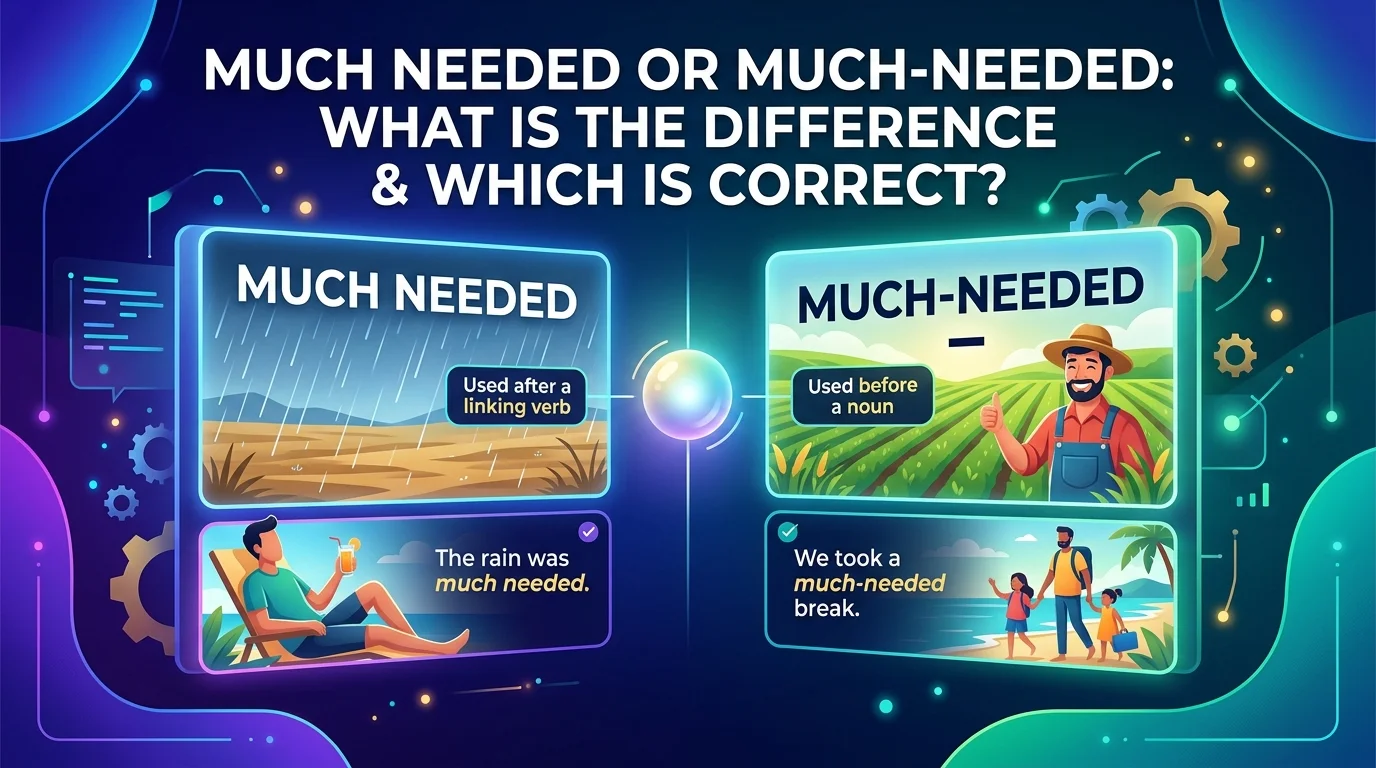
Understanding whether to write “much needed” or “much-needed” is important for clear and correct English writing. These two forms look similar, but they function differently in grammar. One is used after verbs, while the other is used before nouns. This comparison will help you understand the correct usage with simple explanations and examples.
Comparison Overview
“Much needed” and “much-needed” both express something that is greatly required or necessary. The difference lies in structure and placement in a sentence. “Much needed” is usually used after the verb, while “much-needed” is a hyphenated adjective used before a noun. Both are correct, but context decides which one to use.
Definition of Much Needed
“Much needed” is a phrase used to describe something that is very necessary, usually placed after a verb or used in a sentence without directly modifying a noun. It emphasizes importance or urgency in a general way.
Definition of Much-Needed
“Much-needed” is a hyphenated adjective used before a noun. It directly describes the noun and shows that something is highly required or essential.
Main Differences Between Much Needed and Much-Needed
The main difference is grammatical structure and placement.
“Much needed” is used when the phrase comes after a verb or stands alone in a sentence. It does not directly modify a noun.
“Much-needed” is used before a noun as a compound adjective and is always hyphenated to show that the words work together as one idea.
In short, one is descriptive in general usage, while the other is attributive and directly modifies a noun.
Comparison Table
| Feature | Much Needed | Much-Needed |
| Grammar role | Phrase | Compound adjective |
| Hyphen | No | Yes |
| Position in sentence | After verb or at end | Before noun |
| Function | General description | Direct modification |
| Example | This break is much needed | This is a much-needed break |
Grammar Guide
Understanding the grammar behind these forms helps you avoid mistakes and write naturally.
How each term is used in sentences
“Much needed” is often used after linking verbs like is, was, or seems.
Example: This rest is much needed.
“Much-needed” is used before a noun to describe it directly.
Example: This is a much-needed rest.
Common mistakes learners make
Many learners forget to use the hyphen when the phrase comes before a noun. Others incorrectly add a hyphen when the phrase comes after a verb.
Incorrect: This is a much needed break.
Correct: This is a much-needed break.
Incorrect: The break is much-needed.
Correct: The break is much needed.
Simple rules to remember
If the phrase comes before a noun, always use a hyphen.
If it comes after a verb, do not use a hyphen.
Quick tips for writing and speaking
Think of “much-needed” as a single describing word.
If you can replace it with another adjective like “important,” it should be hyphenated when placed before a noun.
When to Use Each One
Use “much needed” when describing something in a general statement after a verb.
Use “much-needed” when directly describing a noun such as break, help, support, or change.
When NOT to Use Each One
Do not use “much needed” before a noun.
Do not remove the hyphen when the phrase is acting as a single adjective before a noun.
Avoid mixing both forms in the same sentence incorrectly, as it creates grammatical inconsistency.
Which One to Use (Decision Guide)
If the phrase is placed before a noun, choose “much-needed.”
If it comes after a verb or stands alone, choose “much needed.”
A simple test is to check whether the phrase is directly describing a noun. If yes, use the hyphenated form.
Real-World Practical Examples
Much Needed Examples
- A break is much needed after the long meeting.
- Help is much needed in rural areas.
- This feedback is much needed for improvement.
- Silence is much needed in the library.
- A change is much needed in the system.
Much-Needed Examples
- This is a much-needed vacation for the team.
- She gave a much-needed explanation during the meeting.
- The city received much-needed rain.
- We implemented a much-needed update to the software.
- He took a much-needed rest after exams.
Self-Assessment (Fill in the Blanks)
- I need a ______ break after work.
- The solution was ______ in this situation.
- This is a ______ improvement in the system.
- Support is ______ for new students.
- They announced a ______ policy change.
- A rest is ______ after exercise.
- This is a ______ opportunity for growth.
- Help is ______ during emergencies.
- The team needs a ______ strategy.
- The advice was ______ for beginners.
- We took a ______ vacation last month.
- The system update was ______.
- A break is ______ after studying.
- The change is ______ in education.
- This is a ______ solution to the problem.
- Assistance is ______ in disaster zones.
- The upgrade was ______ for users.
- A pause is ______ in long discussions.
- This is a ______ decision by management.
- Relief is ______ after the storm.
Answers
- much-needed
- much needed
- much-needed
- much needed
- much-needed
- much needed
- much-needed
- much needed
- much-needed
- much needed
- much-needed
- much-needed
- much needed
- much-needed
- much-needed
- much needed
- much-needed
- much needed
- much-needed
- much needed
Final Verdict
Both “much needed” and “much-needed” are correct, but they are used in different grammatical positions. The hyphenated form is used before nouns to act as a single describing word, while the non-hyphenated form is used after verbs or in general statements. Understanding this simple rule helps you write more naturally and avoid common grammar mistakes in everyday English.
Conclusion About Much Needed or Much-Needed
Understanding the difference between “much needed” and “much-needed” makes a noticeable impact on your writing clarity and accuracy. While both forms express necessity or importance, their usage depends entirely on sentence structure. The hyphenated version works as a single descriptive adjective before a noun, while the non-hyphenated form is used after verbs or in general statements. Mastering this simple distinction helps you write more naturally, avoid common grammar mistakes, and improve overall readability. Whether you are writing essays, emails, or professional content, using the correct form ensures your message sounds polished, correct, and easy to understand for readers in any context.
FAQs
Is much needed and much-needed the same thing?
Both phrases carry the same meaning of something being highly necessary. The difference lies in grammar. “Much-needed” is used before nouns as a compound adjective, while “much needed” is used after verbs or in general statements. Understanding placement helps ensure correct usage in writing and communication.
When should I use much-needed in a sentence?
Use “much-needed” when it comes directly before a noun. It acts as a single descriptive adjective. For example, a much-needed break or a much-needed solution. The hyphen connects the words so they function together, improving clarity and grammatical correctness in formal and informal writing.
When is much needed correct to use?
“Much needed” is correct when it appears after a verb or in a general statement. For example, the help is much needed. In this case, it does not directly modify a noun but instead describes a situation or condition in a broader sense.
Why is much-needed written with a hyphen?
The hyphen shows that “much” and “needed” function together as one adjective. This helps avoid confusion and makes it clear that both words jointly describe the noun that follows. Without the hyphen before a noun, the sentence may look grammatically unclear or incorrect.
Can I use much needed before a noun?
No, you should not use “much needed” directly before a noun. In that position, you must use the hyphenated form “much-needed.” The hyphen ensures the phrase works as a single adjective, which is necessary for proper grammatical structure and clarity in writing.
Is much-needed formal or informal English?
“Much-needed” is suitable for both formal and informal English. It is commonly used in academic writing, professional communication, and everyday conversation. Its purpose is simply to describe something essential, making it a versatile phrase in many different writing contexts.
What is a simple rule to remember the difference?
A simple rule is: use a hyphen when the phrase comes before a noun and remove it when the phrase comes after a verb. This quick guideline helps you choose the correct form without overthinking grammar rules or sentence structure.
What are some common mistakes with much needed and much-needed?
A common mistake is forgetting the hyphen before a noun or adding it incorrectly after a verb. Another error is mixing both forms in one sentence. These mistakes can affect clarity, so understanding placement is important for correct usage.
Are both forms acceptable in English writing?
Yes, both forms are acceptable as long as they are used correctly. The meaning remains the same, but grammatical position determines whether the hyphen is needed. Proper usage ensures your writing is clear, professional, and easy for readers to understand.
How can I improve my usage of much needed and much-needed?
Practice identifying whether the phrase is before a noun or after a verb. Reading examples and writing your own sentences helps build confidence. Over time, the correct usage becomes natural, improving both your grammar accuracy and writing fluency.

Sarah Mitchell is an experienced writer and grammar teacher with over 10 years of expertise in English language education. She helps learners improve their grammar, writing, and communication skills through clear explanations and practical examples. Sarah creates learner-friendly content focused on real-life English, making language learning simple, effective, and confidence-building.