
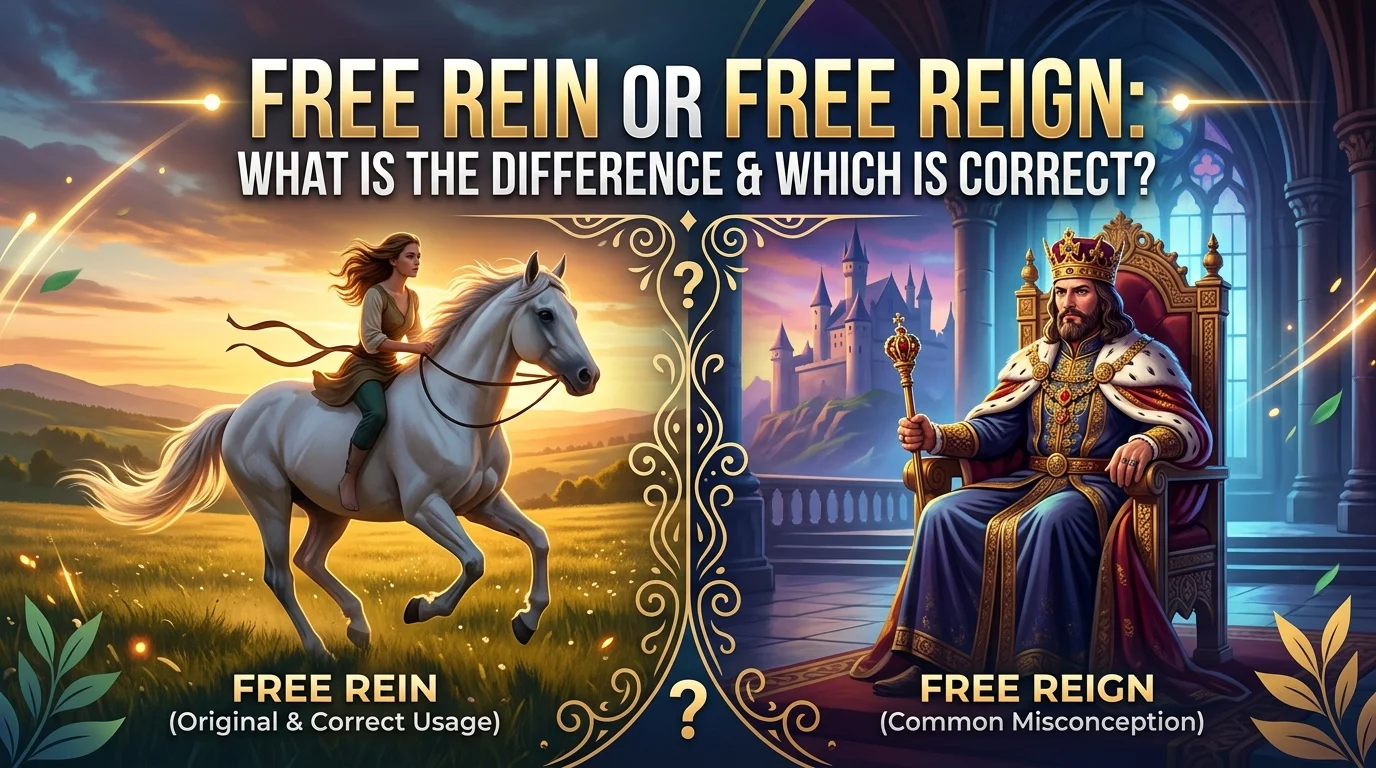
Many people get confused between “free rein” and “free reign” because they sound almost identical when spoken. However, only one is traditionally correct in standard English. This comparison will help you understand the meaning, usage, and differences so you can confidently use the right expression in writing and conversation.
Comparison Overview
“Free rein” and “free reign” are often used interchangeably in casual speech, but they are not the same in correct grammar and origin. “Free rein” is the original idiom, while “free reign” is a common spelling mistake that developed due to pronunciation similarity and misunderstanding of the word “rein.” Both appear in modern usage, but only one is historically accurate.
Definition of Free Rein
“Free rein” is an idiomatic expression that means giving someone complete freedom to act, decide, or control a situation without restriction. It comes from horseback riding, where loosening the reins allows the horse to move freely. In modern usage, it refers to independence in decision-making or creativity.
Definition of Free Reign
“Free reign” is a mistaken version of the phrase “free rein.” It is formed due to confusion with the word “reign,” which relates to kings or queens ruling a kingdom. While many people use it informally, it is not the original idiom and is generally considered incorrect in formal writing.
Main Differences Between Free Rein and Free Reign
The key difference lies in meaning and origin. “Free rein” relates to control being loosened, while “free reign” incorrectly suggests ruling power. “Free rein” is about freedom of action, whereas “free reign” mistakenly connects to leadership or monarchy.
In usage, “free rein” is accepted in both formal and informal contexts. “Free reign” is usually seen in informal writing or common speech errors. In professional or academic writing, “free rein” should always be used.
| Feature | Free Rein | Free Reign |
| Correctness | Correct idiom | Common error |
| Origin | Horse riding | Misunderstanding of “reign” |
| Meaning | Freedom of action | Incorrect idea of ruling |
| Usage | Formal and informal | Informal mistakes |
Grammar Guide
“Free rein” functions as an idiomatic noun phrase. It is not literally about horses in modern usage but retains the idea of control being loosened.
How each term is used in sentences
The structure is usually:
Give someone free rein over something.
Examples:
She was given free rein over the project design.
The manager gave the team free rein to choose their strategy.
“Free reign” is used by mistake in similar sentence structures but should be avoided in formal grammar.
Common mistakes learners make
Many learners assume “reign” is correct because it is a familiar English word related to power and leadership. This leads to incorrect substitution in writing. Another mistake is thinking both versions are acceptable alternatives.
Simple rules to remember
If the phrase is about freedom or lack of control, always use “rein.”
If it involves kings or queens, “reign” is correct but not in this idiom.
Quick tips for writing and speaking
Think of a horse being guided loosely. That image helps you remember “rein” instead of “reign.” Also, in formal writing, always double-check this phrase because it is a frequent spelling trap.
When to Use Each One
Use “free rein” when describing flexibility, independence, or lack of restrictions in tasks, decisions, or creativity. It is appropriate in business, education, writing, and everyday conversation.
Avoid using “free reign” in formal communication, academic work, or professional documents. It may be understood, but it is still considered incorrect in standard English.
When NOT to Use Each One
Do not use “free rein” when referring to monarchy, kingship, or ruling authority. In those cases, “reign” is used in its literal sense, not as part of this idiom.
Do not use “free reign” in essays, exams, reports, or professional emails, because it reflects a spelling error rather than standard usage.
Which One to Use (Decision Guide)
If you are talking about giving someone freedom or control over something, choose “free rein.”
If you are talking about royal power, use “reign,” but not in this expression.
If you are unsure, think about horses and control rather than kings and queens. That mental image will guide you to the correct choice.
Real-World Practical Examples
Free Rein Examples
- The teacher gave students free rein to choose their project topics.
- The designer had free rein to create the new logo.
- Parents gave their child free rein during the art activity.
- The editor gave the writer free rein over the story structure.
- The company gave the marketing team free rein for the campaign strategy.
Free Reign Examples
- The manager mistakenly wrote that employees had free reign over tasks.
- Many blogs still use the phrase free reign instead of free rein.
- In casual speech, people often say free reign without knowing it is incorrect.
- The article incorrectly mentioned free reign in its explanation.
- Students sometimes write free reign in exams by mistake.
Self-Assessment (Fill in the Blanks)
- I will use ______ when giving someone full creative freedom.
- The correct word is ______ because it refers to loosened control, not ruling power.
- She was given ______ over the entire project design.
- The phrase ______ is commonly used incorrectly instead of the correct idiom.
- Teachers often give students ______ in creative writing tasks.
- The correct expression is ______ in formal English writing.
- He had ______ to decide how to complete the assignment.
- Many people mistakenly write ______ due to spelling confusion.
- The manager allowed ______ over the marketing strategy.
- The correct idiom is ______, not a reference to monarchy.
- In professional writing, ______ should always be used.
- The phrase ______ comes from horseback riding terminology.
- She was given ______ to redesign the website.
- ______ is considered a common grammatical mistake.
- The team worked with ______ on the new project.
- The correct choice is ______ when referring to freedom of action.
- He mistakenly used ______ in his essay.
- The correct idiom ______ means unrestricted control.
- Students should avoid using ______ in formal exams.
- The phrase ______ is linked to the idea of loosening control.
Answers
- free rein
- free rein
- free rein
- free reign
- free rein
- free rein
- free rein
- free reign
- free rein
- free rein
- free rein
- free rein
- free rein
- free reign
- free rein
- free rein
- free reign
- free rein
- free reign
- free rein
Final Verdict
“Free rein” is the correct and standard idiom used to describe giving someone full freedom or control over actions or decisions. “Free reign” is a widespread but incorrect variation that comes from confusion with the word “reign.” To write accurately and professionally, always choose “free rein” when referring to independence or unrestricted control.
Conclusion About Free Rein or Free Reign
Understanding the difference between free rein and free reign makes a big impact on clear and correct communication. While both phrases sound almost identical, only free rein is the accurate idiom used to describe giving someone full freedom or control in a situation. Free reign, although commonly seen, is actually a frequent spelling mistake caused by confusion with the word reign. By remembering the horse riding origin of rein, it becomes easier to choose the correct expression in writing and speech. Whether you are writing professionally, studying English, or improving everyday communication, using the correct form helps maintain accuracy and credibility. With consistent practice, this small but important grammar detail becomes easy to master and use naturally.
FAQs
What does free rein mean?
Free rein means giving someone complete freedom to act, decide, or create without strict control. It comes from horseback riding, where loosening the reins allows the horse to move freely. In modern English, it is used when someone is trusted with independence in decision making, creativity, or managing tasks without restrictions.
Is free reign correct English?
Free reign is not considered correct in standard English. It is a common mistake caused by confusion with the word reign. The correct idiom is free rein, which refers to freedom of action. Although many people still use free reign informally, it should be avoided in professional or academic writing.
Why do people say free reign instead of free rein?
People often say free reign because it sounds more familiar and is confused with the word reign, which relates to kings and queens. Since both words sound the same in speech, the spelling error became widespread. However, the original phrase comes from horseback riding and uses rein.
Can free rein and free reign be used interchangeably?
No, they should not be used interchangeably in formal writing. Free rein is the correct idiom, while free reign is an incorrect variation. Even though many people understand both, using the correct form ensures clarity, accuracy, and professionalism in communication, especially in academic and business contexts.
What is the origin of free rein?
Free rein originates from horseback riding terminology. When a rider loosens the reins, the horse is allowed to move freely. This idea of releasing control evolved into a figurative expression meaning giving someone independence or freedom to make decisions without restrictions in various situations.
Is free rein formal or informal?
Free rein is acceptable in both formal and informal English. It is commonly used in professional writing, academic work, and everyday conversation. Because it is a recognized idiom, it maintains its correctness across different contexts, making it suitable for a wide range of communication styles.
What is the meaning of reign in English?
Reign refers to the period during which a king, queen, or ruler holds power. It is associated with authority, leadership, and governance. This is different from rein, which relates to control or guidance, especially in the idiom free rein.
How can I remember the correct phrase?
A simple way to remember is to think of a horse. When a rider gives loose reins, the horse moves freely. This image helps connect free rein with freedom. Associating it with horses instead of royalty makes it easier to avoid the common mistake free reign.
Is free rein used in business writing?
Yes, free rein is often used in business writing when describing autonomy or decision making freedom. Managers may give teams free rein to develop ideas, strategies, or creative solutions. It reflects trust and flexibility in professional environments while maintaining clear communication.
What is the biggest mistake with free rein and free reign?
The biggest mistake is assuming both phrases are correct or interchangeable. Many writers mistakenly use free reign due to spelling confusion. However, only free rein is the correct idiom for expressing freedom of action, while reign relates only to royal authority.

Sarah Mitchell is an experienced writer and grammar teacher with over 10 years of expertise in English language education. She helps learners improve their grammar, writing, and communication skills through clear explanations and practical examples. Sarah creates learner-friendly content focused on real-life English, making language learning simple, effective, and confidence-building.