
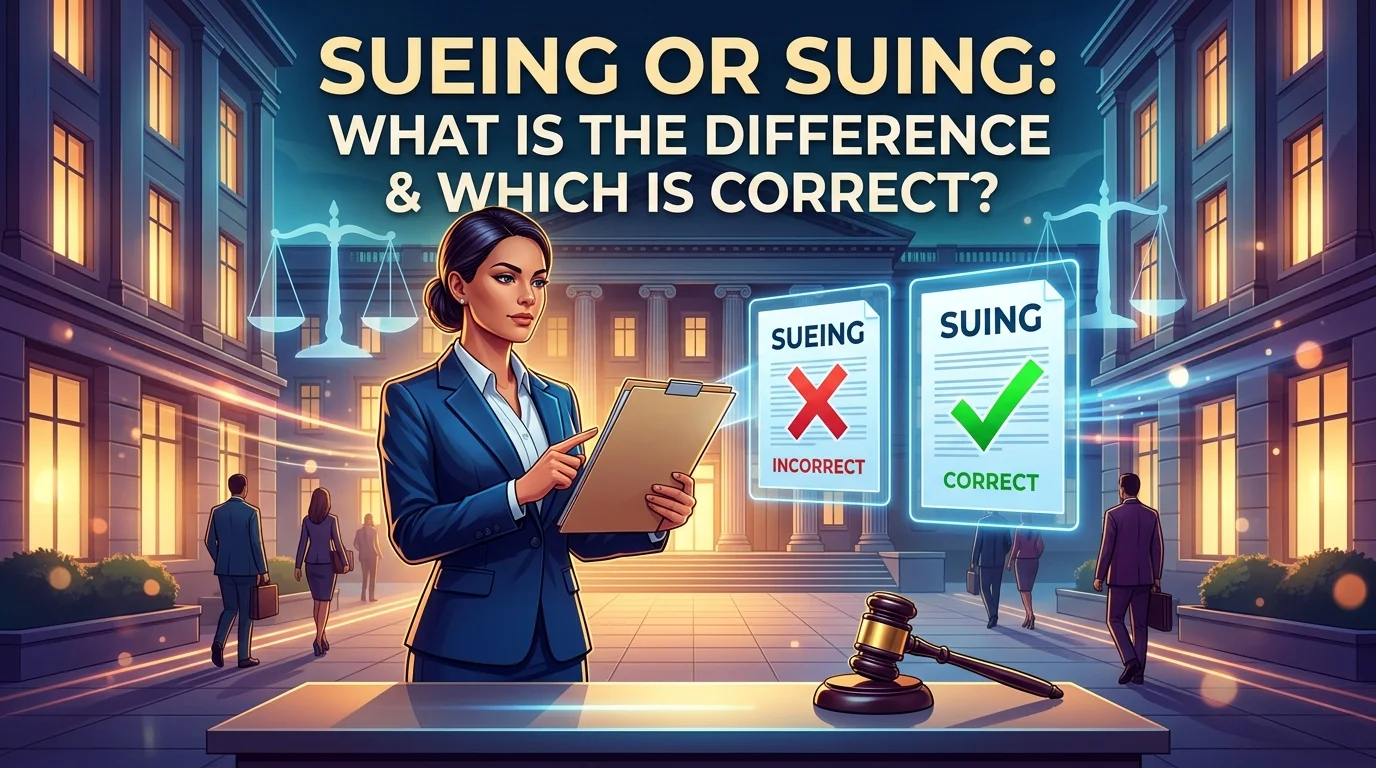
Understanding the difference between “sueing” and “suing” is important for anyone learning English or dealing with legal writing. These two forms often cause confusion, especially because they sound similar. However, only one is grammatically correct, and knowing the difference helps you write and speak with confidence in legal and everyday contexts.
Comparison Overview
“Sueing” and “suing” are often compared because both appear in discussions about legal action. They relate to the verb “sue,” which means to take someone to court. However, only one spelling follows correct English grammar rules. The confusion usually comes from how verbs change when adding endings like “ing.”
Definition of Sueing
“Sueing” is a common misspelling of the verb form. People often write it by mistake when trying to add “ing” to “sue.” However, this form is not accepted in standard English grammar. It appears in informal writing or typing errors but is not considered correct in legal or academic contexts.
Definition of Suing
“Suing” is the correct present participle and gerund form of the verb “sue.” It refers to the action of taking legal steps against someone in a court of law. It is widely used in legal, formal, and everyday English when discussing lawsuits or legal claims.
Main Differences Between Sueing and Suing
The key difference lies in spelling and correctness. “Sueing” is incorrect and should not be used in formal writing. “Suing” is the proper grammatical form and is accepted in all contexts.
“Suing” follows standard English verb rules where a silent “e” is dropped before adding “ing.” Since “sue” ends with a silent “e,” it becomes “suing,” not “sueing.”
| Aspect | Sueing | Suing |
| Correctness | Incorrect | Correct |
| Usage | Rare, error | Standard |
| Grammar rule | Breaks rule | Follows rule |
| Meaning | No official meaning | Legal action |
Grammar Guide
How each term is used in sentences
“Suing” is used when describing ongoing legal action.
Examples:
- She is suing the company for damages.
- They are suing their landlord for unfair treatment.
- He is suing for breach of contract.
“Sueing” should not be used in correct English writing.
Common mistakes learners make
Many learners mistakenly add “e” before “ing,” forming “sueing.” This happens because they assume all verbs simply add “ing” without spelling changes. Another mistake is using both forms interchangeably.
Simple rules to remember
If a verb ends in a silent “e,” remove the “e” before adding “ing.”
Sue becomes suing.
Write becomes writing.
Make becomes making.
Quick tips for writing and speaking
Always check spelling in formal writing. If you see “sueing,” correct it to “suing.” Reading legal texts can help reinforce the correct form.
When to Use Each One
Use “suing” when describing legal action, lawsuits, or court-related processes. It is appropriate in academic writing, news reports, legal documents, and everyday conversation.
“Sueing” should not be used in any formal or professional context since it is not grammatically correct.
When NOT to Use Each One
Avoid using “sueing” in essays, legal writing, emails, or professional communication. It is always considered an error.
Do not use “suing” when you are not referring to legal action. It should not be confused with general actions or unrelated verbs.
Which One to Use (Decision Guide)
If you are describing someone taking legal action, always choose “suing.” If you are unsure about spelling, remember the rule of dropping the silent “e” before adding “ing.” If “sueing” appears in your writing, it should be corrected immediately.
Real-World Practical Examples
Sueing Examples
- There are no correct examples for “sueing” because it is a spelling mistake.
- Students sometimes write “sueing” in exams, but it is marked incorrect.
- Spellcheck tools usually highlight “sueing” as an error.
- Some informal internet posts mistakenly use “sueing.”
- It appears in typing errors in casual writing.
Suing Examples
- She is suing her employer for unpaid wages.
- The company is suing a competitor for copyright violation.
- They are suing the contractor for incomplete work.
- He is suing the hospital for medical negligence.
- The artist is suing for unauthorized use of his work.
Self-Assessment (Fill in the Blanks)
- She is ______ the company for damages.
- The correct spelling is ______.
- ______ is not accepted in formal English.
- They are ______ their landlord.
- The lawyer is ______ a large corporation.
- ______ is a common spelling mistake.
- He is ______ for breach of contract.
- The verb “sue” becomes ______ in present participle form.
- Many students mistakenly write ______ instead of suing.
- The company is ______ its competitor.
- ______ should not be used in academic writing.
- She is ______ for unfair dismissal.
- Legal action is called ______.
- He is ______ a hospital for negligence.
- The correct grammar form is ______.
- ______ does not follow English spelling rules.
- They are ______ over property rights.
- The court case involves ______.
- Always use ______ in formal writing.
- ______ is considered incorrect spelling.
Answers
- suing
- suing
- sueing
- suing
- suing
- sueing
- suing
- suing
- sueing
- suing
- sueing
- suing
- suing
- suing
- suing
- sueing
- suing
- suing
- suing
- sueing
Final Verdict
The correct and only accepted form is “suing.” It follows standard English grammar rules and is used in all formal and informal contexts involving legal action. “Sueing” is simply a spelling mistake and should be avoided. Remembering the silent “e” rule makes it easy to choose the right form every time and ensures clear, correct communication.
Conclusion About Sueing or Suing
Understanding the difference between “sueing” and “suing” makes a big difference in writing clear and correct English, especially in legal or formal contexts. While both terms may look similar, only “suing” is grammatically correct and widely accepted in standard English. It refers to the legal process of taking someone to court to resolve a dispute or seek compensation. On the other hand, “sueing” is simply a spelling mistake that often appears due to confusion with verb rules. Remembering the simple pattern of dropping the silent “e” before adding “ing” helps you avoid this error easily. By using “suing” correctly, your writing becomes more accurate, professional, and easier to understand in both academic and real-world communication.
FAQs
Is sueing a correct spelling?
“Sueing” is not a correct spelling in English. It is a common mistake that happens when people incorrectly add “ing” to “sue.” The correct and accepted form is “suing,” which follows standard grammar rules and is used in legal, academic, and everyday communication.
What does suing mean in law?
“Suing” means taking legal action against a person, company, or organization in a court of law. It is done to resolve disputes, claim damages, or seek justice. It is a formal legal process commonly used in civil cases and contractual disagreements.
Why is suing correct instead of sueing?
“Suing” is correct because English grammar rules require dropping the silent “e” before adding “ing.” Since “sue” ends in a silent “e,” it becomes “suing.” This rule ensures consistent spelling across many English verbs that follow the same pattern.
Is sueing ever acceptable in writing?
“Sueing” is never acceptable in standard English writing. It is always considered a spelling error. Whether in formal, informal, or academic contexts, the correct form “suing” should always be used to maintain clarity and correctness.
How do I remember the correct spelling?
A simple way to remember is: if a verb ends in a silent “e,” remove it before adding “ing.” For example, sue becomes suing. Practicing similar verbs like make becoming making helps reinforce this spelling rule effectively.
Is suing used only in legal situations?
Yes, “suing” is mainly used in legal situations. It refers specifically to taking someone to court. It is not used for general actions or everyday activities outside of legal disputes or formal legal discussions.
Can businesses be involved in suing?
Yes, businesses often engage in suing other companies or individuals when legal disputes arise. This can involve contracts, intellectual property, or financial disagreements. It is a common term in corporate law and business litigation.
Is suing used in both UK and US English?
Yes, “suing” is used in both UK and US English with the same meaning and spelling. There is no difference in usage between the two, making it a universally accepted legal term across English-speaking regions.
What happens if I use sueing in exams?
Using “sueing” in exams is considered incorrect spelling and may lead to lost marks. Examiners expect the correct form “suing,” so it is important to follow proper grammar rules to ensure accuracy and better results.
Is suing a verb or noun?
“Suing” is a verb form, specifically the present participle of “sue.” It can also function as a gerund when used as a noun-like action, such as describing the act of taking legal steps against someone.

Daniel Brooks is an English educator with a passion for explaining similes and word comparisons in plain language. He covers topics like versus meanings, correct usage, and figurative language to help writers avoid common mistakes and improve clarity in everyday writing.