
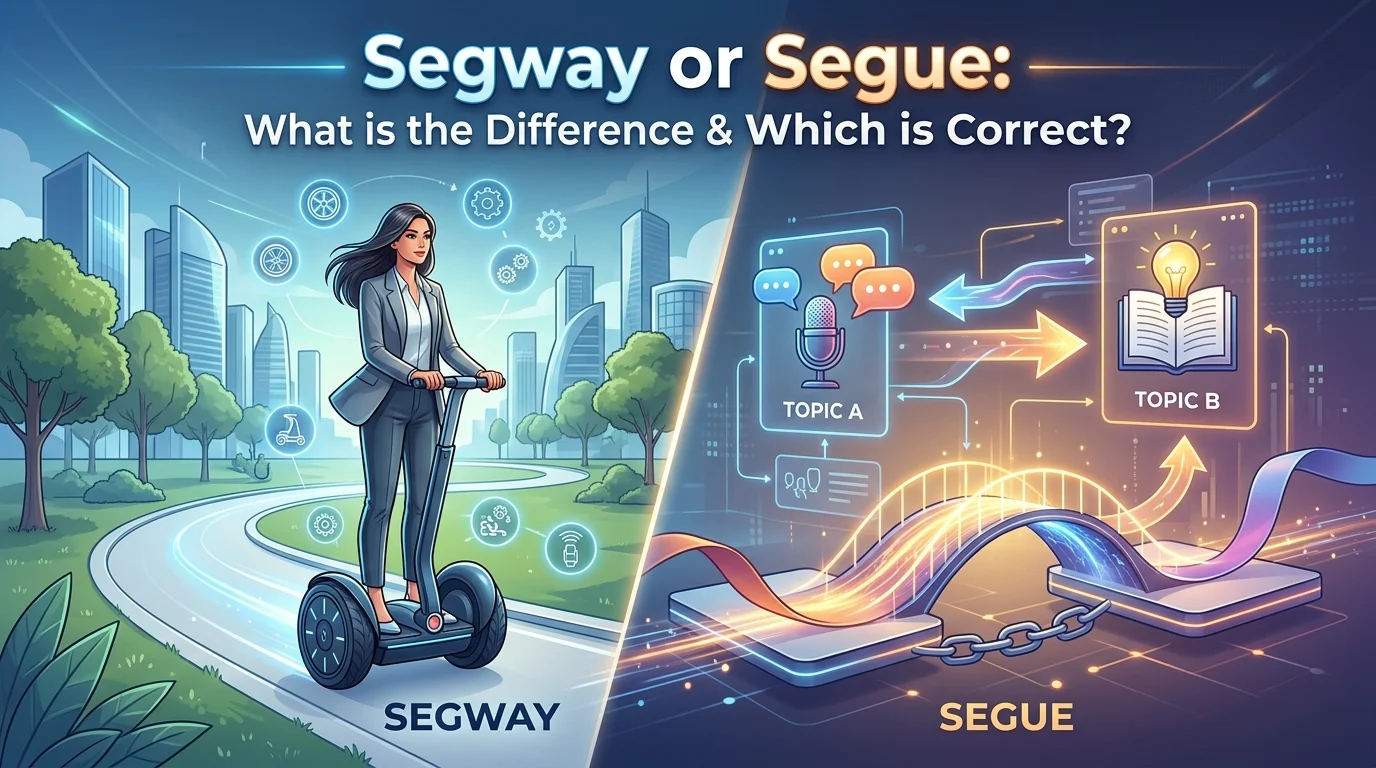
This comparison explains the difference between “Segway” and “Segue,” two words that sound similar but have completely different meanings. One refers to a personal transportation device and brand, while the other is a term used in language, music, and conversation. Understanding this difference helps avoid confusion in writing, speaking, and everyday communication.
Comparison Overview
“Segway” and “segue” are often confused because they are pronounced similarly, but they belong to entirely different contexts. One is a proper noun linked to a mobility product, while the other is a common word used to describe a smooth transition between ideas or topics. Knowing their distinction improves clarity in both writing and speech.
Definition of Segway
Segway is a brand best known for producing self-balancing electric personal transport devices. A Segway is a two-wheeled machine that helps a rider move by leaning forward or backward to control direction and speed. It is commonly used for tours, security patrols, and short-distance travel in urban areas.
Definition of Segue
A “segue” is a smooth transition from one topic, idea, or section to another. It is commonly used in speech, writing, music, and broadcasting. The purpose of a segue is to make changes feel natural and connected rather than sudden or awkward.
Main Differences Between Segway and Segue
The key difference is meaning and usage. “Segway” refers to a physical transportation device and brand, while “segue” refers to a transition in ideas or sound.
“Segway” is a noun tied to technology and mobility, whereas “segue” is often used as a verb or noun in communication and creative fields.
Another major difference is context. You would use “Segway” when talking about transport or vehicles, but “segue” when shifting between topics, conversations, or music segments.
Grammar Guide
“Segway” functions as a proper noun and is always capitalized because it refers to a brand name. It is not used in grammatical transitions or sentence structure.
“Segue” functions as both a noun and a verb. As a verb, it describes the action of transitioning smoothly. As a noun, it describes the transition itself.
How each term is used in sentences
For “Segway,” sentences usually describe physical movement or devices.
For “segue,” sentences describe transitions between ideas, topics, or sounds.
Examples:
- The tour guide rode a Segway through the city.
- The speaker made a smooth segue into the next topic.
Common mistakes learners make
Many people mistakenly use “Segway” when they actually mean “segue,” especially in writing. Another common error is spelling “segue” as “segway,” which is incorrect outside the brand context.
Simple rules to remember
If you are talking about movement or a transport device, use Segway. If you are talking about transitions in speech, writing, or music, use segue.
Quick tips for writing and speaking
Think of “Segway” as a machine you ride. Think of “segue” as a bridge between ideas. This mental image helps avoid confusion during writing or conversation.
When to Use Each One
Use Segway when referring to electric personal transporters or the brand itself. It is mostly used in travel, tourism, or technology discussions.
Use segue when moving from one idea to another in writing, speaking, presentations, podcasts, or music composition.
When NOT to Use Each One
Do not use Segway when describing transitions in conversation or writing. It does not function as a grammatical transition word.
Do not use segue when referring to vehicles, transportation devices, or any physical product. It has no connection to mobility technology.
Which One to Use (Decision Guide)
If your sentence involves movement, transport, or a riding device, choose Segway. If your sentence involves linking ideas, topics, or speech flow, choose segue. This simple distinction ensures correct usage in most situations.
Real-World Practical Examples
Segway Examples
- The tourists explored the park using a Segway.
- Security staff patrolled the mall on a Segway.
- The company introduced a new Segway model with better battery life.
- He learned how to balance on a Segway in just a few minutes.
- The guide explained safety rules before riding the Segway.
Segue Examples
- The teacher used a story to segue into the next lesson.
- The radio host made a smooth segue between songs.
- She tried to segue the conversation away from politics.
- The presentation segued naturally into the financial report.
- The musician used drums to segue into the chorus.
Self-Assessment (Fill in the Blanks)
- I will use ______ when referring to a personal transport device.
- The correct word is ______ when describing a smooth transition in speech.
- A speaker can ______ into a new topic during a presentation.
- A ______ is commonly used for guided city tours.
- The word ______ is used in music to shift between sections.
- The brand ______ makes electric scooters and transporters.
- A good presenter knows how to ______ between ideas smoothly.
- Tourists often ride a ______ in urban sightseeing.
- The correct spelling for transition in conversation is ______.
- A Segway is a type of ______ device.
- Teachers often ______ from one topic to another.
- The ______ helps maintain flow in storytelling.
- Security guards sometimes use a ______ for patrol.
- The word ______ is not used for grammar transitions.
- A smooth ______ improves communication clarity.
- The company ______ produces personal transport machines.
- Writers use ______ to connect paragraphs.
- A Segway is powered by ______ technology.
- The correct term for transitioning ideas is ______.
- A presenter may ______ between sections of a speech.
Answers
- Segway
- segue
- segue
- Segway
- segue
- Segway
- segue
- Segway
- segue
- transport
- segue
- segue
- Segway
- Segway
- segue
- Segway
- segue
- electric
- segue
- segue
Final Verdict
“Segway” and “segue” may sound similar, but they belong to completely different worlds. Segway is a branded transportation device used for mobility, while segue is a language tool used for smooth transitions in speech, writing, and media. Choosing the correct term depends entirely on context. If it involves riding or transport, use Segway. If it involves flow between ideas, use segue.
Conclusion About Segway or Segue
Understanding the difference between Segway and segue helps eliminate one of the most common language confusions in English. Although they sound alike, they serve completely different purposes in communication. Segway refers to a modern personal transport device often used for travel and tours, while segue is a linguistic tool used to create smooth transitions between ideas, topics, or conversations. Recognizing the context is the key to choosing the correct term. Once you understand their roles, your writing becomes clearer, more professional, and easier for readers to follow in both casual and formal situations.
FAQs About Segway or Segue
What is the main difference between Segway and segue?
The main difference is meaning and usage. Segway is a branded electric transport device used for mobility, while segue is a word used to describe a smooth transition between ideas or topics. One belongs to transportation, and the other belongs to language and communication. They are not interchangeable in any context.
Is Segway ever used in writing or grammar?
Segway is not used in grammar or sentence structure. It is strictly a proper noun referring to a type of personal transport device. Using it in place of transition words is incorrect. In writing, the correct term for linking ideas smoothly is always segue, not Segway.
What does segue mean in simple words?
Segue means to move smoothly from one idea, topic, or section to another without interruption. It is commonly used in speaking, writing, presentations, and music. A good segue helps communication feel natural and connected, making it easier for listeners or readers to follow the flow of information.
Can Segway and segue be used interchangeably?
No, they cannot be used interchangeably. Segway refers to a physical transportation device, while segue refers to a verbal or written transition. Mixing them up leads to incorrect meaning and confusion. Each word belongs to a completely different category of language and should be used in its proper context.
Where is Segway commonly used?
Segway is commonly used in tourism, security, and urban transportation. It is often seen in guided city tours, large indoor spaces, and short-distance travel situations. The device helps users move efficiently while standing, making it popular for modern personal mobility solutions in controlled environments.
Where is segue commonly used?
Segue is widely used in writing, public speaking, broadcasting, music, and presentations. It helps speakers and writers transition smoothly between topics or sections. In radio shows or podcasts, segues are often used to move between songs or discussions without breaking the flow of communication.
Why do people confuse Segway and segue?
People confuse them because they sound very similar when spoken. However, their meanings are unrelated. One is a brand name for a transport device, and the other is a linguistic term for transitions. The similarity in pronunciation is the main reason for frequent spelling and usage mistakes.
Is segue a verb or a noun?
Segue can be both a verb and a noun. As a verb, it describes the action of transitioning smoothly between ideas. As a noun, it refers to the transition itself. This flexibility makes it useful in both spoken and written communication across different contexts.
How can I remember the difference easily?
A simple way to remember is to link Segway with wheels and riding, since it is a transport device. Link segue with speech and flow, since it connects ideas. This mental association helps avoid confusion and ensures correct usage in both writing and conversation.
What is a good example of a segue in conversation?
A good example of a segue in conversation is when someone changes topics smoothly, such as moving from discussing weather to travel plans without a sudden break. It keeps the conversation natural and easy to follow, improving overall communication and listener engagement.

Sophia Turner is a grammar-focused writer who covers similes, word-versus-word meanings, and correct English usage. Her content is designed for learners who want quick answers, logical explanations, and practical guidance for improving writing accuracy and style.