
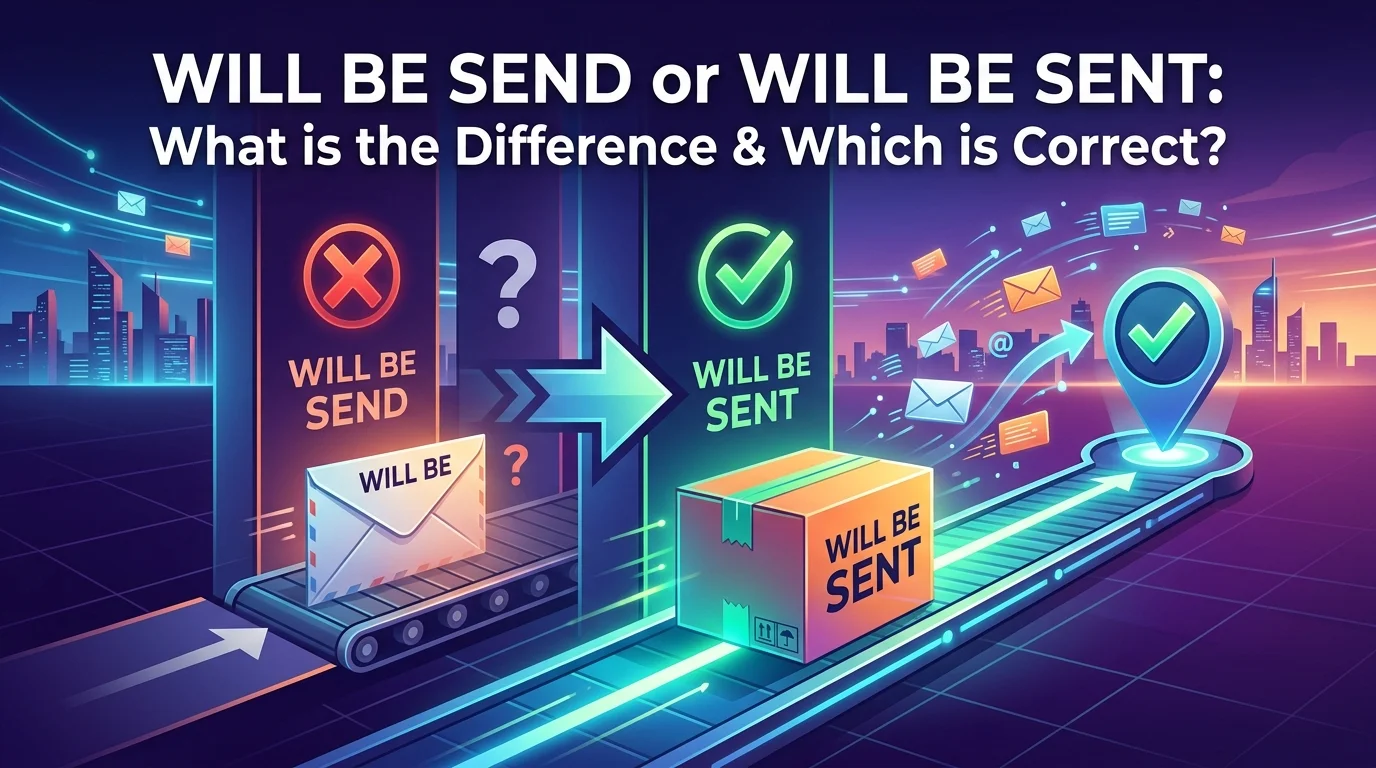
This comparison explains the difference between “will be send” and “will be sent,” two phrases that often confuse English learners. They look similar but only one follows correct grammar rules. Understanding this difference is important for writing clear and professional sentences in emails, exams, and everyday communication.
Comparison Overview
Both phrases are related to the verb “send,” but they are not used in the same way. “Will be send” appears to be an incorrect attempt to form a future passive structure, while “will be sent” is the grammatically correct passive form used in English. The difference lies in verb form and grammar structure.
Definition of Will Be Send
“Will be send” is an incorrect grammatical construction. It mistakenly combines the auxiliary structure “will be” with the base verb “send,” which does not fit English passive voice rules. Because of this mismatch, it is not considered standard English and should be avoided in writing and speech.
Definition of Will Be Sent
“Will be sent” is the correct future passive form of the verb “send.” It is used when something is going to be delivered, transferred, or dispatched in the future. The word “sent” is the past participle form of “send,” which is required in passive voice structures.
Main Differences Between Will Be Send and Will Be Sent
The key difference is grammatical correctness. “Will be send” is incorrect because it uses the base verb instead of the past participle. “Will be sent” is correct because it follows the structure of future passive voice: will + be + past participle.
Another difference is usage. “Will be send” is not used in formal or informal English, while “will be sent” is widely used in emails, logistics, business communication, and daily conversation.
| Feature | Will Be Send | Will Be Sent |
| Grammar status | Incorrect | Correct |
| Verb form | Base verb | Past participle |
| Usage | Not used | Commonly used |
| Meaning clarity | Confusing | Clear and standard |
Grammar Guide
The correct structure in future passive voice is: subject + will be + past participle. In this case, “sent” is the past participle of “send,” which makes the sentence grammatically correct.
How each term is used in sentences
Correct structure examples:
- The parcel will be sent tomorrow.
- The email will be sent shortly.
- The documents will be sent by courier.
Incorrect structure:
- The parcel will be send tomorrow.
Common mistakes learners make
Many learners mistakenly use the base verb after “will be,” thinking all verbs stay unchanged in future tense. Another common mistake is directly translating from native languages, which often ignores passive voice rules.
Simple rules to remember
- After “will be,” always use the past participle form.
- “Send” becomes “sent” in passive voice.
- If it describes receiving action, use passive structure.
Quick tips for writing and speaking
- Think “will be + V3 form.”
- If unsure, check if the verb is in past participle form.
- Use “sent” for delivery, messages, and transfers.
When to Use Each One
Use “will be sent” when describing something that will be delivered or dispatched in the future, such as emails, parcels, reports, or notifications. “Will be send” should never be used because it is grammatically incorrect.
When NOT to Use Each One
Never use “will be send” in any context. It does not follow English grammar rules and will be marked incorrect in academic writing, professional emails, and exams.
Which One to Use (Decision Guide)
If you are forming a future passive sentence, always check the verb form after “be.” If it is a past participle, the sentence is correct. If it is a base verb like “send,” it is incorrect. Therefore, “will be sent” is always the right choice.
Real-World Practical Examples
Will Be Send Examples
- This form is incorrect and should not be used.
- “Will be send” is not accepted in English grammar.
- The message will be send tomorrow (incorrect usage).
- Any sentence using “will be send” is grammatically wrong.
- Students should avoid writing “will be send” in exams.
Will Be Sent Examples
- The package will be sent to your address tomorrow.
- The invitation will be sent by email this evening.
- The report will be sent to the manager for review.
- The documents will be sent via courier service.
- The notification will be sent automatically by the system.
Self-Assessment (Fill in the Blanks)
- The email will be ______ tomorrow.
- I will ensure the report will be ______ on time.
- The parcel will be ______ to your home.
- The message will be ______ shortly.
- The documents will be ______ by courier.
- The invitation will be ______ today.
- The notice will be ______ to all employees.
- The file will be ______ after approval.
- The letter will be ______ in the morning.
- The update will be ______ via system notification.
- I will use ______ when talking about future delivery.
- The correct form is ______ in passive voice.
- ______ is incorrect grammar usage.
- The word ______ is the past participle form.
- Emails will be ______ automatically.
- Reports will be ______ to management.
- The package will be ______ next week.
- Always use ______ after “will be.”
- ______ should not be used in English writing.
- The correct expression is ______.
:Answers
- sent
- sent
- sent
- sent
- sent
- sent
- sent
- sent
- sent
- sent
- will be sent
- will be sent
- will be send
- sent
- sent
- sent
- sent
- sent
- will be send
- will be sent
Final Verdict
“Will be send” is incorrect and should never be used in English writing or speaking. The correct form is “will be sent,” which follows the proper future passive structure using the past participle of “send.” Once you remember the rule “will be + past participle,” you can easily avoid this mistake and write more accurate and natural English sentences.
Conclusion About Will Be Send or Will Be Sent
The confusion between “will be send” and “will be sent” is very common among English learners, but the rule is actually quite simple once understood. English passive voice always requires the past participle form of the verb, which makes “will be sent” the only correct option. Whether you are writing emails, business messages, or academic sentences, using the correct form helps you sound clear, professional, and confident. On the other hand, “will be send” is grammatically incorrect and should always be avoided. By remembering the structure “will be + past participle,” you can easily avoid this mistake and improve your overall English accuracy in both writing and speaking.
FAQs
What is the correct form between will be send and will be sent?
The correct form is “will be sent.” It follows the future passive voice structure, which requires the past participle form of the verb. “Will be send” is incorrect because it uses the base verb instead of the past participle, making it grammatically wrong in standard English usage.
Why is will be send incorrect in English grammar?
“Will be send” is incorrect because English passive voice requires the structure “will be + past participle.” Since “send” is a base verb, it cannot follow “will be” directly. The correct past participle form is “sent,” which makes “will be sent” the proper and grammatically accepted version.
When should I use will be sent in a sentence?
Use “will be sent” when describing something that will be delivered or dispatched in the future. It is commonly used for emails, parcels, documents, and messages. This structure is used in both formal and informal English whenever an action is expected to happen later.
Is will be send ever correct in any situation?
No, “will be send” is never correct in standard English grammar. It does not follow the rules of passive voice construction. In all contexts, whether formal or informal, academic or professional, the correct form is always “will be sent.”
What is the grammar rule behind will be sent?
The rule is “will be + past participle.” In this case, “sent” is the past participle of “send.” This structure is used in future passive voice sentences, where the subject receives the action rather than performing it.
Can will be sent be used in formal writing?
Yes, “will be sent” is widely used in formal writing such as business emails, official notices, academic reports, and professional communication. It is grammatically correct and considered standard English, making it suitable for all formal contexts.
What are examples of will be sent?
Examples include: The report will be sent tomorrow, The package will be sent by courier, and The invitation will be sent via email. These sentences show how something is scheduled to be delivered or dispatched in the future.
Why do learners confuse send and sent?
Learners often confuse “send” and “sent” because they expect verbs to stay in base form after “will be.” However, passive voice requires a past participle, not a base verb. This difference leads to the common mistake of using “will be send.”
How can I remember the correct form easily?
A simple trick is to remember: “will be + V3 form.” Since V3 of “send” is “sent,” the correct phrase becomes “will be sent.” Practicing this pattern helps avoid mistakes in future passive sentences.
Does will be sent change in different contexts?
No, “will be sent” remains the same in all contexts because it follows a fixed grammatical structure. Whether in emails, business communication, or everyday conversation, the form does not change.

Ethan Clarke is a language writer who specializes in breaking down similes, word meanings, and commonly confused terms. His work focuses on clear explanations, practical examples, and simple comparisons that help readers understand how English