
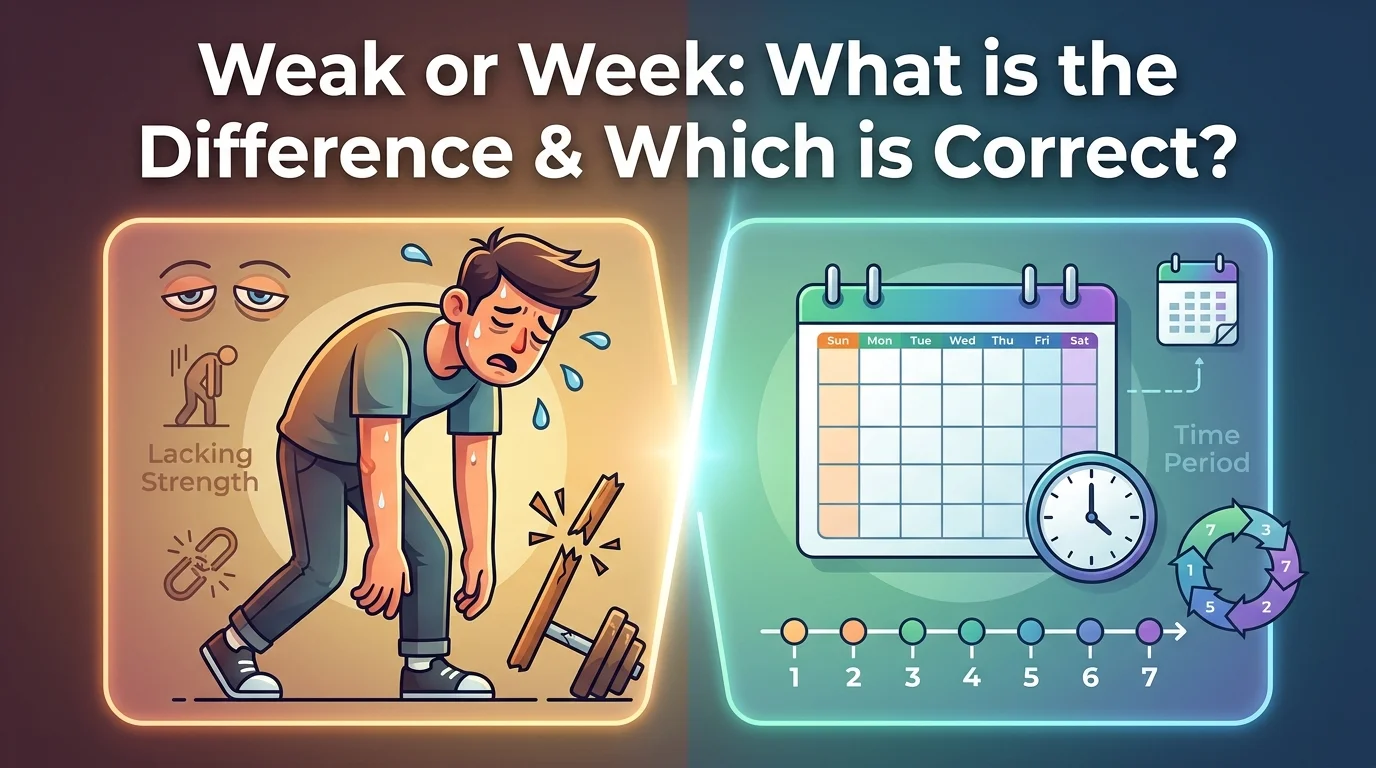
The words “weak” and “week” often confuse English learners because they sound exactly the same but have completely different meanings. One describes strength, while the other refers to time. Understanding the difference is important for correct spelling, grammar, and clear communication in writing and speaking.
Comparison Overview
“Weak” and “week” are homophones, meaning they are pronounced the same but spelled differently and used in different contexts. “Weak” is related to strength or ability, while “week” is a unit of time consisting of seven days. Despite sounding identical, they are never interchangeable.
Definition of Weak
“Weak” is an adjective used to describe something or someone that lacks strength, power, or effectiveness. It can refer to physical strength, emotional resilience, or even arguments and systems that are not strong or convincing.
Definition of Week
“Week” is a noun that represents a period of time equal to seven days. It is commonly used in calendars, schedules, planning, and time-related expressions in everyday life.
Main Differences Between Weak and Week
The key difference lies in meaning and usage. “Weak” describes a condition of low strength, while “week” describes time duration. One is descriptive (adjective), and the other is structural (noun). They also belong to completely different grammatical categories and cannot replace each other in any context.
| Feature | Weak | Week |
| Meaning | Lack of strength or power | Seven-day time period |
| Part of Speech | Adjective | Noun |
| Usage | Physical, emotional, or abstract strength | Time, schedules, planning |
| Example | I feel weak after illness | I will travel next week |
Grammar Guide
“Weak” functions as an adjective, modifying nouns to describe their condition. “Week” functions as a noun and is used to refer to time periods in sentences.
How each term is used in sentences
Weak: She felt weak after the long journey.
Week: We have a meeting next week.
Common mistakes learners make
A common mistake is confusing spelling due to identical pronunciation. Learners often write “I had a hard weak” instead of “week.” Another error is using “week” when describing strength.
Simple rules to remember
If you are talking about strength, ability, or condition, use “weak.”
If you are talking about time, days, or schedules, use “week.”
Quick tips for writing and speaking
Think of “weak” as something that can be broken or tired. Think of “week” as a calendar block of seven days. Associating meaning with context helps avoid confusion.
When to Use Each One
Use “weak” when describing physical strength, emotional state, or effectiveness of something. Use “week” when discussing time periods, schedules, events, or planning.
When NOT to Use Each One
Do not use “weak” when referring to time because it creates incorrect meaning. Do not use “week” when describing strength or performance because it will confuse the reader or listener.
Which One to Use (Decision Guide)
If your sentence talks about energy, strength, or ability, choose “weak.” If it talks about days, dates, or time duration, choose “week.” This simple logic eliminates most confusion.
Real-World Practical Examples
Weak Examples
- I felt weak after skipping meals all day.
- The bridge is weak and needs repair.
- His argument was weak and unconvincing.
- She became weak due to illness.
- The team looked weak in defense during the match.
Week Examples
- I will finish the project next week.
- We have exams this week.
- She travels every week for work.
- The weather has been cold this week.
- I plan to visit my family in a week.
Self-Assessment (Fill in the Blanks)
- I felt ______ after running for an hour.
- We will meet next ______.
- His excuse sounded very ______.
- The calendar shows a busy ______ ahead.
- She is still ______ after the fever.
- I study English twice a ______.
- The athlete looked ______ after the injury.
- We had a productive ______ at work.
- The wall is too ______ to hold weight.
- I will call you later this ______.
- He felt ______ after the long walk.
- This ______ has been very busy.
- The system is too ______ to handle load.
- I plan to rest next ______.
- She became ______ after not eating.
- We had three meetings this ______.
- The bridge is ______ and unsafe.
- I will finish it in a ______.
- His performance was ______ today.
- I look forward to next ______.
Answers
- weak
- week
- weak
- week
- weak
- week
- weak
- week
- weak
- week
- weak
- week
- weak
- week
- weak
- week
- weak
- week
- weak
- week
Final Verdict
“Weak” and “week” may sound identical, but they serve entirely different purposes in English. “Weak” describes lack of strength or effectiveness, while “week” refers to a seven-day time period. Once you connect each word to its meaning and context, choosing the correct one becomes simple and automatic in both writing and conversation.
Conclusion About Weak or Week
Understanding the difference between “weak” and “week” is essential for clear and confident English communication. Although these two words sound exactly the same, their meanings are completely unrelated. “Weak” describes a lack of strength, energy, or effectiveness, while “week” refers to a period of seven days used in everyday planning and scheduling. Many learners mix them up in writing, which can change the entire meaning of a sentence. By focusing on context, you can easily decide which word fits correctly. Whenever you talk about strength or ability, choose “weak.” When referring to time, days, or schedules, use “week.” With a little practice, this distinction becomes natural and helps improve both writing accuracy and speaking fluency.
FAQs
What is the main difference between weak and week?
“Weak” refers to a lack of strength, power, or effectiveness, while “week” is a noun that represents seven days. Even though they sound the same, they have completely different meanings and are used in different contexts. Understanding this difference helps avoid spelling and grammar mistakes in everyday writing and speaking.
Why do weak and week sound the same?
They are homophones in English, meaning they share the same pronunciation but differ in spelling and meaning. This happens because English has many words that evolved differently over time but kept similar sounds. Context in a sentence is the only way to identify which word is being used correctly.
Can weak and week be used interchangeably?
No, they cannot be used interchangeably. “Weak” describes condition or strength, while “week” refers to time duration. Using them incorrectly changes the meaning of a sentence completely. For example, “I feel weak” is correct, while “I feel week” is incorrect and confusing.
How can I remember the difference easily?
A simple trick is to link “weak” with “weaker strength” since both contain the idea of low power. For “week,” remember it has seven days, just like a calendar week. Associating each word with its meaning helps prevent confusion during writing and speaking.
Is weak always an adjective?
Yes, “weak” is primarily used as an adjective. It describes people, objects, ideas, or situations that lack strength, effectiveness, or intensity. For example, a weak signal, weak health, or weak argument all show reduced strength or quality in different contexts.
Is week only used for seven days?
Yes, “week” always refers to a period of seven consecutive days. It is commonly used in planning, schedules, and time management. People often say this week, next week, or last week to refer to specific time periods in everyday communication.
What are common mistakes with weak and week?
The most common mistake is spelling errors due to similar pronunciation. Learners often write “weak” instead of “week” when talking about time. Another mistake is using “week” when describing strength or health, which leads to incorrect and confusing sentences.
How do I use weak in a sentence?
“Weak” is used to describe low strength or poor condition. For example, “She felt weak after illness” or “The argument was weak.” It can apply to physical, emotional, or abstract situations where something lacks power or effectiveness.
How do I use week in a sentence?
“Week” is used to describe time periods. For example, “We have exams next week” or “I work five days a week.” It is always related to scheduling, planning, or measuring time in everyday life and communication.
Why is it important to learn weak vs week?
Learning the difference improves writing accuracy and communication clarity. These words are frequently used in daily English, so mixing them up can cause misunderstandings. Knowing their correct usage helps build stronger grammar skills and more professional language expression.

Ethan Clarke is a language writer who specializes in breaking down similes, word meanings, and commonly confused terms. His work focuses on clear explanations, practical examples, and simple comparisons that help readers understand how English