
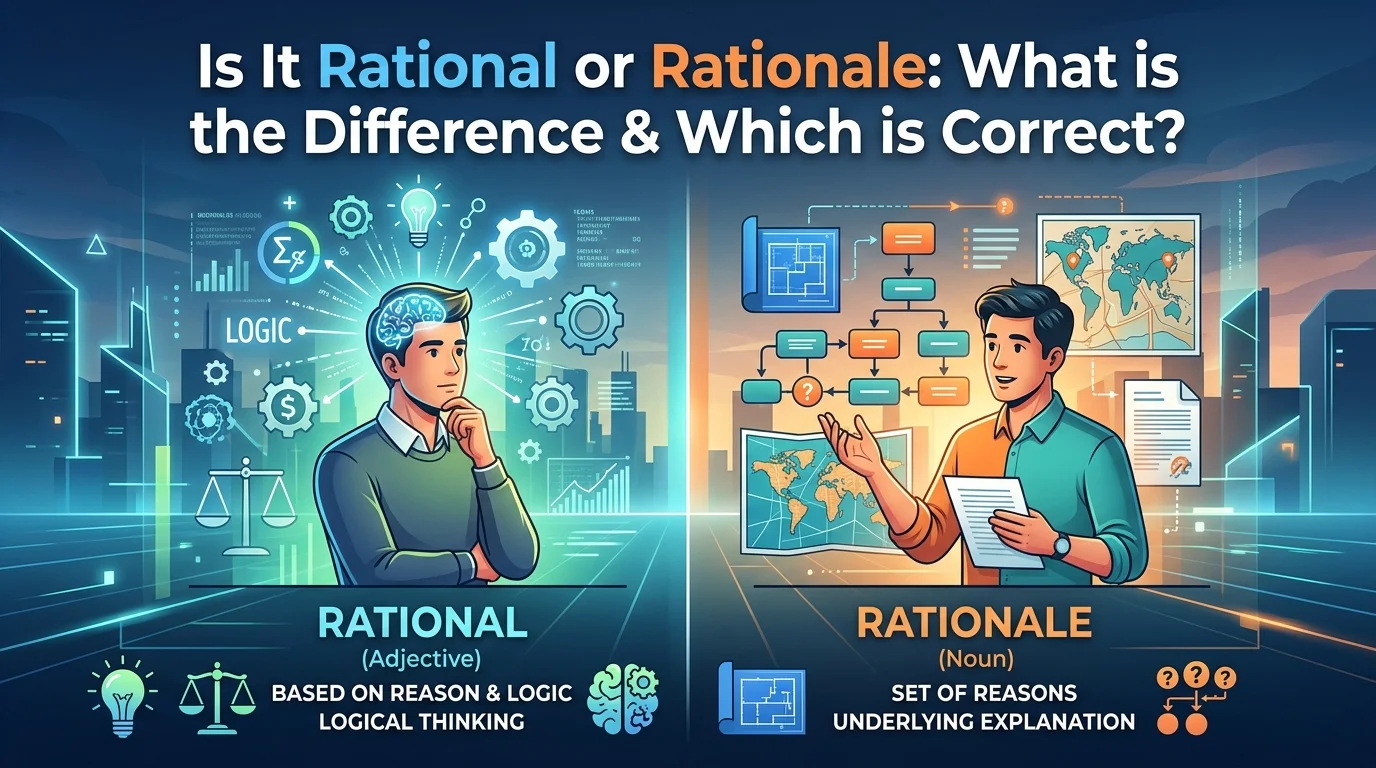
The terms “rational” and “rationale” often confuse English learners because they look similar but have very different meanings. One describes logical thinking, while the other explains a reason or explanation behind something. Understanding the difference helps improve grammar accuracy, writing clarity, and everyday communication.
Comparison Overview
“Rational” and “rationale” are related in spelling but not in function. “Rational” is mainly an adjective used to describe logical thinking or reasonable behavior. “Rationale” is a noun that refers to the explanation or reasoning behind a decision or idea. Knowing when to use each helps avoid common grammar mistakes.
Definition of Rational
“Rational” is an adjective that describes someone or something based on logic, reason, or clear thinking. It is used when talking about decisions, thoughts, or behavior that are sensible and not emotional or random. A rational person thinks carefully before acting and relies on facts rather than feelings.
Definition of Rationale
“Rationale” is a noun that means the reason, explanation, or justification for an action, belief, or decision. It is used when someone explains why something was done or why a particular choice was made. It often appears in academic writing, business discussions, and formal explanations.
Main Differences Between Rational and Rationale
The key difference lies in their grammatical role and meaning. “Rational” describes a quality of thinking, while “rationale” explains the reason behind something.
Rational is an adjective used for describing people or ideas. Rationale is a noun used for explaining decisions or actions. One focuses on logic itself, while the other focuses on the explanation of logic.
Comparison Table:
| Feature | Rational | Rationale |
| Part of speech | Adjective | Noun |
| Meaning | Logical or reasonable | Explanation or reason |
| Usage | Describes behavior or thinking | Explains a decision |
| Example focus | A rational decision | The rationale behind a decision |
Grammar Guide
Rational is used to describe nouns, especially people, decisions, or thoughts. It answers the question “Is it logical or reasonable?”
Rationale is used as a subject or object in a sentence. It answers the question “What is the reason behind this?”
How each term is used in sentences
Rational is used like: a rational decision, a rational argument, or a rational person.
Rationale is used like: the rationale for the decision, the rationale behind the plan, or the rationale was unclear.
Common mistakes learners make
Many learners use “rational” when they actually need “rationale.” For example, saying “What is your rational?” is incorrect. The correct form is “What is your rationale?”
Another mistake is using “rationale” as an adjective, which is not correct.
Simple rules to remember
If you are describing logic or thinking, use rational.
If you are explaining a reason, use rationale.
Quick tips for writing and speaking
Think of rational as describing a mindset. Think of rationale as describing an explanation. If you can replace the word with “reason,” then rationale is the correct choice.
When to Use Each One
Use rational when talking about behavior, decisions, or thinking that is logical and sensible. It fits situations involving judgment or reasoning ability.
Use rationale when you need to explain why something happened or why a choice was made. It is commonly used in reports, essays, and professional communication.
When NOT to Use Each One
Do not use rational when you are referring to an explanation or justification. It does not function as a noun.
Do not use rationale when describing a person or behavior as logical. It cannot replace an adjective.
Which One to Use (Decision Guide)
If the sentence describes a person, thought, or decision as logical, choose rational.
If the sentence explains the reason behind something, choose rationale.
A simple test is to check if you are describing or explaining. Describing uses rational. Explaining uses rationale.
Real-World Practical Examples
Rational Examples
- She made a rational decision based on facts.
- It is important to stay rational during emergencies.
- The manager remained rational despite pressure.
- A rational thinker evaluates all evidence first.
- His response was calm and rational in the meeting.
Rationale Examples
- The rationale behind the project was cost reduction.
- She explained the rationale for changing the schedule.
- The teacher asked for the rationale behind the answer.
- The business strategy had a clear rationale.
- No one understood the rationale for the sudden decision.
Self-Assessment (Fill in the Blanks)
I will use ______ when referring to logical thinking.
The correct word is ______ because it describes an explanation behind a decision.
I need to stay ______ during stressful situations.
The ______ for the policy was not clearly explained.
A ______ person thinks before acting.
What is the ______ behind this change?
She gave a strong ______ for her choice.
The team acted in a ______ manner.
The ______ of the experiment was unclear.
He remained ______ even under pressure.
We need a clear ______ for this decision.
Is this a ______ approach to solving the problem?
The teacher explained the ______ of the lesson plan.
You must be ______ when making financial decisions.
The ______ behind the rule was simple.
They provided no ______ for the delay.
A ______ explanation was required.
She tried to sound ______ during the discussion.
The ______ for the new system was approved.
He gave a ______ argument in court.
Answers
- rational
- rationale
- rational
- rationale
- rational
- rationale
- rationale
- rational
- rationale
- rational
- rationale
- rational
- rationale
- rational
- rationale
- rationale
- rationale
- rational
- rationale
- rational
Final Verdict
Rational and rationale are closely related in spelling but serve completely different purposes in English. Rational describes logical thinking or behavior, while rationale explains the reason behind something. If you are describing how someone thinks, use rational. If you are explaining why something was done, use rationale. Understanding this distinction helps improve grammar accuracy and makes communication clearer in both writing and speech.
Conclusion About Is It Rational or Rationale
Understanding the difference between “rational” and “rationale” makes a big impact on clear and correct English usage. While they may look similar, their meanings serve completely different purposes in communication. “Rational” describes logical thinking, behavior, or decisions based on reason and facts. In contrast, “rationale” explains the reason or justification behind an action or idea. Once you remember that rational is about thinking and rationale is about explaining, choosing the correct word becomes much easier. This small distinction helps improve grammar accuracy in writing, speaking, and professional communication, making your expression more precise and confident in everyday use.
FAQs About Is It Rational or Rationale
What does rational mean in simple words?
Rational means thinking in a logical, clear, and sensible way. It describes a person or decision based on reason instead of emotion. When someone is rational, they carefully analyze facts before acting and avoid impulsive or emotional reactions in situations.
What does rationale mean in grammar?
Rationale is a noun that refers to the explanation or reason behind a decision, action, or belief. It is used when someone needs to justify or describe why something was done in a specific way, especially in formal or academic contexts.
Can rational and rationale be used interchangeably?
No, they cannot be used interchangeably. Rational is an adjective describing logic or reasoning ability, while rationale is a noun that explains reasons. Using one in place of the other leads to grammatical errors and unclear meaning in sentences.
How do I remember the difference between rational and rationale?
A simple trick is to link rational with “logic” and rationale with “reason.” If you are describing thinking, use rational. If you are explaining why something happened, use rationale. This mental shortcut helps avoid confusion in writing.
Is rational used for people or things?
Rational is commonly used for people, decisions, and thoughts. It describes someone who behaves logically and sensibly. It can also describe choices or arguments that are based on clear reasoning rather than emotion or guesswork.
Where is rationale commonly used?
Rationale is often used in academic writing, business reports, research papers, and formal discussions. It is used when explaining the justification behind decisions, policies, methods, or strategies in a clear and structured way.
What is a common mistake with rational and rationale?
A frequent mistake is using rational as a noun, such as saying “What is your rational?” The correct form is “What is your rationale?” Another error is using rationale to describe a person, which is incorrect grammar usage.
Why is rational important in communication?
Rational thinking helps ensure decisions are based on facts and logic instead of emotions. It improves clarity in problem-solving, supports better judgment, and leads to more effective communication in both personal and professional situations.
Can rationale be plural?
Yes, rationale can be pluralized as rationales when referring to multiple reasons or explanations. For example, different departments may provide separate rationales for a shared decision or policy change in an organization.
Is rational always positive?
Rational is generally considered positive because it reflects logical and sensible thinking. However, in some contexts, it may simply describe neutral decision-making without emotional influence, depending on how it is used in a sentence.

Daniel Brooks is an English educator with a passion for explaining similes and word comparisons in plain language. He covers topics like versus meanings, correct usage, and figurative language to help writers avoid common mistakes and improve clarity in everyday writing.