
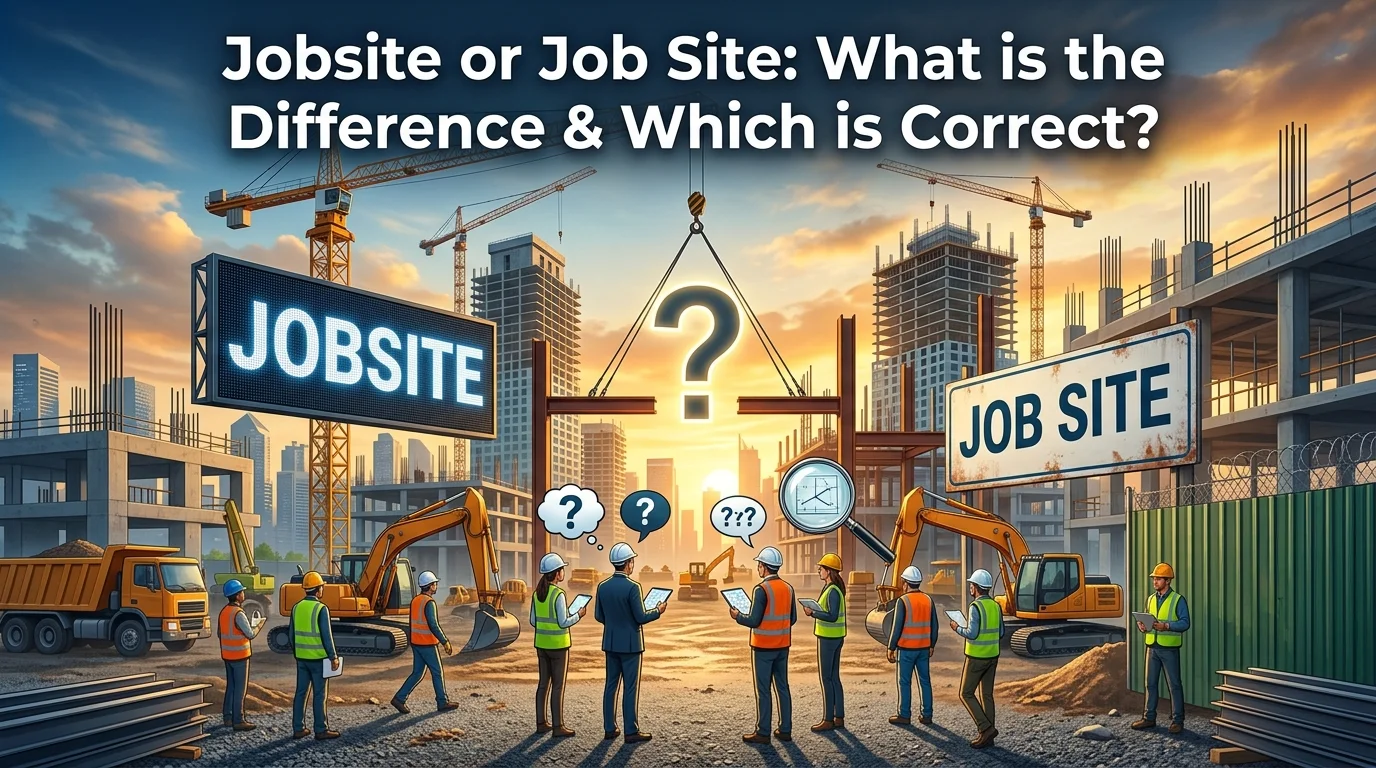
The terms “jobsite” and “job site” often confuse writers, students, and professionals in construction and project management contexts. While they look similar, their usage differs in style and grammar conventions. Understanding the correct form helps improve writing clarity, especially in formal documents, workplace communication, and SEO content.
Comparison Overview
“Jobsite” and “job site” both refer to a physical location where work or a project is being carried out, especially in construction, engineering, and maintenance industries. The key difference lies in language style: one is a closed compound word, while the other is a two-word form used in more formal or traditional writing. Both are widely understood, but usage depends on context and style guide preferences.
Definition of Jobsite
“Jobsite” is a closed compound noun commonly used in American English, especially in modern writing, construction industry communication, and digital content. It refers to a specific location where work is actively taking place, such as building construction or field operations. It is often preferred in informal, technical, or industry-specific contexts.
Definition of Job Site
“Job site” is a two-word noun phrase that carries the same meaning as “jobsite.” It is more traditional and is often used in formal writing, academic texts, editorial standards, and some style guides that prefer separated compound nouns. It is still widely accepted and understood in professional communication.
Main Differences Between Jobsite and Job Site
The main difference between “jobsite” and “job site” is structural rather than meaning-based. Both refer to the same concept, but their usage depends on writing style, formality, and editorial preference.
“Jobsite” is more compact and modern, often used in marketing, construction company branding, and casual professional writing. “Job site” is more formal and aligns with traditional grammar rules where compound nouns are kept separate.
In meaning, there is no difference. In usage, consistency within a document is what matters most.
Comparison Table
| Feature | Jobsite | Job Site |
| Structure | One word | Two words |
| Formality | Less formal | More formal |
| Usage | Modern writing, industry use | Academic, editorial writing |
| Meaning | Same | Same |
Grammar Guide
Both “jobsite” and “job site” function as nouns. They are used to describe a place rather than an action or quality. Grammar rules do not change the meaning, but they influence how the term is presented in writing.
How each term is used in sentences
- The team arrived at the jobsite early in the morning.
- Safety rules must be followed at every job site.
- The jobsite was inspected before construction began.
- Workers left the job site after completing their shift.
- Equipment was delivered directly to the jobsite entrance.
Common mistakes learners make
One common mistake is mixing both forms within the same document, which reduces consistency. Another error is treating “jobsite” as a verb or using it without context, which can confuse readers.
Simple rules to remember
If you are writing casually or in industry communication, “jobsite” is acceptable. If you are writing formally or following strict editorial guidelines, “job site” is safer.
Quick tips for writing and speaking
Choose one form and stay consistent throughout your document. Check style guides if you are writing for publication. In spoken English, both are pronounced the same, so confusion only happens in writing.
When to Use Each One
Use “jobsite” when writing in modern construction communication, internal reports, marketing content, or casual professional documents. It is common in websites and company materials.
Use “job site” when writing academic papers, formal reports, journalism, or when following traditional grammar rules. It is also preferred in style-sensitive publications.
When NOT to Use Each One
Avoid switching between “jobsite” and “job site” in the same document. Do not use them interchangeably without consistency. Also avoid using them in contexts where a more specific term like “construction site” or “worksite” would be clearer.
Which One to Use (Decision Guide)
If your audience is industry professionals or digital readers, “jobsite” is often acceptable. If your audience is academic, editorial, or formal, choose “job site.” When in doubt, follow the two-word version because it is more universally accepted in formal English.
Real-World Practical Examples
Jobsite Examples
- The contractor visited the jobsite to check progress.
- Safety helmets are required at the jobsite at all times.
- The jobsite was closed due to bad weather conditions.
- Workers reported early to the jobsite briefing.
- Materials were stored securely at the jobsite.
Job Site Examples
- The engineer conducted a survey at the job site.
- Visitors must register before entering the job site.
- The job site inspection revealed several issues.
- Noise levels at the job site are strictly regulated.
- The manager arrived at the job site for evaluation.
Self-Assessment (Fill in the Blanks)
- The workers arrived early at the ______ to begin construction.
- Safety rules must be followed at every ______.
- The engineer inspected the ______ before approval.
- Materials were delivered directly to the ______.
- The ______ was shut down due to weather conditions.
- Visitors must sign in at the ______ entrance.
- The contractor reviewed progress at the ______.
- The ______ required additional safety measures.
- Reports were submitted after leaving the ______.
- The ______ was fully operational by Monday.
- Equipment was stored securely at the ______.
- The manager visited the ______ for inspection.
- Noise control rules apply at the ______.
- The ______ was cleared before work resumed.
- Workers gathered at the ______ briefing area.
- The ______ had strict safety supervision.
- Engineers evaluated the ______ conditions.
- The ______ was temporarily closed for repairs.
- Documentation was completed at the ______.
- The ______ followed updated construction guidelines.
Answers
- jobsite
- job site
- job site
- jobsite
- jobsite
- job site
- jobsite
- job site
- jobsite
- job site
- jobsite
- job site
- job site
- jobsite
- jobsite
- job site
- job site
- jobsite
- job site
- jobsite
Final Verdict
Both “jobsite” and “job site” are correct and refer to the same meaning, but they differ in style and formality. “Jobsite” is more modern and commonly used in industry and digital content, while “job site” is more traditional and preferred in formal writing. The best choice depends on your audience and writing style, but consistency is the most important rule to follow.
Conclusion About Jobsite or Job Site
Both “jobsite” and “job site” refer to the same idea, but their usage depends on writing style and context. Whether you are writing for construction documents, academic work, or digital content, choosing the right form helps maintain clarity and consistency. “Jobsite” is commonly used in modern industry writing and online platforms, while “job site” remains preferred in formal and traditional grammar settings. Neither is incorrect, but consistency within a piece of writing is important for professionalism. Understanding this small difference helps improve communication, especially in professional environments where precision matters. In the end, the best choice depends on your audience and purpose, so pick one form and use it consistently throughout your writing. With clear awareness of both forms, writers can avoid confusion, improve readability, and create content that aligns better with industry standards and reader expectations across different platforms and communication styles.
FAQs About Jobsite or Job Site
What is difference between jobsite and job site?
Both terms refer to the same meaning, a place where work is carried out, especially in construction or project-based industries. The difference is only in writing style. “Jobsite” is a closed form used in modern usage, while “job site” is a two-word traditional form preferred in formal writing. Both are correct and interchangeable depending on context and style preference.
When should I use jobsite?
Use “jobsite” when writing in modern professional or industry-focused contexts such as construction updates, company websites, internal reports, and marketing materials. It is widely accepted in informal and digital communication. However, ensure consistency throughout the document. It is especially useful when you want a compact, modern term that aligns with current industry writing trends and online usage patterns.
When should I use job site?
“Job site” is best used in formal writing such as academic papers, reports, journalism, and editorial content. It aligns with traditional grammar rules that prefer separating compound nouns. It is also useful when following strict style guides. This form adds a more formal tone and is often preferred in documents where clarity and correctness are prioritized over modern styling.
Is jobsite grammatically correct?
Yes, “jobsite” is grammatically correct as a modern closed compound noun. It is widely accepted in industry writing, especially in construction and digital content. While some traditional grammar guides prefer “job site,” both forms are considered correct. The key is not grammar correctness but maintaining consistency throughout your writing to ensure clarity and professionalism.
Is job site more formal?
Yes, “job site” is generally considered more formal because it follows traditional grammar conventions that separate compound nouns into two words. It is commonly used in academic writing, official reports, and editorial standards. However, both forms are acceptable, and formality depends more on context and audience than correctness alone.
Can I mix jobsite and job site?
It is not recommended to mix both forms within the same document. Doing so can make writing appear inconsistent and less professional. Instead, choose one version based on your audience or style guide and use it consistently throughout your content. Consistency improves readability and strengthens overall writing quality.
Which is better for SEO writing?
Both “jobsite” and “job site” can perform well in search optimization because users commonly search for both versions. However, “jobsite” is often favored in digital content due to its modern usage and compact form. The best strategy is to include both naturally in content while maintaining readability and consistency.
Do both terms mean the same thing?
Yes, both terms mean exactly the same thing. They refer to a location where work, especially construction or project-related activity, takes place. The only difference is in spelling style and formatting, not in meaning or usage context.
What industries use jobsite most?
The term “jobsite” is most commonly used in construction, engineering, maintenance, and project management industries. It is also seen in logistics and field service sectors. Its modern, compact form makes it popular in digital platforms, company websites, and internal communication systems within these industries.
How do style guides treat jobsite vs job site?
Style guides vary in their preference. Some prefer “job site” as the formal, traditional form, while others accept or encourage “jobsite” for modern usage. The key rule across most guides is consistency. Writers should choose one form and apply it uniformly throughout the document to maintain clarity and professionalism.

Daniel Brooks is an English educator with a passion for explaining similes and word comparisons in plain language. He covers topics like versus meanings, correct usage, and figurative language to help writers avoid common mistakes and improve clarity in everyday writing.