
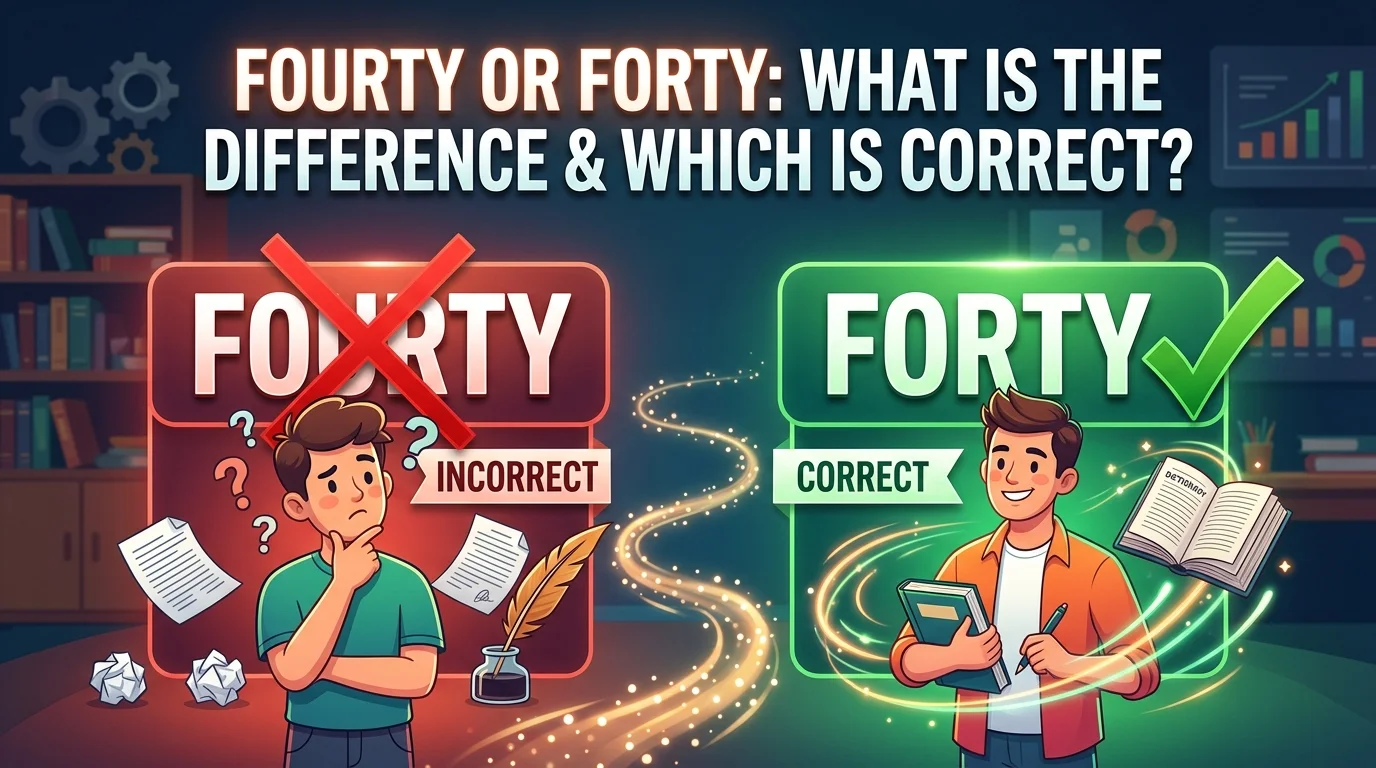
Many English learners get confused between “fourty” and “forty” because both words sound almost the same. However, only one spelling is correct in standard English. Understanding the difference helps improve spelling, grammar, writing accuracy, and confidence in both formal and everyday communication.
Comparison Overview
“Fourty” and “forty” both relate to the number 40, but they are not equally correct in English grammar. “Forty” is the official and accepted spelling used in dictionaries, schools, books, business writing, and everyday communication. “Fourty” is a common misspelling that many learners accidentally use because it looks similar to “four.”
Definition of Fourty
“Fourty” is an incorrect spelling of the number 40 in English. Although many people write it this way because it seems connected to the word “four,” it is not grammatically accepted in standard English.
The spelling “fourty” should generally be avoided in formal writing, academic work, professional communication, and exams.
Examples of incorrect usage:
- I have fourty dollars.
- She is fourty years old.
- The class has fourty students.
All of these examples should use “forty” instead.
Definition of Forty
“Forty” is the correct spelling of the number 40 in English. It is used when talking about quantity, age, numbers, measurements, prices, years, and many other situations.
“Forty” functions as a number word and is accepted in all forms of English writing and speaking.
Examples:
- He ran forty kilometers.
- She turned forty last week.
- The company hired forty employees.
Main Differences Between Fourty and Forty
| Feature | Fourty | Forty |
| Correct spelling | No | Yes |
| Dictionary accepted | No | Yes |
| Used in formal English | No | Yes |
| Common learner mistake | Yes | No |
| Related to number 40 | Yes | Yes |
| Safe for exams and professional writing | No | Yes |
The biggest difference is grammatical correctness. “Forty” is the only proper spelling in English, while “fourty” is considered an error.
Grammar Guide
How Each Term Is Used in Sentences
“Forty” is used as a number or quantity word.
Examples:
- There were forty chairs in the hall.
- My uncle is forty years old.
- The package weighs forty pounds.
- She saved forty dollars this month.
- Forty students attended the seminar.
“Fourty” should not be used in proper English sentences.
Incorrect examples:
- He bought fourty books.
- She waited fourty minutes.
Correct versions:
- He bought forty books.
- She waited forty minutes.
Common Mistakes Learners Make
Many learners make these mistakes:
- Adding “u” because of the word “four”
- Typing “fourty” quickly without checking spelling
- Assuming pronunciation matches spelling
- Confusing English number patterns
- Using autocorrect suggestions incorrectly
Another common mistake is writing:
- fourty-one
- fourty-five
- fourty-seven
Correct forms are:
- forty-one
- forty-five
- forty-seven
Simple Rules to Remember
Remember these easy rules:
- The number 40 is always spelled “forty.”
- Never add “u” after “fo.”
- If you see “fourty,” it is incorrect.
- All compound numbers use “forty,” such as “forty-two” or “forty-nine.”
A simple memory trick:
“Four loses the ‘u’ when it becomes forty.”
Quick Tips for Writing and Speaking
- Double-check number spellings in formal writing.
- Use spell-check tools carefully.
- Practice writing common number words.
- Read books and articles to become familiar with correct spelling.
- Remember that pronunciation does not always match spelling in English.
When to Use Each One
Use “forty” when:
- Writing numbers in words
- Mentioning age
- Discussing money
- Talking about quantity
- Writing academic papers
- Sending professional emails
- Taking English exams
Examples:
- Forty employees attended the meeting.
- She paid forty dollars.
- The journey lasted forty days.
Do not intentionally use “fourty” in any formal or standard English situation.
When NOT to Use Each One
Do not use “fourty”:
- In school assignments
- In business writing
- In official documents
- In exams
- In books or articles
- In resumes or applications
Avoid sentences like:
- I waited fourty minutes.
- The building has fourty rooms.
Instead write:
- I waited forty minutes.
- The building has forty rooms.
Which One to Use (Decision Guide)
Use this quick guide:
| Situation | Correct Choice |
| Writing the number 40 | Forty |
| Academic writing | Forty |
| Business communication | Forty |
| Everyday conversation | Forty |
| English grammar tests | Forty |
| Informal texting | Still use Forty |
Decision rule:
If you mean the number 40, always use “forty.” Never use “fourty.”
Real-World Practical Examples
Fourty Examples
These examples show incorrect usage that learners commonly make:
- The office hired fourty workers.
- She completed fourty pages.
- We drove fourty miles yesterday.
- He saved fourty dollars.
- The machine operated for fourty hours.
Corrected versions:
- The office hired forty workers.
- She completed forty pages.
- We drove forty miles yesterday.
- He saved forty dollars.
- The machine operated for forty hours.
Forty Examples
- The teacher graded forty exams.
(Education) - My grandmother is forty years old.
(Daily life) - Scientists observed forty samples during the experiment.
(Science) - The company earned forty million dollars last year.
(Business) - I wrote forty pages for my project.
(Writing) - The software supports forty languages.
(Technology) - Forty guests attended the wedding.
(Conversation)
Self-Assessment (Fill in the Blanks)
- She waited ______ minutes for the bus.
- The correct spelling of the number 40 is ______.
- He bought ______ apples from the market.
- I am ______ years old.
- The company hired ______ new workers.
- The incorrect spelling is ______.
- We studied for ______ hours yesterday.
- The class contains ______ students.
- You should write ______ in formal English.
- The train traveled ______ miles.
- My father turned ______ this year.
- The package weighs ______ kilograms.
- Never write ______ in academic essays.
- She saved ______ dollars last month.
- The teacher checked ______ notebooks.
- The grammatically correct form is ______.
- They spent ______ days on vacation.
- The meeting lasted ______ minutes.
- Dictionaries recognize ______ as correct.
- The commonly mistaken spelling is ______.
Answers
- forty
- forty
- forty
- forty
- forty
- fourty
- forty
- forty
- forty
- forty
- forty
- forty
- fourty
- forty
- forty
- forty
- forty
- forty
- forty
- fourty
Final Verdict
Between “fourty” and “forty,” only “forty” is correct in English grammar. “Fourty” is a spelling mistake that many learners make because of the connection to the word “four.” In every professional, academic, and everyday situation, “forty” should always be used. Remembering this simple spelling rule will help improve your writing accuracy and confidence in English communication.
Conclusion About Fourty Or Forty
Understanding the difference between “fourty” and “forty” is a small but important step in improving English spelling accuracy. While both may sound the same in speech, only “forty” is the correct and accepted form in standard English. “Fourty” is simply a common spelling mistake that appears due to confusion with the word “four.” Once you remember the correct form, your writing instantly becomes clearer, more professional, and more credible. Whether you are writing emails, assignments, or everyday messages, using “forty” correctly helps you communicate with confidence and precision in any situation.
FAQs
Is “fourty” a correct English word?
No, “fourty” is not correct in standard English. It is a common spelling mistake. The proper and accepted spelling for the number 40 is “forty,” which is used in all formal writing, education, and professional communication.
Why is “forty” spelled without a “u”?
“Forty” is an irregular spelling in English. Even though it comes from “four,” the historical development of the language dropped the “u.” That is why we write “forty” instead of “fourty.”
Which is used in exams, fourty or forty?
Only “forty” is correct in exams. Using “fourty” is considered a spelling error and can result in marks being deducted in academic writing or English tests.
Is “fourty” used in any English dialect?
No standard English dialect officially uses “fourty.” It is universally considered incorrect in British, American, and international English.
Why do people often write “fourty” instead of “forty”?
People usually write “fourty” because they associate the spelling with the word “four.” Since pronunciation is similar, the mistake becomes common among learners.
How do I remember the correct spelling of forty?
A simple trick is to remember that “four loses its u when it becomes forty.” This helps avoid confusion and reinforces correct spelling.
Is “forty” used for all contexts?
Yes, “forty” is used in all contexts, including age, quantity, money, time, and measurements. It is the only correct form regardless of situation.
What is the plural form of forty?
Numbers like forty do not have a plural form. However, you can use it in plural contexts like “forty students” or “forty cars.”
Can I use “forty” in formal writing?
Yes, “forty” is fully correct and widely used in formal writing such as essays, reports, emails, and academic documents.
Is “fourty” acceptable in informal texting?
Even in informal texting, “forty” should still be used. “Fourty” is always considered incorrect in proper English usage.

Ethan Clarke is a language writer who specializes in breaking down similes, word meanings, and commonly confused terms. His work focuses on clear explanations, practical examples, and simple comparisons that help readers understand how English