
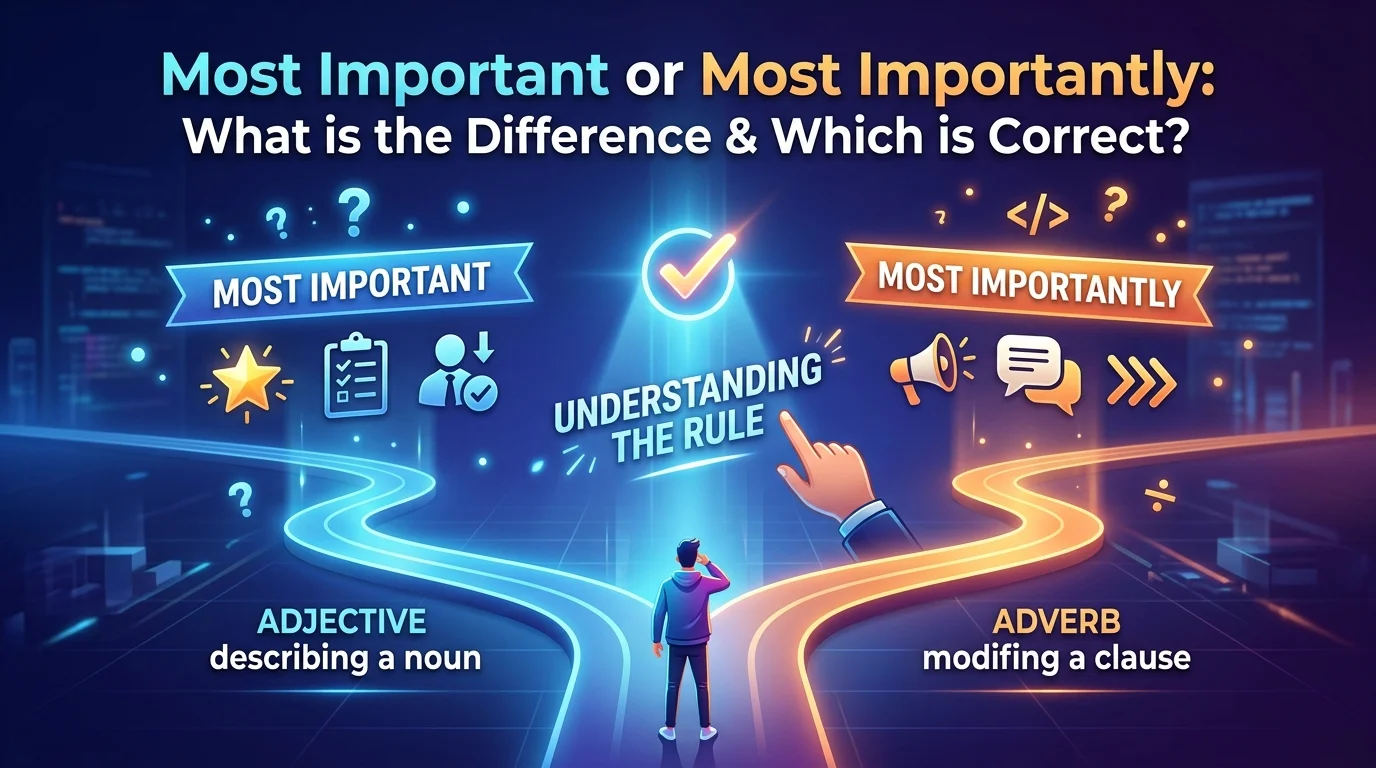
Understanding the difference between “most important” and “most importantly” is essential for clear and natural English writing. These two expressions are often confused by learners because they look similar but function differently in sentences. This guide explains their meanings, grammar, usage, and real examples so you can confidently choose the correct form in any context.
Comparison Overview
Both expressions come from the idea of importance, but they play different roles in a sentence. “Most important” is typically used as an adjective phrase to describe a noun, while “most importantly” is an adverbial phrase used to modify a whole sentence or introduce a key point. Knowing this difference helps improve both writing clarity and fluency.
Definition of Most Important
“Most important” is a superlative adjective phrase. It is used to describe something that has the highest level of importance among a group of things. It directly modifies a noun.
It answers the question: Which thing is the most important?
Example idea: the most important rule, the most important factor, the most important lesson.
Definition of Most Importantly
“Most importantly” is an adverbial phrase used to emphasize a key point in a sentence. It does not describe a noun directly. Instead, it connects ideas or highlights the main message.
It often appears at the beginning or middle of a sentence.
Example idea: Most importantly, we must stay safe.
Main Differences Between Most Important and Most Importantly
The key difference lies in grammar and function. “Most important” modifies nouns, while “most importantly” modifies entire ideas or sentences.
| Feature | Most Important | Most Importantly |
| Word type | Adjective phrase | Adverbial phrase |
| Function | Describes a noun | Emphasizes a sentence or idea |
| Position | Before a noun | At sentence start or mid-sentence |
| Usage focus | Specific item or thing | Main idea or conclusion |
Grammar Guide
How each term is used in sentences
“Most important” is used before nouns to show priority.
Example pattern: the most important + noun
“Most importantly” is used to introduce a key point or emphasize a statement.
Example pattern: Most importantly + sentence
Common mistakes learners make
Many learners incorrectly use “most important” to start sentences when they should use “most importantly.” Another common mistake is using “most importantly” before a noun, which is grammatically incorrect.
Simple rules to remember
If you are describing a thing, use “most important.” If you are highlighting a key idea, use “most importantly.”
Quick tips for writing and speaking
Think of “most important” as pointing to a object or idea, and “most importantly” as introducing a conclusion or emphasis. This simple distinction prevents confusion in most cases.
When to Use Each One
Use “most important” when ranking items, factors, or things in importance. Use “most importantly” when summarizing or emphasizing the main message in speech or writing. It is especially common in essays, presentations, and formal writing.
When NOT to Use Each One
Do not use “most important” at the beginning of a sentence unless it modifies a noun immediately after it. Do not place “most importantly” directly before a noun, as it cannot function as an adjective.
Which One to Use (Decision Guide)
If you can replace the phrase with a noun phrase, choose “most important.” If the phrase introduces a key point or summary idea, choose “most importantly.” Always check whether you are describing something or emphasizing a statement.
Real-World Practical Examples
Most Important Examples
- The most important factor in success is discipline.
- Water is the most important resource for life.
- This is the most important rule in the classroom.
- Health is the most important priority for everyone.
- Communication is the most important skill in teamwork.
Most Importantly Examples
- Most importantly, you should stay calm during the exam.
- The project was completed on time and, most importantly, within budget.
- Most importantly, we need to protect the environment.
- He is experienced and, most importantly, reliable.
- Most importantly, follow all safety instructions.
Self-Assessment (Fill in the Blanks)
- The ______ factor in learning is consistency.
- ______, always check your work before submitting.
- Health is the ______ thing in life.
- ______, we must respect others’ opinions.
- This is the ______ lesson of the chapter.
- ______, stay focused on your goals.
- The ______ rule in football is fairness.
- She is talented and, ______, hardworking.
- The ______ part of the project is planning.
- ______, safety comes first in all situations.
- Time management is the ______ skill for students.
- ______, never give up during challenges.
- This is the ______ decision we have made.
- ______, always double-check calculations.
- Trust is the ______ element in relationships.
- ______, keep your documents organized.
- The ______ aspect of success is effort.
- ______, follow instructions carefully.
- Education is the ______ investment in life.
- ______, teamwork leads to better results.
Answers
- most important
- most importantly
- most important
- most importantly
- most important
- most importantly
- most important
- most importantly
- most important
- most importantly
- most important
- most importantly
- most important
- most importantly
- most important
- most importantly
- most important
- most importantly
- most important
- most importantly
Final Verdict
Both “most important” and “most importantly” are correct, but they are not interchangeable. “Most important” is used when describing a noun, while “most importantly” is used when emphasizing a key idea or conclusion. Understanding this difference helps you write more naturally and avoid common grammar mistakes in both academic and everyday English.
Conclusion About Most Important or Most Importantly
Understanding the difference between “most important” and “most importantly” helps you write clearer and more natural English in both academic and everyday communication. Although they look similar, they serve very different grammatical roles. “Most important” is used to describe a noun and highlight the highest level of significance among things, such as rules, ideas, or factors. In contrast, “most importantly” is used to introduce or emphasize a key idea, often guiding readers toward the main takeaway of a sentence. When used correctly, these expressions improve sentence flow, clarity, and overall writing quality. Learning this simple distinction makes your communication more precise and confident. With regular practice, you will quickly recognize when to describe something and when to emphasize a point, helping you avoid common grammar mistakes and express ideas more effectively in any context.
FAQs
What is the main difference between most important and most importantly?
The main difference is grammatical function. “Most important” describes a noun, while “most importantly” introduces or emphasizes a key idea in a sentence. One modifies things, the other modifies ideas. This distinction helps ensure clarity in writing and prevents incorrect sentence structure in both formal and informal communication.
Can most importantly start a sentence?
Yes, “most importantly” can start a sentence and is often used to highlight the main point or conclusion. It helps guide attention to the most significant idea. For example, Most importantly, follow safety guidelines. It is commonly used in essays, speeches, and professional writing for emphasis.
Is most important grammatically correct?
Yes, “most important” is grammatically correct when used before a noun. It is an adjective phrase that shows the highest level of importance among items. For example, the most important rule is honesty. It should always be followed by a noun to form a complete and correct phrase.
When should I use most importantly?
Use “most importantly” when you want to emphasize a key message, conclusion, or important point in a sentence. It is useful in writing and speaking when transitioning to the main idea. It helps make communication clearer by drawing attention to what matters most in the context.
Can most importantly be used before a noun?
No, “most importantly” should not be used before a noun because it functions as an adverbial phrase. It modifies whole sentences or ideas, not nouns. If you need to describe a noun, you should use “most important” instead for correct grammatical structure and clarity.
What part of speech is most important?
“Most important” is an adjective phrase. It is used to describe nouns and show that something has the highest level of importance. It helps compare significance between different items. For example, the most important factor in success is effort and consistency.
Why do people confuse these two phrases?
People confuse these phrases because they look similar and both relate to importance. However, their roles in grammar are different. One modifies nouns and the other modifies entire sentences. This similarity in form and meaning often leads to mistakes in writing and speaking.
Is it wrong to say most important at the start of a sentence?
It is not necessarily wrong if followed immediately by a noun phrase, but it cannot stand alone at the beginning of a sentence. It must describe something. Without a noun, the phrase becomes incomplete, which is why many learners mistakenly use it incorrectly in sentence openings.
How can I remember the difference easily?
A simple way to remember is: use “most important” when describing a thing, and use “most importantly” when introducing a key idea. If it points to a noun, choose the first. If it emphasizes a sentence or message, choose the second. Practice helps make it automatic.
Which is more formal in writing?
Both are formal when used correctly. “Most important” is formal in descriptive contexts, while “most importantly” is formal when introducing key points or conclusions. The level of formality depends on correct usage rather than the phrase itself, making both suitable for academic and professional writing.

Amelia Wright focuses on making figurative language easy to understand. Her writing explains similes, metaphors, and word meanings using relatable examples. She aims to help readers recognize subtle differences in usage and apply them correctly in both academic and casual writing.