
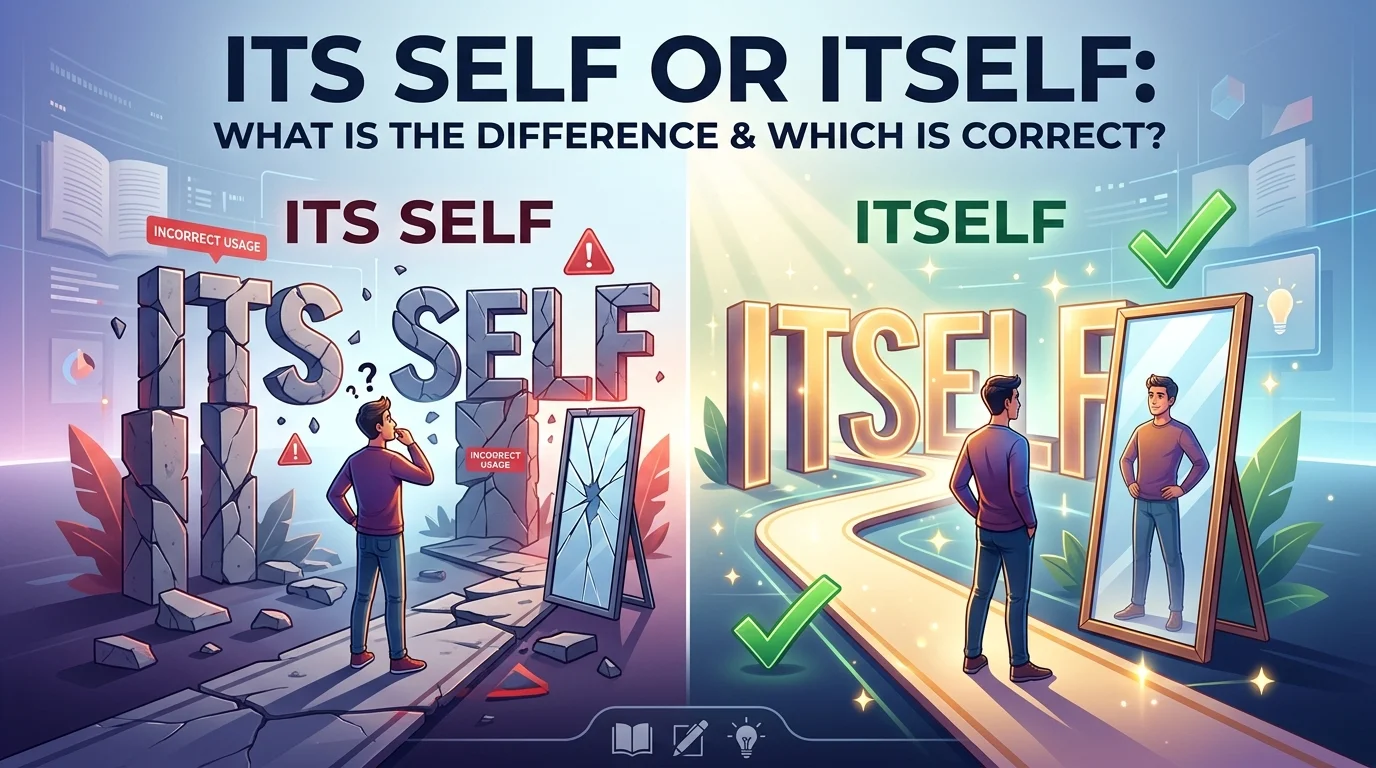
The confusion between “Its Self” and “Itself” is very common among English learners and even native speakers. These two forms look similar but only one is grammatically correct in standard English. Understanding the difference helps improve writing accuracy, clarity, and overall grammar confidence in everyday communication.
Comparison Overview
“Its Self” and “Itself” are often confused because they involve the same root word “it.” However, only one functions as a proper reflexive pronoun in English. “Itself” is the correct, widely accepted form used in modern grammar, while “Its Self” is generally considered incorrect in standard usage and appears only in rare or outdated contexts where “self” is treated as a separate noun.
Definition of Its Self
“Its Self” is a nonstandard or incorrect separation of the reflexive concept of “it.” It attempts to split “it” and “self” into two words, but in modern English grammar this is not accepted. It is sometimes seen in older philosophical or stylistic writing, but it is not used in correct academic or professional English.
Definition of Itself
“Itself” is a reflexive pronoun used when the subject “it” acts on itself. It is widely used in English to refer back to animals, objects, ideas, or things without gender. It helps show that the action of the verb reflects back on the same subject.
Main Differences Between Its Self and Itself
The primary difference is grammatical correctness and usage. “Itself” is a single, standardized pronoun used in modern English, while “Its Self” is a separated form that is not accepted in standard grammar.
| Feature | Its Self | Itself |
| Correctness | Incorrect in modern English | Correct and standard |
| Usage | Rare, outdated, or philosophical | Everyday communication |
| Structure | Two separate words | One reflexive pronoun |
| Function | Intended meaning unclear | Shows action reflecting back to subject |
| Acceptance | Not used in formal writing | Used in all contexts |
Grammar Guide
“Itself” is a reflexive pronoun that replaces the object when it is the same as the subject. It ensures clarity and avoids repetition in sentences.
How each term is used in sentences
Correct usage patterns:
- The machine repaired itself.
- The dog cleaned itself after the bath.
- The system updated itself automatically.
Incorrect usage:
- The machine repaired its self. (incorrect split form)
Common mistakes learners make
One common mistake is separating “itself” into two words because of the presence of “its.” Another mistake is confusing “its” (possessive) with “itself” (reflexive).
Simple rules to remember
If the subject is “it” and the action returns to the same subject, always use “itself.” Never separate it into two words in modern English.
Quick tips for writing and speaking
Think of “self” as always attached when referring to reflexive actions. If you can replace the phrase with “himself” or “herself,” then “itself” is likely correct.
When to Use Each One
“Itself” is used when referring to something non-human performing an action on itself, such as machines, animals, or abstract ideas. “Its Self” should not be used in modern writing except when quoting historical or philosophical texts.
When NOT to Use Each One
Do not use “Its Self” in academic writing, business communication, exams, or everyday English. It is also incorrect to split “itself” into two words for emphasis or style. Always avoid replacing “itself” with “its self.”
Which One to Use (Decision Guide)
If you are referring to an object, animal, or idea doing something to itself, use “itself.” If you are unsure, test the sentence by replacing “itself” with “himself” or “herself.” If it still makes sense, “itself” is correct. Never use “Its Self” in standard writing.
Real-World Practical Examples
Its Self Examples
“Its Self” is not used in modern standard English, but here are examples of incorrect or historical-style usage for learning purposes:
- The concept of the mind and its self was discussed in philosophy.
- The idea of its self was debated in ancient texts.
- Writers once separated its self in early grammar discussions.
- The notion of its self appears in old manuscripts.
- Philosophers referred to consciousness and its self.
Itself Examples
- The cat cleaned itself after eating.
- The phone turned itself off automatically.
- The company rebranded itself last year.
- The door locked itself when closed.
- The software updated itself overnight.
Self-Assessment (Fill in the Blanks)
- The machine repaired ______ without help.
- The dog cleaned ______ after playing outside.
- The system updated ______ automatically.
- The idea explained ______ in the report.
- The phone turned ______ off.
- The team organized ______ for the event.
- The cat groomed ______ carefully.
- The device switched ______ on.
- The program restarted ______.
- The company rebranded ______.
- The answer revealed ______ in the text.
- The robot assembled ______.
- The project completed ______ on time.
- The software fixed ______.
- The engine cooled ______ after running.
- The structure supports ______.
- The system monitors ______.
- The application installs ______ automatically.
- The network configures ______.
- The device protects ______ from damage.
Answers
- itself
- itself
- itself
- itself
- itself
- itself
- itself
- itself
- itself
- itself
- itself
- itself
- itself
- itself
- itself
- itself
- itself
- itself
- itself
- itself
Final Verdict
“Itself” is the only correct and standard form in modern English grammar. It is used as a reflexive pronoun for objects, animals, and ideas when the subject acts on itself. “Its Self” is not accepted in contemporary writing and should be avoided in all formal and informal contexts. For clear, correct, and professional English, always choose “itself.”
Conclusion About Its Self or Itself
The confusion between Its Self and Itself often comes from how similar they look, but understanding the difference makes English much clearer and more accurate. Itself is the only correct reflexive pronoun used in modern grammar, while Its Self is generally considered incorrect or outdated in standard usage. Once you recognize that reflexive pronouns always stay as one word, avoiding errors becomes much easier. This small grammar rule can significantly improve writing quality in essays, emails, and professional communication. Whether you are a student or a writer, mastering this distinction helps you sound more natural and confident in English. The key takeaway is simple: whenever a subject acts on itself, always choose itself and avoid splitting it into two words. With regular practice and attention to context, this common confusion can be eliminated quickly and permanently. This understanding also helps reduce common grammar mistakes in everyday writing and speaking.
FAQs
Which is correct Its Self or Itself?
Itself is the correct form in modern English grammar. It works as a reflexive pronoun used when a subject acts on itself. Its Self is not accepted in standard writing and is generally considered incorrect. In formal, academic, and everyday communication, itself should always be used to maintain clarity and grammatical accuracy.
What does Itself mean?
Itself is a reflexive pronoun that refers back to a subject that is not a person. It is used for animals, objects, or ideas when they perform an action on themselves. It helps avoid repetition in sentences and makes writing clearer. For example, the machine fixed itself shows the action returning to the same subject.
Why is Its Self wrong?
Its Self is wrong because English reflexive pronouns are always written as a single word. Splitting itself into two words breaks grammatical structure and creates confusion. Modern English standards do not recognize its self as valid usage. Only itself is accepted in writing, speaking, and formal communication across all contexts.
How is itself used in sentences?
Itself is used when the subject of a sentence acts on the same subject. It replaces object forms to avoid repetition. Common patterns include the machine repaired itself or the dog cleaned itself. It can also emphasize independence, as in the company built itself from the ground up in a short time.
Can you give examples of itself?
Itself is commonly used in many everyday contexts. The phone turned itself off due to low battery. The system updated itself overnight without user input. The organization restructured itself to improve efficiency. The cat cleaned itself after eating. The software installed itself automatically after download.
What is the difference between its and itself?
Its is a possessive determiner used to show ownership, while itself is a reflexive pronoun used when something acts on itself. For example, the dog wagged its tail shows possession, while the dog cleaned itself shows reflexive action. Mixing the two is a common grammar mistake that should be avoided.
When should itself be used in formal writing?
Itself should be used in formal writing whenever referring to a non-human subject performing an action on itself. It is appropriate in academic essays, business documents, and technical descriptions. Using itself correctly ensures clarity and professionalism. It should always remain one word, never separated or altered in structure.
What are common mistakes with itself?
Common mistakes include splitting itself into two words, confusing its with itself, and using itself when a possessive form is needed. Many learners also overthink reflexive usage in simple sentences. The best approach is to remember that itself is always one word and always refers back to the subject performing the action.
What is a simple trick to remember itself?
A simple way to remember is to link itself with other reflexive pronouns like himself and herself. If the sentence describes something acting on its own, itself is correct. Another trick is to check if the subject and object are the same. If yes, use itself. This makes selection quick and accurate.
Can Its Self ever be correct?
Its Self is not considered correct in modern English grammar. It may appear in very old philosophical or stylistic texts where self is treated separately as a noun, but this is rare and outdated. In everyday writing, academic work, and professional communication, itself is always the correct and accepted form.

Ethan Clarke is a language writer who specializes in breaking down similes, word meanings, and commonly confused terms. His work focuses on clear explanations, practical examples, and simple comparisons that help readers understand how English