
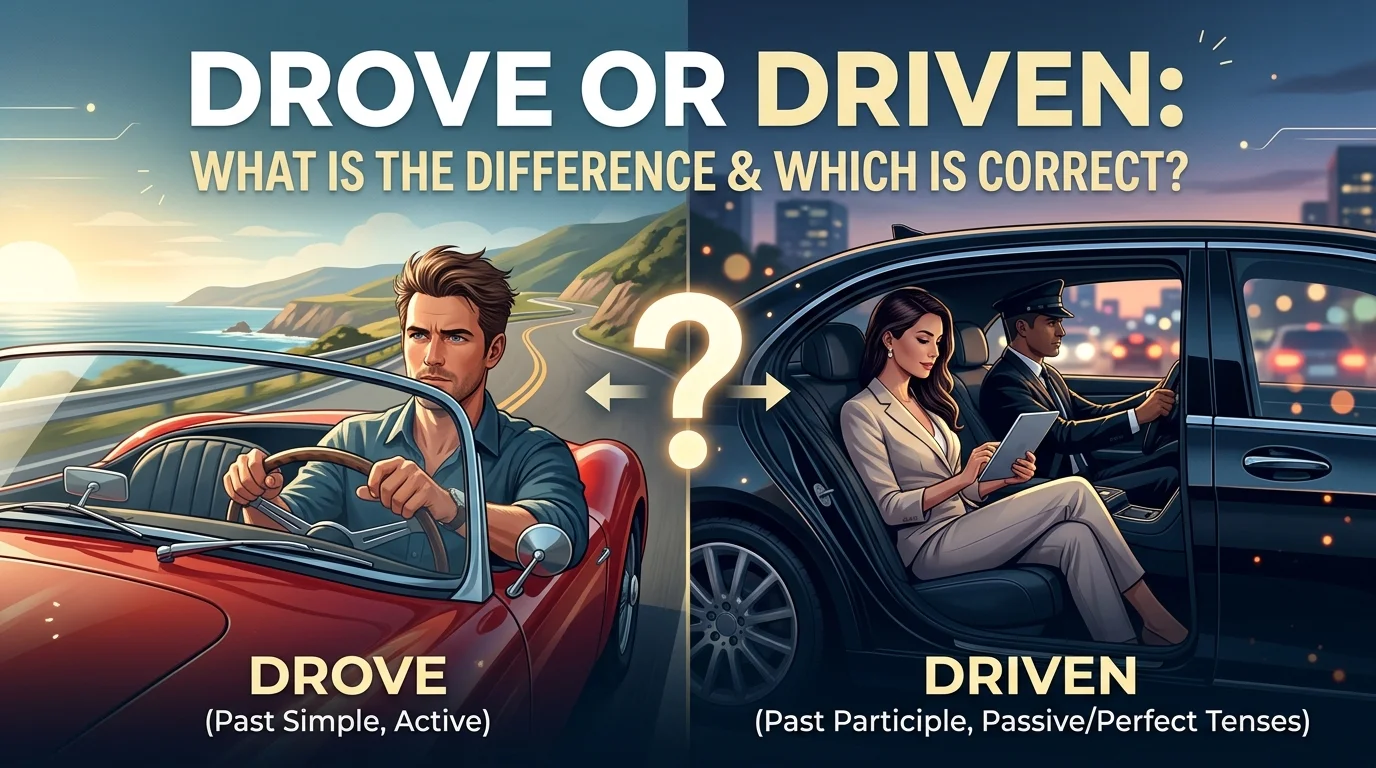
“Drove” and “driven” are two forms of the same verb “drive,” but they are used in different grammatical situations. Many learners confuse them because both relate to past actions involving movement or transportation. Understanding the difference is important for writing correct English sentences and speaking naturally in everyday communication and exams.
Comparison Overview
“Drove” and “driven” both come from the verb “drive,” which means to operate a vehicle or control movement. The key difference is that “drove” is a simple past form, while “driven” is the past participle form. They are not interchangeable and depend on sentence structure and helping verbs.
Definition of Drove
“Drove” is the simple past tense of “drive.” It is used when describing an action that happened and finished in the past without needing a helper verb.
Definition of Driven
“Driven” is the past participle of “drive.” It is used with helping verbs like “has,” “have,” or “had,” and also in passive structures.
Main Differences Between Drove and Driven
The main difference lies in grammar usage. “Drove” stands alone in past tense sentences, while “driven” always needs an auxiliary verb or forms perfect and passive constructions. “Drove” focuses on a completed action, whereas “driven” connects past actions to another time or subject.
Comparison Table:
| Feature | Drove | Driven |
| Verb form | Simple past | Past participle |
| Usage | Alone | With helping verbs |
| Example | I drove to school | I have driven to school |
| Structure | Subject + drove | Subject + has/have/had + driven |
Grammar Guide
Understanding grammar usage helps avoid confusion between these two forms.
How each term is used in sentences
Drove is used in simple past sentences:
I drove to the market yesterday.
Driven is used with helping verbs:
I have driven that car before.
Common mistakes learners make
Many learners incorrectly say “I have drove” instead of “I have driven.” Another common mistake is using “driven” without a helper verb.
Simple rules to remember
Use “drove” for finished past actions without helpers. Use “driven” only with has, have, or had.
Quick tips for writing and speaking
If you can replace the verb with “yesterday,” “last week,” or a finished time, use “drove.” If the sentence uses “has” or “have,” use “driven.”
When to Use Each One
Use “drove” when talking about a completed action in the past. Use “driven” when describing experience, perfect tense, or passive voice situations.
When NOT to Use Each One
Do not use “driven” without a helping verb. Do not use “drove” in present perfect sentences. Avoid mixing them in incorrect structures like “I have drove.”
Which One to Use (Decision Guide)
If the sentence is simple past, choose “drove.” If the sentence includes has, have, or had, choose “driven.” If the focus is on experience or connection to the present, “driven” is correct. If the action is only a past event, “drove” is correct.
Real-World Practical Examples
Drove Examples
- I drove to school yesterday morning.
- She drove her brother to the airport.
- They drove through the mountains last weekend.
- He drove carefully in heavy rain.
- We drove to the city for shopping.
Driven Examples
- I have driven this route many times.
- She has driven a sports car before.
- They have driven across the country.
- He had driven for hours before stopping.
- We have driven that road in winter.
Self-Assessment (Fill in the Blanks)
- I ______ to work yesterday.
- She has ______ that car before.
- They ______ to the beach last summer.
- He has never ______ a truck.
- We ______ through heavy traffic last night.
- I have ______ this road many times.
- She ______ her friend to school.
- They have ______ across the city.
- He ______ too fast yesterday.
- We have never ______ in snow conditions.
- I ______ to the airport last week.
- She has ______ a manual car before.
- They ______ carefully during the storm.
- He has ______ that route before.
- We ______ home after the event.
- I have ______ long distances before.
- She ______ her parents to the station.
- They have ______ that highway often.
- He ______ slowly in the rain.
- We have ______ that journey together.
Answers
- drove
- driven
- drove
- driven
- drove
- driven
- drove
- driven
- drove
- driven
- drove
- driven
- drove
- driven
- drove
- driven
- drove
- driven
- drove
- driven
Final Verdict
“Drove” and “driven” are both correct forms of the verb “drive,” but they are used in different grammatical contexts. “Drove” is used for simple past actions, while “driven” is used with helping verbs and in perfect or passive structures. Understanding this difference helps you speak and write English more accurately and confidently in everyday situations.
Conclusion About Drove or Driven
Understanding the difference between Drove or Driven helps you use English more accurately in both speaking and writing. While both forms come from the same verb, their roles in sentences are very different. “Drove” is used for simple past actions that are already completed, while “driven” works with helping verbs to show experience or connection with the present. Once you recognize this pattern, forming correct sentences becomes much easier and more natural in everyday communication.
FAQs
What is the main difference between drove and driven?
The main difference is grammatical usage. “Drove” is simple past tense used for completed actions in the past. “Driven” is the past participle used with helping verbs like has, have, or had. They cannot replace each other because they function differently in sentence structures and tense formation.
When should I use drove in a sentence?
Use “drove” when talking about a completed action in the past without any helping verb. For example, when describing something that happened at a specific time like yesterday or last year, “drove” is the correct choice. It stands alone as the main verb in simple past tense sentences.
When is driven the correct choice?
“Driven” is correct when used with auxiliary verbs such as has, have, or had. It is also used in passive voice structures. It connects past actions with present relevance or emphasizes experience rather than a single completed event in time.
Can I say I have drove instead of I have driven?
No, “I have drove” is incorrect. The correct form is “I have driven” because present perfect tense requires the past participle, not the simple past form. Using the wrong form is a common mistake among English learners and should be avoided.
Is drove used only for past tense actions?
Yes, “drove” is used only for simple past tense actions that are fully completed. It does not combine with helping verbs like has or have. It simply describes what someone did at a specific time in the past without linking it to the present.
Why do learners confuse drove and driven?
Learners often confuse them because both come from the same verb and refer to past actions. The difference in grammar rules, especially the use of helping verbs with “driven,” makes it harder to remember. Practice and exposure help reduce this confusion over time.
Can driven be used without has or have?
No, “driven” should not be used alone in standard sentences. It needs a helping verb like has, have, or had. Without them, the sentence becomes grammatically incorrect. It is designed to function as part of perfect or passive structures, not independently.
What tense uses the word drove?
“Drove” is used in the simple past tense. It describes actions that started and finished in the past. It is commonly used when talking about specific events, such as driving somewhere yesterday or last week, without linking the action to the present.
How can I remember the difference easily?
A simple way to remember is that “drove” stands alone for past actions, while “driven” always needs a helper like has or have. If you see a helping verb, choose “driven.” If not, and it is a finished action, use “drove.”
Are drove and driven interchangeable?
No, they are not interchangeable. Each has a specific grammatical role. Using them incorrectly can change the meaning or make the sentence ungrammatical. Understanding their structure ensures correct usage in both spoken and written English.