
Understanding the difference between “assist with” and “assist in” is important for clear and natural English usage. These phrases often seem interchangeable, but they follow different grammatical patterns and are used in slightly different contexts. This guide will help you confidently choose the correct expression in writing and speaking.
Comparison Overview
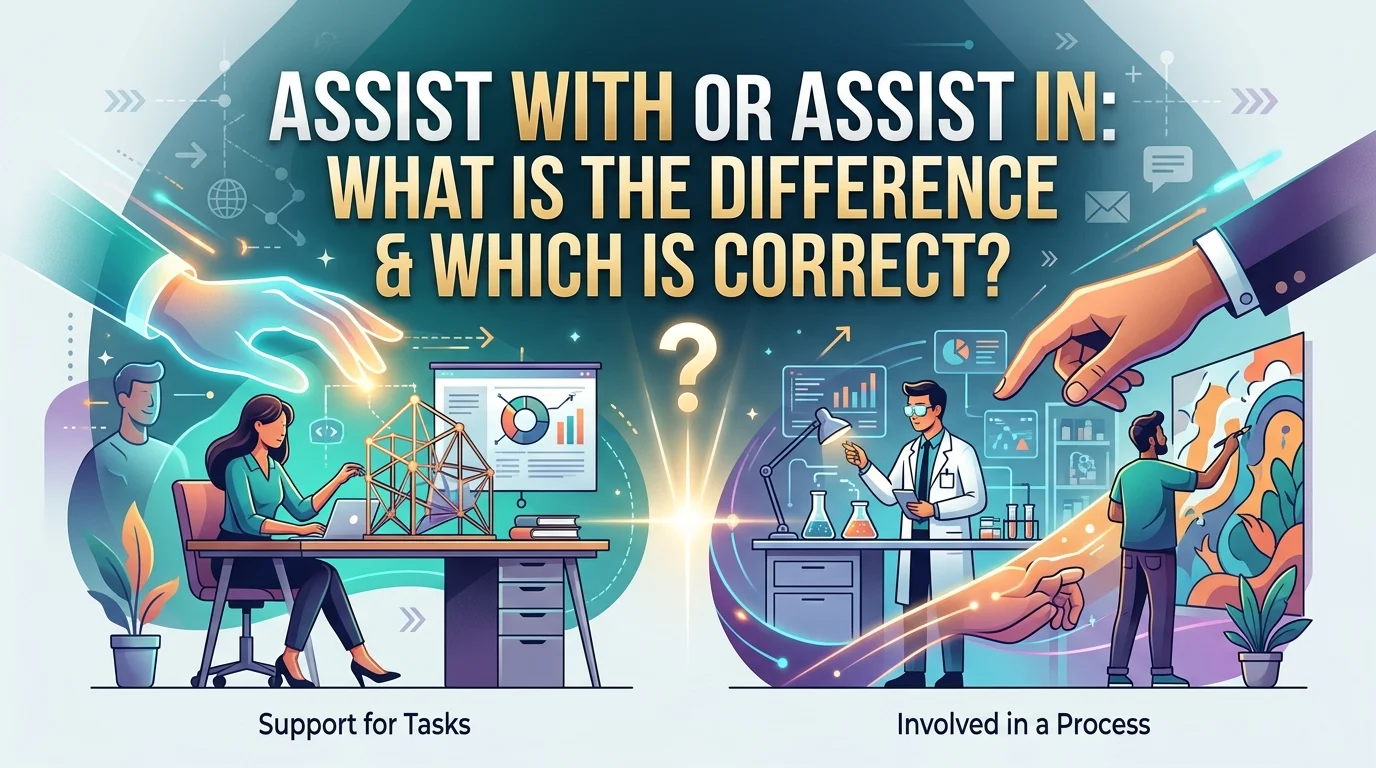
“Assist with” and “assist in” both mean to help someone or contribute to an action, but they differ in structure and usage. “Assist with” is commonly used when referring to tasks, objects, or general help, while “assist in” is often used when talking about processes, activities, or larger actions. Both are correct, but context decides which one fits best.
Definition of Assist With
“Assist with” means to help someone with a task, object, or specific duty. It focuses more on what is being handled or managed.
In simple terms, it is used when the help is directed toward something practical or tangible, such as work, chores, or responsibilities.
Definition of Assist In
“Assist in” means to help participate in or contribute to an activity, process, or action. It emphasizes involvement in a broader event or ongoing situation.
It is often used when someone is part of a system, process, or organized activity.
Main Differences Between Assist With and Assist In
The key difference lies in context and focus:
“Assist with” is used for specific tasks or objects.
“Assist in” is used for activities, processes, or actions.
For example:
- Assist with homework (task-based)
- Assist in research (process-based)
Comparison Table
| Feature | Assist With | Assist In |
| Focus | Task or object | Process or activity |
| Usage type | Practical help | Participation or involvement |
| Common context | Daily chores, work tasks | Research, projects, operations |
Grammar Guide
Both phrases are prepositional verb combinations, but they function differently depending on the noun that follows.
How each term is used in sentences
Assist with + noun (task/object)
- She assisted with the project.
- I will assist with your homework.
Assist in + gerund or activity
- He assisted in building the website.
- They assisted in developing the software.
Common mistakes learners make
Many learners mix both phrases without considering context. A common mistake is using “assist in” for simple tasks like “assist in the dishes,” which sounds unnatural. Another error is using “assist with” for formal processes like “assist with investigation” when “assist in investigation” is more appropriate.
Simple rules to remember
Use “assist with” when you are helping with something concrete or specific.
Use “assist in” when you are part of a larger action or process.
Quick tips for writing and speaking
Think of “with” as working on something and “in” as being inside an activity. This mental shortcut helps you choose the correct form quickly in conversation or writing.
When to Use Each One
Use “assist with” in everyday situations like helping with chores, assignments, or personal tasks. It fits well in casual and practical communication.
Use “assist in” in formal, academic, or professional contexts where actions are part of a system, project, or structured activity.
When NOT to Use Each One
Do not use “assist with” when referring to formal processes like investigations, studies, or research work. Similarly, avoid using “assist in” for simple physical or routine tasks such as carrying items or fixing objects. Mixing them incorrectly can make sentences sound unnatural or unclear.
Which One to Use (Decision Guide)
If you are talking about a simple task or object, choose “assist with.” If you are describing involvement in a process, activity, or project, choose “assist in.” When in doubt, ask whether the action is a task (with) or a process (in).
Real-World Practical Examples
Assist With Examples
- She assisted with organizing the classroom.
- I will assist with your application form.
- He assisted with the cooking during the event.
- The teacher assisted with homework corrections.
- They assisted with setting up the equipment.
Assist In Examples
- She assisted in developing the new app.
- He assisted in conducting the experiment.
- They assisted in managing the project timeline.
- I assisted in preparing the annual report.
- The team assisted in improving the system.
Self-Assessment (Fill in the Blanks)
- I will ______ the cleaning after the event.
- She helped ______ completing the assignment.
- They ______ the research project last year.
- He will ______ organizing the meeting.
- We ______ developing the new software.
- The nurse will ______ patient care.
- I need someone to ______ my paperwork.
- She ______ in preparing the presentation.
- They ______ with setting up the room.
- He ______ in analyzing the data.
- I will ______ the event arrangements.
- She ______ in writing the report.
- We ______ with packing the supplies.
- They ______ in improving the system design.
- He ______ with fixing the equipment.
- She ______ in conducting the study.
- I ______ with daily office tasks.
- They ______ in planning the project.
- He will ______ with customer support.
- She ______ in managing operations.
Answers
- assist with
- in
- assisted in
- assist with
- assisted in
- assist in
- assist with
- assisted in
- assisted with
- assisted in
- assist with
- assisted in
- assisted with
- assisted in
- assisted with
- assisted in
- assist with
- assisted in
- assist with
- assisted in
Final Verdict
Both “assist with” and “assist in” are correct, but they are not interchangeable in every situation. “Assist with” is best for practical tasks and direct help, while “assist in” fits better for activities, processes, and structured work. Choosing the right phrase depends on whether you are talking about handling something specific or participating in a broader action. With practice, the difference becomes natural and easy to apply in everyday English.
Conclusion About Assist With or Assist In
Choosing between “assist with” and “assist in” becomes much easier once you understand the context behind each phrase. While both expressions describe helping someone or contributing to a task, they are not identical in usage. “Assist with” fits naturally when dealing with specific, practical tasks like chores, assignments, or hands-on responsibilities. On the other hand, “assist in” is more suitable for structured activities, processes, or broader professional and academic work. Using them correctly not only improves grammatical accuracy but also makes communication sound more natural and fluent. With a little practice, you can easily decide which phrase fits your sentence, helping you write and speak English with greater confidence and clarity in everyday situations and formal settings alike.
Frequently Asked Questions
Is assist with and assist in the same thing?
Both phrases mean helping, but they are not identical. “Assist with” is used for specific tasks or objects, while “assist in” is used for activities or processes. The meaning of help is similar, but context determines which phrase sounds natural and grammatically correct in English.
When should I use assist with in a sentence?
Use “assist with” when referring to practical or specific tasks like homework, cleaning, or organizing. It focuses on direct help with something tangible. This phrase is common in everyday communication and works best in informal or general situations where tasks are clearly defined.
When should I use assist in instead?
“Assist in” is used when someone is involved in a process, activity, or project. It is common in academic, business, or formal writing. It highlights participation in something broader, such as research, development, or planning, rather than a single, simple task.
Can assist with and assist in be used interchangeably?
In many cases, they can overlap slightly, but they are not always interchangeable. Using the wrong one can sound unnatural. “Assist with” suits tasks, while “assist in” suits processes. Choosing correctly improves clarity, fluency, and overall grammatical accuracy in both writing and speaking.
Is assist in more formal than assist with?
Yes, “assist in” is generally more formal because it is often used in academic, professional, or technical contexts. “Assist with” is more casual and commonly used in everyday conversations. The level of formality often depends on the type of activity being described.
What comes after assist with?
After “assist with,” you usually use a noun or noun phrase such as “assist with homework” or “assist with preparation.” It focuses on a direct object or task. This structure helps clarify exactly what kind of help is being provided in the sentence.
What comes after assist in?
After “assist in,” you typically use a gerund or activity like “assist in developing” or “assist in managing.” This structure shows involvement in an ongoing process. It is commonly used in formal writing where actions are part of a larger system or workflow.
Can I say assist in the project?
Yes, “assist in the project” is grammatically correct and commonly used. It implies involvement in a larger task or structured work. It is often preferred in professional and academic contexts where projects involve multiple stages, teamwork, and coordinated efforts.
Which is more common, assist with or assist in?
“Assist with” is more common in everyday language because people often talk about practical tasks. “Assist in” is more frequent in formal writing and professional communication. Both are widely used, but their frequency depends on context and level of formality.
How can I remember the difference easily?
A simple way to remember is that “with” connects you to tasks, while “in” places you inside an activity. Think of “assist with” as helping on something and “assist in” as helping within something. This mental rule makes usage easier to recall.

Sophia Turner is a grammar-focused writer who covers similes, word-versus-word meanings, and correct English usage. Her content is designed for learners who want quick answers, logical explanations, and practical guidance for improving writing accuracy and style.