
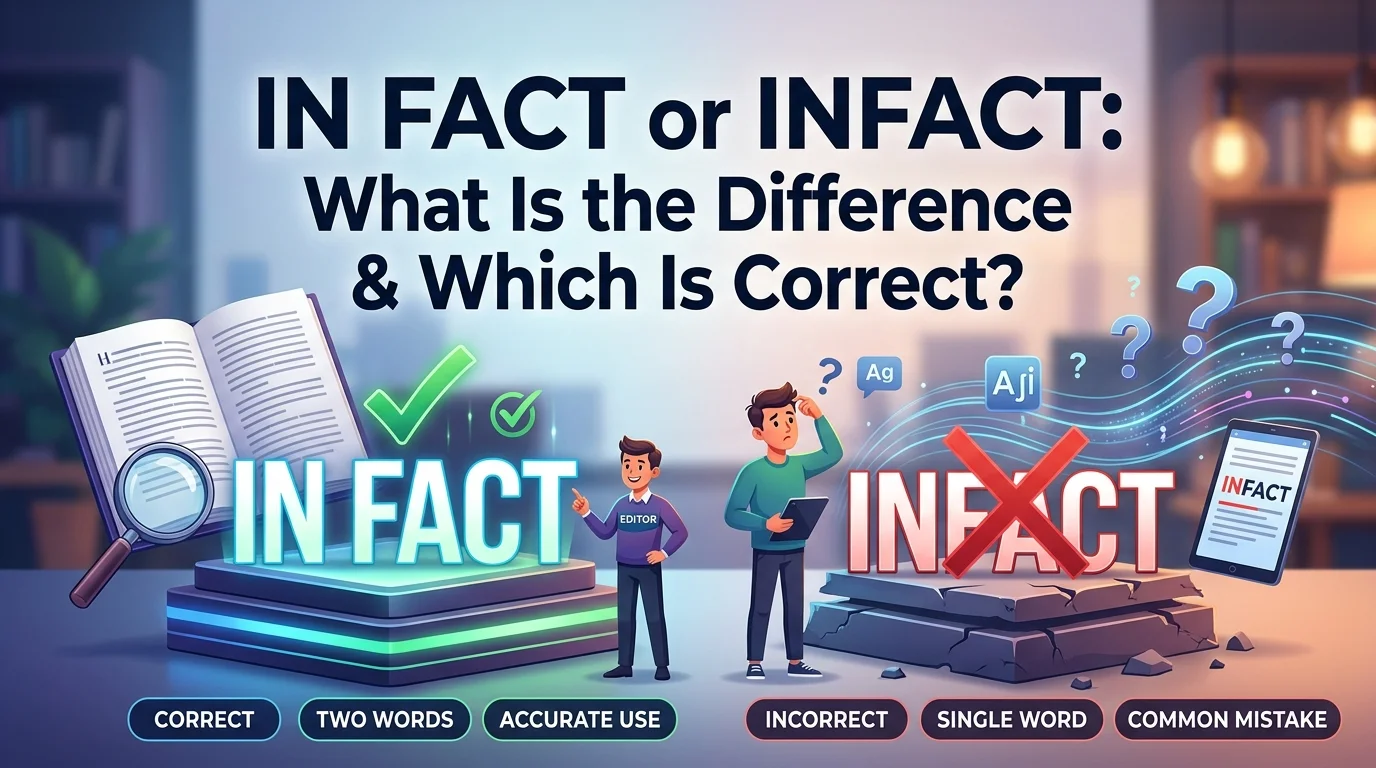
Many English learners get confused between “in fact” and “infact” because they look almost identical. However, only one of them is correct in standard English. Understanding this small but important difference helps improve your grammar, writing accuracy, and confidence in both formal and everyday communication.
Comparison Overview
The comparison between “in fact” and “infact” is about spelling, grammar, and correct usage.
In fact is a proper English phrase used to add emphasis, correction, or extra information.
Infact is a common misspelling and is considered incorrect in modern English writing.
This means the comparison is not about two different meanings, but about identifying the correct form.
| Feature | In Fact | Infact |
| Correct spelling | Yes | No |
| Standard English | Yes | No |
| Used in writing | Yes | No |
| Found in dictionaries | Yes | No |
Definition of In Fact
In fact is a two-word phrase used to emphasize a statement or add more precise information.
It often means:
- actually
- indeed
- really
- as a matter of fact
Its purpose is to strengthen or clarify what is being said.
Example:
She is not just talented; in fact, she is one of the best writers in the class.
Definition of Infact
Infact is not a correct English word.
It usually appears because people mistakenly combine “in” and “fact” into one word.
This spelling should be avoided in:
- essays
- emails
- exams
- business writing
- academic writing
Example of incorrect usage:
Infact, I completed the task yesterday. ❌
Correct version:
In fact, I completed the task yesterday. ✅
Main Differences Between In Fact and Infact
The major difference is spelling and correctness.
| Point | In Fact | Infact |
| Number of words | Two words | One word |
| Grammatically correct | Yes | No |
| Accepted in formal writing | Yes | No |
| Dictionary approved | Yes | No |
| Recommended for learners | Yes | Never |
The simple rule is: always use “in fact.”
Why “In Fact” Is Correct
The phrase “in fact” comes from older English usage where “in” functions as a preposition and “fact” is a noun.
Together they create an adverbial phrase meaning:
- actually
- truly
- indeed
Since both words serve separate grammatical roles, they stay separated.
Grammar Guide
How each term is used in sentences
In Fact
Pattern:
statement + in fact + additional information
Examples:
- He is very young; in fact, he is only sixteen.
- I thought it was expensive. In fact, it was cheap.
Infact
Not used in correct grammar.
Wrong:
- Infact, she was right.
Correct:
- In fact, she was right.
Common mistakes learners make
Many learners:
- combine the two words accidentally
- type too quickly and miss the space
- assume “infact” is acceptable because it looks natural
Wrong:
- Infact I agree.
Correct:
- In fact, I agree.
Simple rules to remember
- Always use two words: in + fact
- If unsure, think of “as a matter of fact.”
- Never join them into one word.
Easy memory trick:
“Fact needs space.”
Quick tips for writing and speaking
- Add a comma after in fact when it starts a sentence.
- In fact, he arrived early.
- Use it to emphasize information.
- She did not fail; in fact, she topped the exam.
- Never write infact in formal writing.
When to Use Each One
Use in fact when:
- correcting someone
- emphasizing a truth
- adding surprising information
- strengthening a statement
- writing formally
Examples:
- I was not late; in fact, I arrived first.
- The plan worked. In fact, it exceeded expectations.
Use infact:
- never in correct English.
When NOT to Use Each One
Do not use in fact when:
- simple sentences do not need emphasis
- another connector fits better like “however” or “therefore”
Wrong:
- I went to school in fact yesterday. ❌
Better:
- I went to school yesterday. ✅
Do not use infact:
- in any context
Which One to Use (Decision Guide)
Ask yourself these questions:
Do I want to emphasize or clarify something?
→ Use in fact
Am I writing it as one word?
→ Stop and separate it.
Quick decision:
- Need correct English? → In fact
- Unsure? → In fact
- Typing “infact”? → fix it to in fact
Real-World Practical Examples
In Fact Examples
- Education: In fact, grammar improves with daily practice.
- Daily life: I was not tired; in fact, I felt energetic.
- Business: Sales increased. In fact, they doubled this month.
- Science: Water is essential; in fact, life depends on it.
- Technology: This app is popular; in fact, millions use it daily.
Infact Examples
All of these are incorrect:
- Infact, learning is fun. ❌
- Infact I know the answer. ❌
- Infact, this works well. ❌
- Infact she called me. ❌
- Infact they agreed. ❌
Correct all by changing to in fact.
Self-Assessment (Fill in the Blanks)
- I will use ______ when adding emphasis.
- The correct word is ______ because it is standard English.
- She was not angry; ______, she was smiling.
- ______ is not a valid English spelling.
- Use ______ in formal writing.
- I thought he was older; ______, he is only 18.
- Never write ______ in essays.
- The teacher said, “______ your answer is right.”
- The correct phrase contains a ______.
- ______ is accepted in dictionaries.
- I was surprised; ______, I laughed.
- Avoid writing ______ in emails.
- “______” means actually or indeed.
- The wrong form is ______.
- We use ______ to clarify a statement.
- She did not fail; ______, she succeeded.
- ______ should always be written as two words.
- Do not type ______ by mistake.
- Grammar books recommend ______.
- The best choice is ______.
Answers
- in fact
- in fact
- in fact
- infact
- in fact
- in fact
- infact
- in fact
- space
- in fact
- in fact
- infact
- in fact
- infact
- in fact
- in fact
- in fact
- infact
- in fact
- in fact
Final Verdict
The answer is simple: “In fact” is correct, and “infact” is incorrect. Always write it as two separate words because it is a fixed English phrase used to emphasize, clarify, or correct information. While “infact” is a very common typing mistake, it should never appear in proper writing. If you remember one rule, let it be this: when in doubt, choose “in fact.” That choice will always keep your grammar accurate and professional.
Conclusion About Infact Or In Fact
In the comparison between Infact Or In Fact, the clear winner is “in fact,” which is the only grammatically correct and widely accepted form in English. It is used to add emphasis, clarify meaning, or correct a statement in both spoken and written communication. On the other hand, “infact” is simply a common spelling mistake that should be avoided in all formal and informal contexts. Understanding this small difference can greatly improve your writing accuracy, especially in academic, professional, and everyday communication. By consistently using “in fact,” you ensure clarity and correctness in your sentences while avoiding confusion for readers. Remembering this rule is simple: it is always written as two separate words. Mastering such small details helps strengthen your overall grammar skills and makes your communication more polished, confident, and effective.
FAQs About Infact Or In Fact
What is correct in fact or infact?
In standard English, “in fact” is correct while “infact” is incorrect. “In fact” is a two-word adverbial phrase used to emphasize or clarify information in a sentence. It is widely accepted in both formal and informal writing. “Infact” is a common spelling error that should always be corrected to maintain grammatical accuracy and professionalism.
Is infact a real English word?
No, “infact” is not a recognized English word in dictionaries or grammar rules. It is simply a misspelling of the correct phrase “in fact.” Because English uses “in fact” as two separate words for emphasis or clarification, combining them is incorrect. Always avoid “infact” in writing, speaking, and formal communication to maintain accuracy.
When should I use in fact in a sentence?
You should use “in fact” when you want to emphasize a statement, add extra information, or correct something previously said. It often strengthens meaning by showing truth or reality. It can appear at the beginning or middle of a sentence. For example, it highlights surprising facts or confirms details in a clearer, stronger way.
Can in fact start a sentence?
Yes, “in fact” can start a sentence and is often used to introduce additional or stronger information. When it appears at the beginning, it is usually followed by a comma. For example, “In fact, she is the best student in the class.” This usage is common in both writing and speaking.
Why do people write infact?
People often write “infact” due to fast typing, lack of awareness, or misunderstanding that it is one word. Since “in” and “fact” sound connected in speech, learners sometimes combine them incorrectly. It is a common spelling mistake, but with practice and attention, it can easily be avoided in writing.
Is in fact formal or informal?
“In fact” is suitable for both formal and informal English. In formal writing, it is used to clarify or emphasize important points, while in informal speech it helps make statements stronger or more expressive. Its flexibility makes it useful in essays, emails, conversations, and professional communication without sounding inappropriate.
Does in fact need commas?
When “in fact” is used at the beginning of a sentence, it is usually followed by a comma to separate it from the main clause. For example, “In fact, he arrived early.” However, when used in the middle of a sentence, commas are optional depending on emphasis and writing style.
What is synonym of in fact?
Common synonyms of “in fact” include “actually,” “indeed,” “really,” and “as a matter of fact.” These expressions are used to emphasize truth or add clarification in a sentence. However, the choice depends on tone and context. “In fact” remains one of the most natural and widely used expressions in English.
Can I use in fact in academic writing?
Yes, “in fact” is widely accepted in academic writing. It is used to strengthen arguments, present evidence, or clarify statements in a formal tone. It helps writers highlight important information and improve sentence clarity. Because it is grammatically correct and professional, it is suitable for essays, research papers, and reports.
How can I remember difference between in fact and infact?
A simple way to remember is that “in fact” is always written as two separate words, just like other English phrases. Think of it as “in reality” or “as a matter of fact.” If you combine it into one word, it becomes incorrect. Practicing correct usage helps avoid this common spelling mistake easily.

Amelia Wright focuses on making figurative language easy to understand. Her writing explains similes, metaphors, and word meanings using relatable examples. She aims to help readers recognize subtle differences in usage and apply them correctly in both academic and casual writing.