
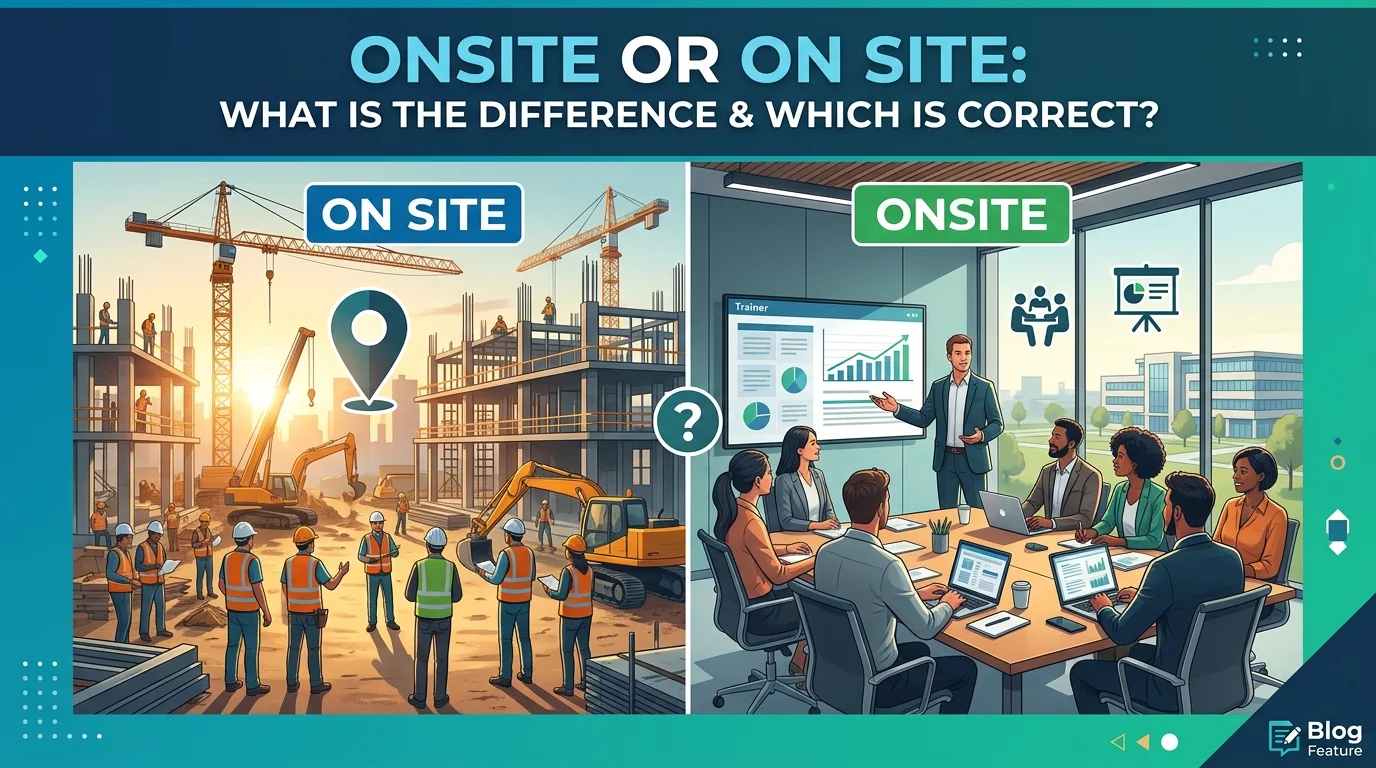
“Onsite” and “on site” look nearly identical, but they are not always used the same way. This small spelling difference can affect grammar, clarity, and professionalism in your writing. Whether you are writing for work, school, or online content, understanding when to use “onsite” or “on site” helps you communicate more accurately.
Comparison Overview
Both “onsite” and “on site” relate to a physical location or being present at a specific place. The confusion happens because they share the same meaning root, but their grammatical roles are different.
“On site” is usually a phrase that describes location.
“Onsite” is usually used as an adjective to describe a noun.
This distinction matters in formal writing, business communication, job descriptions, and everyday English.
Definition of Onsite
“Onsite” is typically an adjective. It describes something connected to or available at a physical location.
It often appears before a noun.
Examples:
• onsite support
• onsite training
• onsite inspection
• onsite manager
Core purpose: to describe a service, activity, or person connected with a specific physical location.
Definition of On Site
“On site” is a prepositional phrase. It tells where something happens or where someone is located.
It usually comes after a verb.
Examples:
• The technician is on site.
• We are working on site today.
• Staff must remain on site.
Core purpose: to indicate physical presence at a location.
Main Differences Between Onsite and On Site
| Feature | Onsite | On Site |
| Part of speech | Adjective | Prepositional phrase |
| Main function | Describes a noun | Describes location |
| Position in sentence | Usually before noun | Usually after verb |
| Example | onsite meeting | meeting is on site |
| Common use | Business, services, events | Physical presence |
The easiest way to remember:
If it describes a noun, use “onsite.”
If it tells where something happens, use “on site.”
Why This Confusion Happens
English often turns phrases into compound words over time. Similar examples include:
• online vs on line
• overtime vs over time
• setup vs set up
“Onsite” follows the same pattern, which is why writers often mix it up.
Comparison Table with Sentence Examples
| Correct Usage | Example |
| Onsite as adjective | We offer onsite maintenance. |
| On site as location | The engineer is on site now. |
| Onsite before noun | onsite security team |
| On site after verb | She stayed on site overnight. |
Grammar Guide
How Each Term Is Used in Sentences
Use “onsite” before nouns:
• We provide onsite training.
• The onsite team arrived early.
Use “on site” after verbs:
• The workers are on site.
• The doctor is on site today.
Common Mistakes Learners Make
Using “onsite” after a verb:
❌ The manager is onsite today.
This is sometimes accepted in modern business English, but “on site” is traditionally preferred.
Correct:
✔ The manager is on site today.
Using “on site” before a noun:
❌ on site support team
Correct:
✔ onsite support team
Simple Rules to Remember
Rule 1: Before a noun = onsite
Rule 2: After a verb = on site
Rule 3: If it answers “where?” = on site
Rule 4: If it describes “what kind?” = onsite
Quick Tips for Writing and Speaking
In formal grammar, prefer “on site” for location.
In business writing, “onsite” as an adjective is very common.
Always check what role the word plays in the sentence.
When to Use Each One
Use “onsite” when:
• describing services
• naming departments
• talking about facilities
• writing job descriptions
• creating business content
Examples:
• onsite consultation
• onsite parking
• onsite event management
Use “on site” when:
• describing where someone is
• explaining location
• giving workplace instructions
• discussing physical attendance
Examples:
• Staff are on site.
• Visitors must remain on site.
When NOT to Use Each One
Do not use “onsite” when talking only about location.
Incorrect:
• The team is onsite.
Better:
• The team is on site.
Do not use “on site” before a noun.
Incorrect:
• on site technician
Correct:
• onsite technician
Which One to Use (Decision Guide)
Ask yourself:
- Am I describing a noun?
Use “onsite.”
Example: onsite training
- Am I describing a location?
Use “on site.”
Example: employees are on site
- Is this a business title or service label?
Usually “onsite.”
Example: onsite coordinator
- Is this a sentence about presence?
Usually “on site.”
Example: the team is on site
Real World Practical Examples
Onsite Examples
- Education: The school offers onsite tutoring.
- Daily life: Our apartment has onsite parking.
- Science: The lab provides onsite testing.
- Business: We scheduled an onsite audit.
- Technology: The company offers onsite installation.
On Site Examples
- Education: The principal is on site today.
- Daily life: The plumber is on site now.
- Science: Researchers stayed on site overnight.
- Business: The consultant arrived on site early.
- Technology: The engineer is on site fixing the server.
Self Assessment (Fill in the Blanks)
- We offer ______ training for all employees.
- The technician is ______ right now.
- The company provides ______ support services.
- All workers must remain ______ during repairs.
- Our hotel has ______ dining options.
- The doctor is ______ today.
- They requested an ______ inspection.
- The staff stayed ______ overnight.
- We arranged an ______ meeting.
- Security must stay ______ at all times.
- The school provides ______ childcare.
- The manager is ______ this morning.
- The firm offers ______ consulting.
- Engineers are already ______.
- The office has ______ security staff.
- Visitors must stay ______.
- We booked an ______ assessment.
- The contractor arrived ______ early.
- They provide ______ maintenance.
- The supervisor is ______ now.
Answers
- onsite
- on site
- onsite
- on site
- onsite
- on site
- onsite
- on site
- onsite
- on site
- onsite
- on site
- onsite
- on site
- onsite
- on site
- onsite
- on site
- onsite
- on site
Final Verdict
“Onsite” and “on site” are closely related, but they serve different grammatical purposes. Use “onsite” when describing a noun, such as a service, team, or event. Use “on site” when talking about physical location or presence. If you remember this simple distinction, you will choose the correct form every time and make your writing clearer and more professional.
Conclusion About Onsite Or On Site
Understanding the difference between “onsite” and “on site” helps you write with more confidence and accuracy in both casual and professional contexts. While they may look similar, their usage depends on grammar and sentence structure. “Onsite” works best when describing services, roles, or features connected to a location, while “on site” clearly shows physical presence or location. Using them correctly improves clarity, especially in business writing, education, and communication. With practice, choosing the right form becomes natural and effortless.
FAQs
What does onsite mean in English?
Onsite is an adjective used to describe something that is located at or provided in a specific place. It is commonly used in business and education, such as onsite training, onsite support, or onsite services. It always comes before a noun and describes what kind of service or feature is being offered at a physical location.
What does on site mean in grammar?
On site is a prepositional phrase that describes location or presence. It is used when someone or something is physically at a place. For example, “The engineer is on site” shows where the engineer is. It usually follows a verb and focuses on where an action is happening.
Is onsite one word or two words?
Both forms are correct depending on usage. “Onsite” is one word and is used as an adjective before nouns. “On site” is two words and is used as a phrase to describe location. Choosing between them depends on sentence structure and meaning.
When should I use onsite in a sentence?
Use onsite when describing a service, facility, or role connected to a location. It comes before a noun, such as onsite training or onsite inspection. It is commonly used in professional, academic, and business writing to describe location-based offerings.
When should I use on site in writing?
Use on site when talking about where someone or something is located. It usually comes after a verb, such as “The team is on site.” It focuses on physical presence rather than describing a noun or service.
Is onsite more formal than on site?
Both are acceptable, but on site is often preferred in traditional grammar when describing location. Onsite is widely used in modern business writing, especially for services and job descriptions. The choice depends on style and context rather than strict formality rules.
Can onsite and on site be used interchangeably?
They are not fully interchangeable because they serve different grammatical roles. Onsite is used before nouns, while on site is used to describe location. Using them incorrectly can change the meaning or make a sentence sound unnatural.
What are examples of onsite usage?
Examples include onsite support, onsite training, and onsite services. In each case, onsite describes the type of service being provided at a location. It helps define features related to a specific place.
What are examples of on site usage?
Examples include “The manager is on site,” “Workers are on site,” and “The technician arrived on site.” These sentences focus on physical presence at a location rather than describing a service or feature.
Why is it important to learn the difference?
Learning the difference helps improve clarity in writing and speaking. It ensures correct grammar usage in professional communication, academic work, and everyday English. Using the right form makes your message easier to understand and more accurate.

Daniel Brooks is an English educator with a passion for explaining similes and word comparisons in plain language. He covers topics like versus meanings, correct usage, and figurative language to help writers avoid common mistakes and improve clarity in everyday writing.