
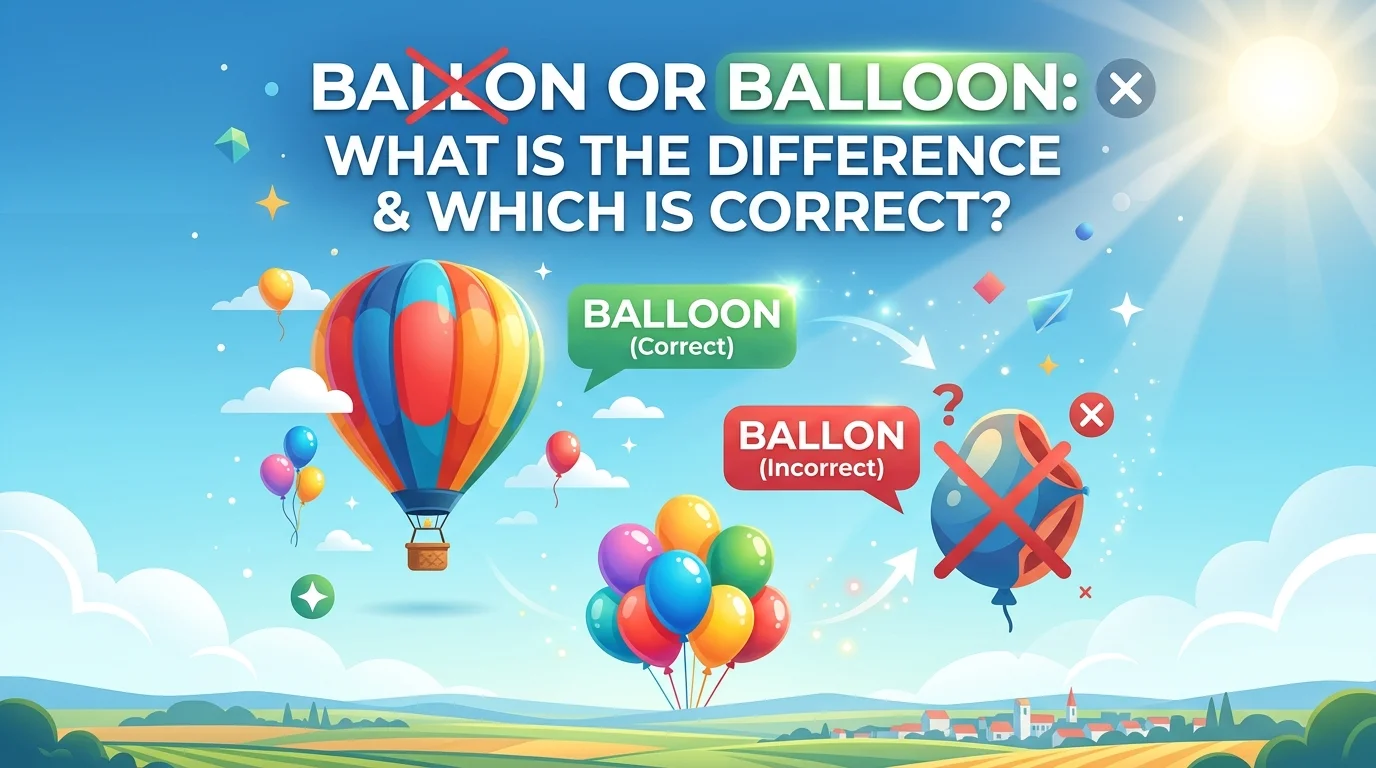
Many English learners get confused between Ballon and Balloon because they look very similar. However, only one is correct in standard English. Understanding the difference helps you avoid spelling mistakes, improve your writing, and use the right word confidently in school, work, and daily conversations.
Comparison Overview
Ballon and Balloon may seem like two different words, but they are not equal in English usage. One is the correct spelling used worldwide, while the other is usually a spelling mistake or appears only as a proper noun in specific names. Knowing this difference prevents common grammar and spelling errors.
| Feature | Ballon | Balloon |
| Standard English word | No | Yes |
| Correct spelling | No | Yes |
| Used in daily writing | Rarely | Yes |
| Dictionary accepted | No (usually) | Yes |
| Meaning | Often misspelling | Inflatable object or figurative term |
Definition of Ballon
Ballon is generally not a standard English word. Most of the time, it is a misspelling of “balloon.”
In some special contexts, Ballon may appear as:
- A surname, such as Jules Ballon
- A place name, such as Ballon
- A brand or proper noun
But in normal English writing, “Ballon” is usually incorrect.
Definition of Balloon
Balloon is the correct English word.
It usually means:
- A rubber or plastic object filled with air or gas
- A large aircraft like a hot air balloon
- Something that expands in size
- A speech bubble in comics
Examples:
- The child held a red balloon.
- The hot air balloon flew over the city.
Main Differences Between Ballon and Balloon
The biggest difference is correctness.
Spelling
- Ballon = incorrect in most English writing
- Balloon = correct spelling
Meaning
- Ballon = usually no intended meaning, just a typo
- Balloon = an actual English word with clear meanings
Usage
- Ballon = should generally be avoided
- Balloon = used in speaking and writing every day
Context
- Ballon = may appear only in names or brands
- Balloon = appears in books, articles, schools, and conversations
Why People Confuse Ballon and Balloon
This confusion happens because:
- both words look almost identical
- many people accidentally drop one “o”
- typing quickly causes spelling mistakes
- autocorrect may not always catch it
A simple memory trick: Balloon has two “o” letters, just like two round balloons.
Grammar Guide
How Each Term Is Used in Sentences
Ballon
- Incorrect: I bought a blue ballon.
Balloon
- Correct: I bought a blue balloon.
Pattern:
- article + adjective + balloon
- a red balloon
- the giant balloon
Common Mistakes Learners Make
Wrong:
- The party had many ballons.
- I saw a hot air ballon.
Correct:
- The party had many balloons.
- I saw a hot air balloon.
Simple Rules to Remember
- If you mean the inflatable object, always use balloon.
- Remember: balloon = double o.
- If spellcheck flags ballon, change it.
Quick Tips for Writing and Speaking
- Pause and check the double o.
- Use a dictionary when unsure.
- Practice typing balloon correctly.
When to Use Each One
Use Balloon when talking about:
- birthday decorations
- hot air travel
- science experiments
- comic speech bubbles
- something growing larger
Use Ballon only when:
- referring to a specific name or place like Ballon
When NOT to Use Each One
Do not use Ballon when:
- writing essays
- sending emails
- making presentations
- writing stories
- taking exams
Do not avoid Balloon when it is the intended word. It is the correct choice.
Which One to Use (Decision Guide)
Ask yourself:
Are you talking about an inflatable object or something expanding?
→ Use Balloon
Are you writing a person’s surname or place name called Ballon?
→ Use Ballon
For 99% of learners, the correct answer is Balloon.
Real World Practical Examples
Ballon Examples
- Ballon is the surname of a historical figure.
- I visited Ballon during my trip.
- The company name included Ballon.
- That website used Ballon as a brand term.
- In English homework, Ballon would usually be marked wrong.
Balloon Examples
- The child released a balloon at the park.
- Scientists used a weather balloon to collect data.
- A hot air balloon crossed the valley.
- Her comic had a speech balloon.
- Prices began to balloon after the policy change.
Self Assessment (Fill in the Blanks)
- I bought a red ______ for the party.
- A hot air ______ can fly high in the sky.
- The correct spelling is usually ______.
- Prices may ______ during inflation.
- A comic speech ______ contains dialogue.
- The child popped the ______.
- Weather experts launched a ______.
- “Ballon” is often a spelling ______.
- Use ______ in standard English.
- The blue ______ floated away.
- A birthday party needs many ______.
- The correct word has two ______ letters.
- Never write ______ in an exam if you mean the object.
- A giant ______ decorated the hall.
- The hot air ______ landed safely.
- My keyboard accidentally typed ______.
- Teachers prefer the spelling ______.
- The dog chased the ______.
- That misspelling was ______.
- The right answer is ______.
Answers
- balloon
- balloon
- balloon
- balloon
- balloon
- balloon
- balloon
- mistake
- balloon
- balloon
- balloons
- o
- ballon
- balloon
- balloon
- ballon
- balloon
- balloon
- ballon
- balloon
Final Verdict
Balloon is the correct English word and should be used in almost every situation involving the inflatable object, hot air travel, or figurative expansion. Ballon is usually just a spelling mistake, except when it appears as a name or place like Ballon. If you remember the double “o”, you will almost always choose the correct word: Balloon.
Conclusion About Ballon Or Balloon
Understanding the difference between Ballon and Balloon helps avoid one of the most common spelling mistakes in English writing. While “Ballon” usually appears only in names or is simply an error, “Balloon” is the correct and widely accepted term used in everyday communication. From celebrations to science experiments and even figurative language, the word “balloon” plays an important role in modern English. Remembering the double “o” makes it easier to use the correct spelling confidently. With this knowledge, you can write more accurately, sound more professional, and avoid confusion in both academic and casual contexts.
FAQs
Is Ballon a correct English word?
“Ballon” is not considered a standard English word in most contexts. It is usually a spelling mistake or appears as part of proper names. In everyday writing, the correct and accepted term is “balloon,” which refers to an inflatable object or figurative expansion in language and descriptions.
What is the correct spelling Balloon or Ballon?
The correct spelling is “balloon.” It contains a double “o,” which is essential for correct usage. “Ballon” is generally incorrect in English writing and should be avoided unless it is part of a specific name, brand, or place. Always use “balloon” in formal and informal communication.
What does Balloon mean in English?
A balloon is an object usually made of rubber or latex that can be filled with air or gas. It is commonly used for decoration, celebrations, or scientific purposes. The word can also be used figuratively to describe something that expands quickly, such as prices or emotions increasing.
Why do people confuse Ballon and Balloon?
People often confuse these words because they look very similar and differ by only one letter. Fast typing, spelling errors, and autocorrect mistakes also contribute to the confusion. Many learners forget the double “o” in balloon, which leads to the incorrect spelling “ballon.”
Can Ballon ever be correct in writing?
Yes, but only in very limited cases. “Ballon” may appear as a surname, brand name, or place name. Outside of these special contexts, it is not correct in standard English writing. For general communication, essays, and professional use, “balloon” is always the right choice.
How do you use Balloon in a sentence?
“Balloon” is used as a noun or verb depending on context. For example, “The child held a red balloon” or “Prices began to balloon rapidly.” It can describe a physical object or represent expansion. It is widely used in daily conversations, education, and media writing.
What is the difference between Ballon and Balloon?
The main difference is correctness. “Balloon” is the standard English word used for inflatable objects and other meanings. “Ballon” is usually a misspelling or a proper noun. In most cases, if you mean the object or concept, “balloon” is the only correct choice.
How can I remember the spelling Balloon easily?
A simple trick is to remember that “balloon” has two “o” letters, just like two round balloons. Visual association helps reinforce correct spelling. Repeating the word in writing and reading it often also helps build long term memory and prevents common spelling mistakes.
Is Balloon used in science or education?
Yes, “balloon” is commonly used in science, especially in weather studies where weather balloons collect atmospheric data. It is also used in education, such as grammar examples or physics demonstrations. The word has practical applications in both academic and real world contexts.
What is the figurative meaning of Balloon?
In figurative language, “balloon” means to increase or expand rapidly. For example, “expenses ballooned during the project” means costs rose quickly. It is often used in business, economics, and everyday speech to describe sudden growth or expansion in size, value, or intensity.

Sarah Mitchell is an experienced writer and grammar teacher with over 10 years of expertise in English language education. She helps learners improve their grammar, writing, and communication skills through clear explanations and practical examples. Sarah creates learner-friendly content focused on real-life English, making language learning simple, effective, and confidence-building.