
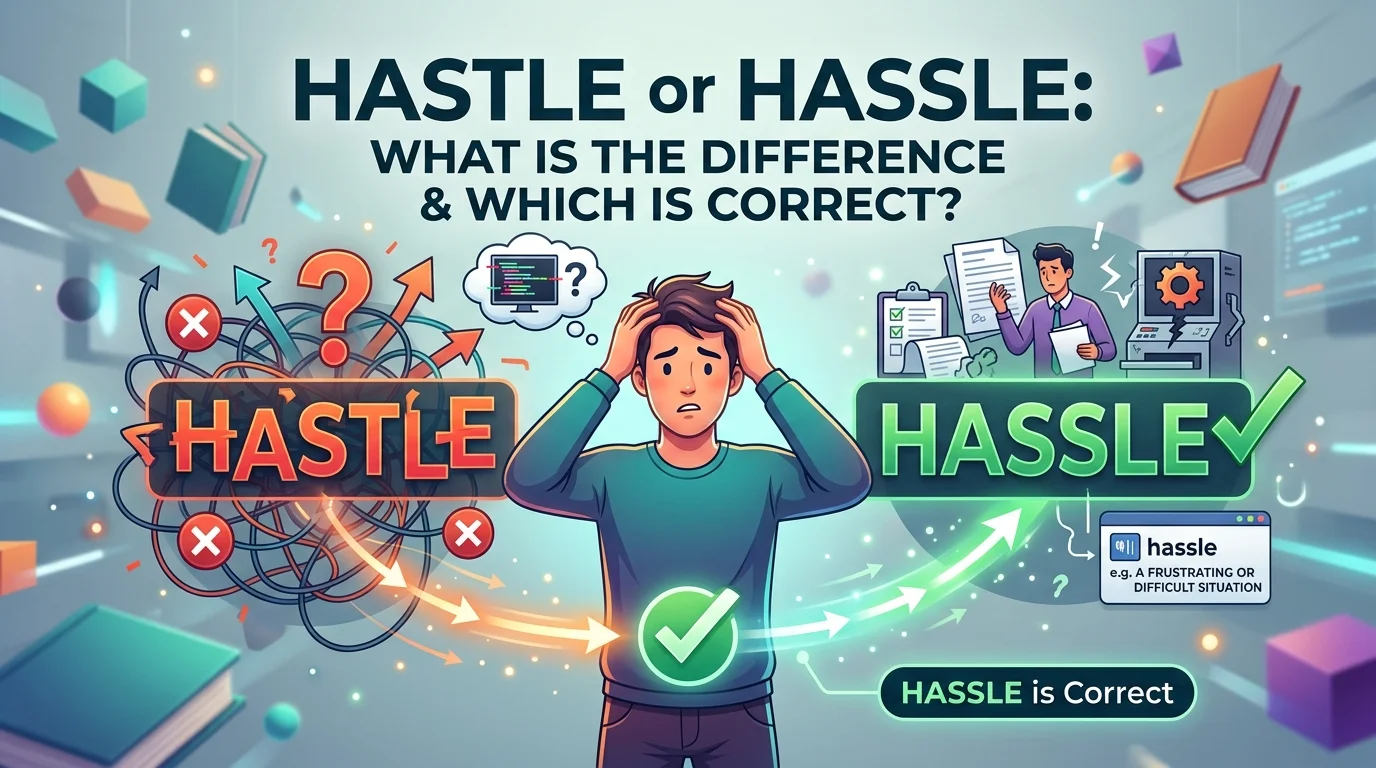
The words “Hastle” and “Hassle” often confuse writers and learners because they look and sound similar. However, only one is correct in standard English. This comparison will clearly explain their meanings, differences, correct usage, and common mistakes so you can confidently choose the right spelling in writing and speech.
Comparison Overview
“Hastle” and “Hassle” are often used interchangeably by mistake, but they are not equal in meaning or correctness. “Hassle” is the correct English word used to describe trouble, inconvenience, or difficulty. “Hastle” is a common misspelling that appears in informal writing but has no recognized meaning in standard English.
Definition of Hastle
“Hastle” is not a standard English word. It is considered a spelling error that usually happens when people mistakenly write or type “hassle.” Since it has no official meaning, it should be avoided in all formal and informal writing.
Definition of Hassle
“Hassle” is a noun and verb used in English to describe a situation that is annoying, difficult, or causes inconvenience. It can refer to small problems in daily life or unnecessary complications in tasks, communication, or processes.
Main Differences Between Hastle and Hassle
The key difference is correctness and usage. “Hassle” is a valid English word used widely in everyday communication, while “Hastle” is simply an incorrect spelling.
| Feature | Hastle | Hassle |
| Status | Incorrect spelling | Correct English word |
| Meaning | No meaning | Trouble or inconvenience |
| Usage | Should not be used | Common in speech and writing |
| Grammar role | Not applicable | Noun and verb |
Spelling Clarification and Origin
The confusion comes from pronunciation, as “hassle” is often spoken quickly, making it sound like “hastle.” However, the correct spelling has no “t.” English learners often add letters based on sound, which leads to this common error.
Grammar Guide
How each term is used in sentences
“Hassle” can be used as a noun or a verb depending on context.
Examples:
- Noun: The paperwork was a real hassle.
- Verb: Don’t hassle me while I am working.
Common mistakes learners make
Many learners incorrectly add a “t” and write “hastle.” Another mistake is using “hassle” in formal academic writing without understanding its informal tone.
Simple rules to remember
- Always spell it as “hassle.”
- Think of “hassle” as meaning trouble or annoyance.
- Remove the “t” if you ever see “hastle.”
Quick tips for writing and speaking
- Pronounce it clearly as “has-uhl.”
- Use it in casual communication more than formal reports.
- Double-check spelling in emails and assignments.
When to Use Each One
Use “hassle” when describing inconvenience, difficulty, or unwanted effort in daily situations. Never use “hastle” in any context since it is not a valid word.
When NOT to Use Each One
Do not use “hastle” in writing, messaging, or academic work. Also avoid overusing “hassle” in highly formal or technical documents where more precise terms like “difficulty” or “complication” may be better.
Which One to Use (Decision Guide)
If you are referring to trouble or inconvenience, always choose “hassle.” If you are unsure between the two, remember that “hastle” is never correct. In all contexts, “hassle” is the only acceptable choice.
Real-World Practical Examples
Hastle Examples
Since “hastle” is incorrect, it is not used in proper English sentences. Instead, here are examples showing what people mistakenly try to write, corrected for clarity:
- Incorrect: It was a big hastle to fix the issue.
- Correct: It was a big hassle to fix the issue.
- Incorrect: Don’t hastle me with questions.
- Correct: Don’t hassle me with questions.
- Incorrect: Moving house is such a hastle.
- Correct: Moving house is such a hassle.
- Incorrect: She caused a lot of hastle at work.
- Correct: She caused a lot of hassle at work.
- Incorrect: The process is too much hastle.
- Correct: The process is too much hassle.
Hassle Examples
- Completing visa paperwork is always a hassle.
- I don’t want to hassle you during your meeting.
- Fixing that software bug was a real hassle.
- Public transport can be a hassle during rush hour.
- Calling customer service turned into a big hassle.
Self-Assessment (Fill in the Blanks)
- The paperwork was a ______ to complete.
- I don’t want to ______ you while you are busy.
- Moving to a new city can be a real ______.
- Please do not ______ me with unnecessary questions.
- That task turned out to be a big ______.
- He tried to avoid any unnecessary ______ at work.
- The correct spelling is ______.
- ______ is not a valid English word.
- Waiting in line was such a ______.
- I don’t want to ______ anyone during their break.
- The project created a lot of ______ for the team.
- It is wrong to write ______ instead of hassle.
- She said the situation was a complete ______.
- Please don’t ______ your coworkers unnecessarily.
- Travel delays can be a real ______.
- The correct word to describe inconvenience is ______.
- He always tries to avoid unnecessary ______.
- Writing ______ is a common spelling mistake.
- The issue caused a major ______ in production.
- ______ is used to describe trouble or inconvenience.
Answers
- hassle
- hassle
- hassle
- hassle
- hassle
- hassle
- hassle
- Hastle
- hassle
- hassle
- hassle
- Hastle
- hassle
- hassle
- hassle
- hassle
- hassle
- Hastle
- hassle
- hassle
Final Verdict
The correct word is “hassle,” which refers to inconvenience, trouble, or unnecessary difficulty. “Hastle” is simply a common spelling mistake with no meaning in standard English. If you remember that only “hassle” is valid, you will avoid confusion and improve your writing accuracy in both casual and formal contexts.
Conclusion About Hastle or Hassle
Understanding the difference between Hastle or Hassle helps you avoid one of the most common spelling mistakes in English. While “hastle” is simply incorrect and has no recognized meaning, “hassle” is the correct term used to describe inconvenience, trouble, or unnecessary difficulty in everyday life. Knowing this distinction improves both your writing accuracy and confidence in communication. Whether you are writing emails, assignments, or casual messages, choosing the right spelling ensures clarity and professionalism. Over time, remembering that only “hassle” is valid will help you eliminate confusion and strengthen your English usage naturally.
FAQs
What is the correct spelling between Hastle or Hassle?
The correct spelling is “hassle.” It is a standard English word used to describe inconvenience or trouble. “Hastle” is a common misspelling that has no meaning in formal or informal English and should always be avoided in writing or communication.
Why do people write Hastle instead of Hassle?
People often write “hastle” due to pronunciation confusion. When spoken quickly, “hassle” may sound like it contains a “t” sound. This leads to spelling errors, especially among beginners learning English or relying on phonetic spelling.
What does the word hassle mean?
“Hassle” means trouble, inconvenience, or something that causes unnecessary effort or annoyance. It can describe both small daily issues and larger problems that make tasks more complicated or stressful in different situations.
Is Hastle a real English word?
No, “hastle” is not a real English word. It does not appear in dictionaries and has no accepted meaning. It is simply a spelling mistake that should be corrected to “hassle” in all forms of writing.
Can hassle be used as a verb?
Yes, “hassle” can be used as a verb meaning to bother or annoy someone repeatedly. For example, someone might hassle another person for attention or help, especially when it becomes persistent or unwanted.
In what situations is hassle commonly used?
“Hassle” is commonly used in everyday situations like travel delays, paperwork, customer service issues, or minor difficulties. It describes anything that feels annoying, time-consuming, or unnecessarily complicated in daily life.
What is the easiest way to remember hassle spelling?
A simple way to remember is that “hassle” has no “t.” Think of it as related to trouble, not haste. Repeating the correct spelling in writing and reading helps reinforce memory and reduce future mistakes.
Is hassle a formal or informal word?
“Hassle” is generally considered informal but widely accepted in everyday English. It is suitable for casual writing, conversations, and emails, but more formal alternatives like “difficulty” or “inconvenience” may be preferred in academic contexts.
Can hassle be replaced with other words?
Yes, “hassle” can be replaced with words like “difficulty,” “problem,” “inconvenience,” or “trouble.” The best replacement depends on the tone and context of the sentence, especially in formal or professional writing.
Why is it important to avoid writing Hastle?
Avoiding “hastle” is important because it is incorrect and can make writing look unprofessional. Using the correct spelling “hassle” improves clarity, credibility, and overall communication quality in both academic and everyday contexts.

Daniel Brooks is an English educator with a passion for explaining similes and word comparisons in plain language. He covers topics like versus meanings, correct usage, and figurative language to help writers avoid common mistakes and improve clarity in everyday writing.
