
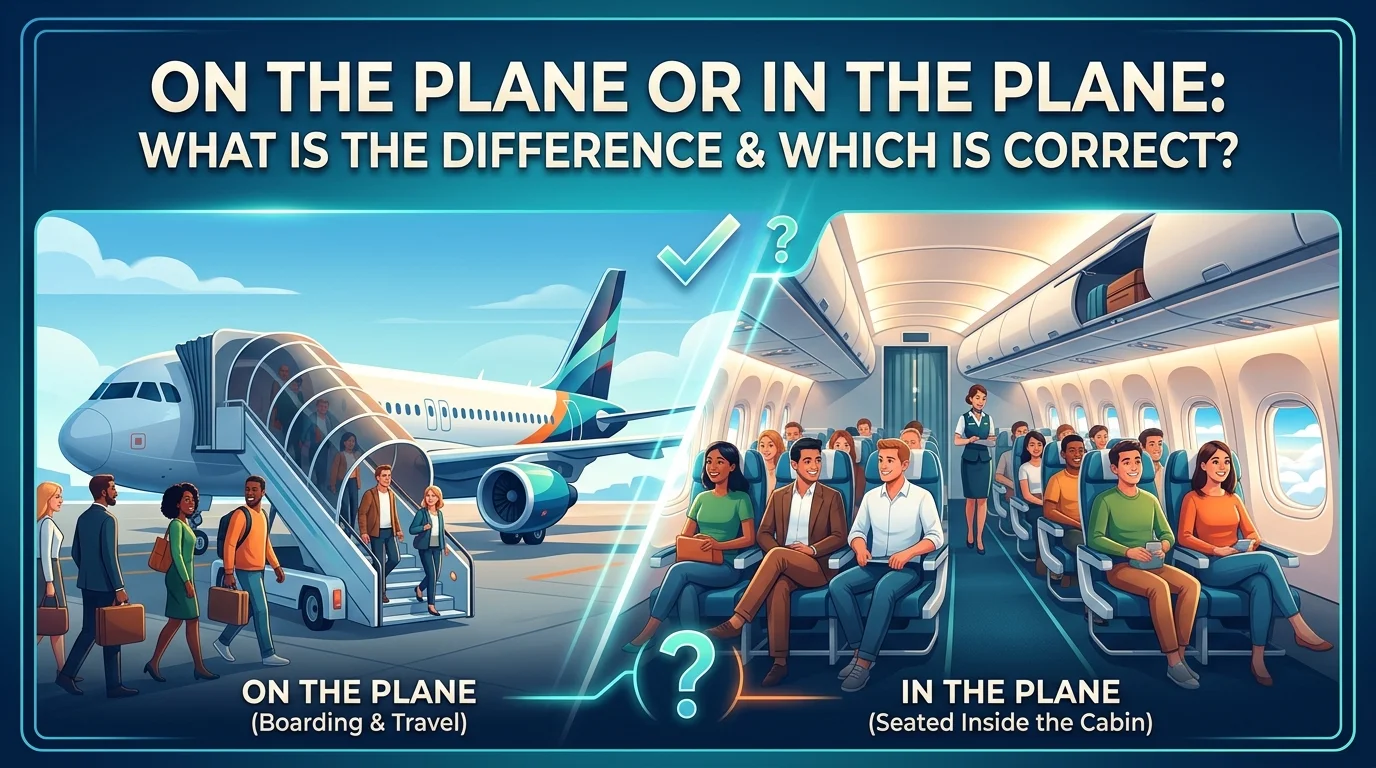
Understanding whether to use “on the plane” or “in the plane” is important for clear and correct English. These phrases often confuse learners because both relate to air travel and spatial meaning, but they are used in different contexts. This guide explains their differences, usage rules, and examples in a simple way.
Comparison Overview
“On the plane” and “in the plane” both describe locations, but they are used in very different ways. “On the plane” is commonly used for air travel, referring to being inside an aircraft as a passenger. “In the plane” is less common in travel and is usually used for mathematical, scientific, or geometric contexts where “plane” means a flat surface or abstract space.
Definition of On the Plane
“On the plane” refers to being inside an aircraft as a passenger or traveler. It is the standard and natural expression used in everyday English when talking about flying.
It emphasizes the idea of being aboard a vehicle rather than physically enclosed in a small space. Even though you are technically inside the aircraft, English speakers use “on” because an airplane is treated like a transport service or platform.
Definition of In the Plane
“In the plane” is used in technical or academic contexts. Here, “plane” does not refer to an airplane. Instead, it refers to a flat surface in geometry, physics, or mathematics.
It describes something located within a two dimensional or three dimensional conceptual space rather than a physical vehicle.
Main Differences Between On the Plane and In the Plane
The key difference lies in meaning and context. “On the plane” is used for air travel and transportation. “In the plane” is used for scientific or mathematical discussions.
“On the plane” is practical and everyday language. “In the plane” is technical and abstract.
In travel, “on the plane” is always correct. In geometry or physics, “in the plane” is correct.
A simple comparison:
| Feature | On the plane | In the plane |
| Context | Air travel | Math or science |
| Meaning | Inside aircraft as passenger | Inside a flat surface or space |
| Usage type | Everyday English | Academic English |
| Example field | Tourism, travel | Geometry, physics |
Grammar Guide
Understanding grammar helps you choose the correct phrase depending on meaning and context.
How each term is used in sentences
“On the plane” is used when talking about traveling:
- I am on the plane to London.
- She slept on the plane during the flight.
“In the plane” is used in technical descriptions:
- A point lies in the plane of the graph.
- The object moves in the plane of symmetry.
Common mistakes learners make
A common mistake is using “in the plane” when talking about flights. Another mistake is assuming both phrases are interchangeable. They are not.
Many learners also confuse “plane” (aircraft) with “plane” (geometric surface), leading to incorrect usage.
Simple rules to remember
Use “on the plane” for travel and flights.
Use “in the plane” for geometry, mathematics, or physics.
If you are unsure, think whether you are talking about transportation or a scientific concept.
Quick tips for writing and speaking
Always check context before choosing the phrase.
If it involves airports, tickets, or flying, use “on the plane.”
If it involves diagrams, graphs, or shapes, use “in the plane.”
When to Use Each One
Use “on the plane” when discussing travel, boarding, flying, or being a passenger.
Use “in the plane” when discussing mathematical models, spatial geometry, or scientific representations.
When NOT to Use Each One
Do not use “in the plane” when talking about air travel. It sounds unnatural and incorrect in everyday English.
Do not use “on the plane” in mathematical or scientific writing where “plane” refers to geometry.
Which One to Use (Decision Guide)
If you are talking about travel, choose “on the plane.”
If you are talking about geometry or abstract space, choose “in the plane.”
Ask yourself: Am I describing a flight or a mathematical concept? Your answer determines the correct phrase.
Real-World Practical Examples
On the plane Examples
- I met a friendly passenger on the plane.
- She watched a movie on the plane.
- We had lunch on the plane during the flight.
- I left my bag on the plane by mistake.
- He felt nervous on the plane before takeoff.
In the plane Examples
- A circle is drawn in the plane of the graph.
- The point lies in the plane defined by the equation.
- Movement occurs in the plane of motion.
- The object rotates in the plane of symmetry.
- Lines intersect in the plane at a specific angle.
Self-Assessment (Fill in the Blanks)
- I am traveling ______ to New York.
- The diagram shows a point located ______ a geometric plane.
- She read a book ______ during the flight.
- A triangle exists ______ of the coordinate system.
- We had turbulence ______ during takeoff.
- The line lies ______ the XY plane.
- He slept ______ for most of the journey.
- A vector moves ______ in three dimensional space.
- I dropped my phone ______ accidentally.
- The shape is drawn ______ the mathematical model.
- Food was served ______ during the trip.
- The object is fixed ______ in the diagram.
- They met a celebrity ______.
- The equation is solved ______.
- I felt comfortable ______.
- A point is plotted ______.
- She worked ______ for ten hours.
- Motion occurs ______ in physics.
- We arrived safely ______.
- The curve exists ______ in geometry.
Answers
- on the plane
- in the plane
- on the plane
- in the plane
- on the plane
- in the plane
- on the plane
- in the plane
- on the plane
- in the plane
- on the plane
- in the plane
- on the plane
- in the plane
- on the plane
- in the plane
- on the plane
- in the plane
- on the plane
- in the plane
Final Verdict
“On the plane” is the correct and natural choice for air travel, while “in the plane” is used in academic and scientific contexts related to geometry or spatial analysis. The confusion happens because both use the word “plane,” but their meanings are completely different. By focusing on context, you can easily choose the correct expression and avoid common mistakes.
Conclusion About On The Plane or In The Plane
The difference between “on the plane” and “in the plane” becomes easy to understand once you focus on context. In everyday English, especially when talking about travel, “on the plane” is the natural and correct choice because it refers to being a passenger on an aircraft. On the other hand, “in the plane” belongs to academic and technical language, particularly in mathematics and geometry, where “plane” describes a flat surface or spatial model. Mixing these two can lead to confusion, but remembering their distinct uses helps you communicate more clearly. Whether you are writing, speaking, or learning English, applying the correct phrase improves accuracy and fluency. With practice, choosing the right expression becomes effortless in both casual conversation and technical discussions.
FAQs
What does “on the plane” mean in English?
“On the plane” means being a passenger inside an aircraft during a flight. It is the standard expression used in everyday English when talking about air travel, boarding, or experiences during a journey. Even though you are inside the aircraft, English uses “on” to describe being aboard transportation.
When should I use “in the plane”?
“In the plane” is used in technical subjects like mathematics, geometry, and physics. It refers to something existing within a flat surface or abstract space. It is not commonly used for travel and should be reserved for academic or scientific contexts where “plane” means a geometric concept.
Is it correct to say “in the plane” for flights?
No, it is not correct in standard travel English. When talking about flights, the correct phrase is “on the plane.” Using “in the plane” for travel sounds unnatural and is generally considered incorrect in everyday communication.
Why do we say “on the plane” instead of “in the plane”?
We say “on the plane” because airplanes are treated like modes of transport such as buses or trains. English uses “on” for these types of transportation, even though passengers are physically inside the vehicle, making it a standard grammatical convention.
What does “in the plane” mean in geometry?
In geometry, “in the plane” refers to a point, line, or shape existing within a flat two dimensional or three dimensional surface. It is used in mathematical explanations and spatial analysis to describe positions and relationships within a defined plane.
Can “on the plane” and “in the plane” be interchangeable?
No, they are not interchangeable. “On the plane” is used for air travel, while “in the plane” is used for mathematical and scientific contexts. Using them interchangeably can lead to confusion and incorrect meaning depending on the situation.
Which is more common, “on the plane” or “in the plane”?
“On the plane” is far more common because it is used in everyday language for air travel. “In the plane” is much less common and mostly appears in academic writing, technical discussions, and scientific explanations.
How can I remember the difference easily?
A simple way to remember is: use “on the plane” for travel and flights, and use “in the plane” for math or geometry. If you are talking about airports or journeys, choose “on.” If you are discussing shapes or graphs, choose “in.”
Does “plane” always mean an airplane?
No, “plane” can mean two things. In everyday language, it refers to an airplane. In mathematics and geometry, it refers to a flat surface or abstract space. The meaning depends entirely on the context in which it is used.
What is a simple example of each usage?
Example for travel: I am on the plane to Dubai.
Example for geometry: A point lies in the plane of the graph.
These examples show how context changes the meaning and correct usage of each phrase.

Daniel Brooks is an English educator with a passion for explaining similes and word comparisons in plain language. He covers topics like versus meanings, correct usage, and figurative language to help writers avoid common mistakes and improve clarity in everyday writing.