
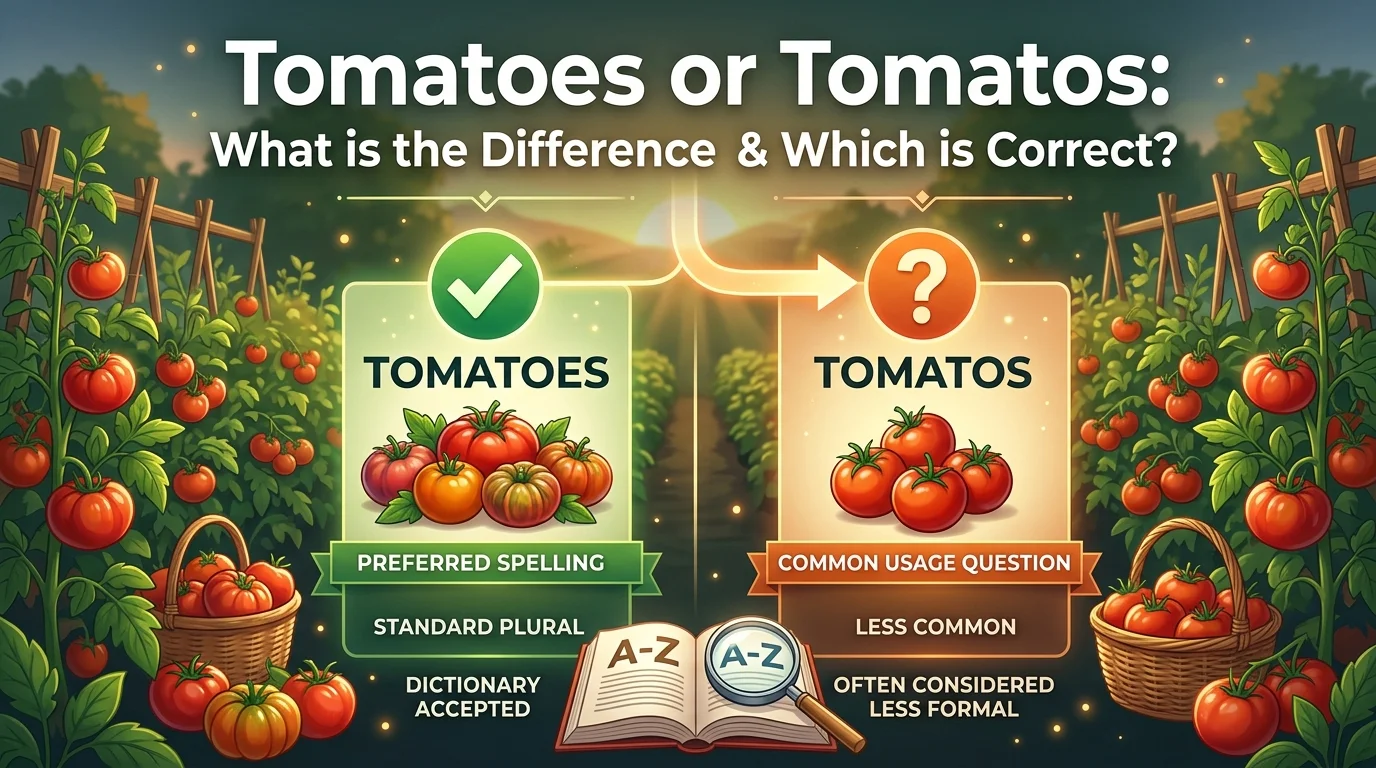
The confusion between “tomatoes” and “tomatos” is common in English writing, especially for learners and casual writers. This comparison helps clarify the correct spelling, meaning, and usage so you can write confidently without mistakes. Understanding the difference also improves your grammar accuracy in everyday communication.
Comparison Overview
“Tomatoes” and “tomatos” refer to the same concept of a popular edible fruit used as a vegetable in cooking. However, only one form is grammatically correct in modern English. “Tomatoes” is the correct plural spelling, while “tomatos” is an incorrect variation that often appears due to spelling confusion or misunderstanding of plural rules.
Definition of Tomatoes
Tomatoes is the correct plural form of tomato. It refers to multiple units of the red, round fruit commonly used in salads, sauces, and cooking recipes. The word follows standard English pluralization rules where words ending in “o” often take “es” in their plural form, especially when they are commonly used nouns like tomato.
Definition of Tomatos
Tomatos is an incorrect spelling of the word tomatoes. It is not accepted in standard English grammar or formal writing. This form usually appears due to phonetic spelling, where writers assume the plural is formed simply by adding “s.” However, this rule does not apply to the word tomato.
Main Differences Between Tomatoes and Tomatos
The main difference lies in correctness and usage. “Tomatoes” is the standard plural form used in English dictionaries and all formal writing. It follows grammatical rules and is universally accepted. “Tomatos,” on the other hand, is a spelling mistake and should be avoided in academic, professional, and everyday writing.
Another difference is recognition. “Tomatoes” is easily understood and widely used in recipes, grocery lists, and communication. “Tomatos” may confuse readers or be flagged as incorrect in grammar tools and spell checkers.
Comparison Table
| Feature | Tomatoes | Tomatos |
| Correctness | Correct | Incorrect |
| Usage | Standard English | Not accepted |
| Meaning | Plural of tomato | Misspelling |
| Recognition | Widely understood | Considered an error |
| Dictionary status | Included | Not included |
Grammar Guide
Understanding the grammar behind these words helps avoid repeated mistakes. The word “tomato” comes from Spanish origins, and its plural form in English does not follow the simple “add s” rule.
How each term is used in sentences
Correct usage examples:
- I bought fresh tomatoes from the market.
- Tomatoes are rich in vitamins.
- She added chopped tomatoes to the salad.
- The recipe requires two tomatoes.
- These tomatoes are very ripe.
Incorrect usage:
- I bought fresh tomatos from the market.
- Tomatos are rich in vitamins.
Common mistakes learners make
Many learners assume all nouns ending in “o” form plurals by adding only “s.” This leads to writing “tomatos” instead of “tomatoes.” Another mistake is copying spelling errors from informal online text without verification.
Simple rules to remember
If a word ends in “o” and refers to a common food item like tomato, potato, or hero, the plural often becomes “es” rather than just “s.” So tomato becomes tomatoes.
Quick tips for writing and speaking
Always rely on spell check tools but also learn common irregular plural rules. Practice writing food-related vocabulary to strengthen memory of correct forms.
When to Use Each One
Use “tomatoes” whenever you are referring to more than one tomato in any context, including cooking, shopping, agriculture, or conversation. It is suitable for both formal and informal writing.
“Tomatos” should never be used in correct English writing. If you see it, treat it as an error and replace it with “tomatoes.”
When NOT to Use Each One
Do not use “tomatos” in academic writing, exams, professional documents, recipes, or online content. It is always incorrect.
Avoid using “tomatoes” only when referring to a single fruit. In that case, use “tomato” instead of the plural form.
Which One to Use (Decision Guide)
If you are talking about one item, use “tomato.” If you are talking about more than one, use “tomatoes.” Never use “tomatos” in any situation. A quick check: if your sentence sounds plural and involves quantity greater than one, “tomatoes” is always the correct choice.
Real-World Practical Examples
Tomatoes Examples
- I added fresh tomatoes to my sandwich.
- The farmer harvested ripe tomatoes today.
- Tomatoes are essential for making pasta sauce.
- She prefers organic tomatoes in her diet.
- We used tomatoes in the soup recipe.
Tomatos Examples
- This section has no correct examples because “tomatos” is not valid in English usage.
Self-Assessment (Fill in the Blanks)
- I bought fresh ______ from the grocery store.
- The salad contains chopped ______ and onions.
- The correct spelling is ______, not tomatos.
- Farmers grow ______ in large fields.
- I used two ripe ______ in the recipe.
- ______ are rich in antioxidants.
- The word ______ is incorrect in English.
- We need more ______ for the sauce.
- She cut the ______ into small pieces.
- ______ is the plural form of tomato.
- I saw red ______ in the basket.
- The dish requires fresh ______.
- ______ improves the taste of pasta.
- He wrote tomatos, but the correct word is ______.
- Grocery stores sell many types of ______.
- ______ should be stored in a cool place.
- I prefer fresh ______ over canned ones.
- The farmer picked ______ early in the morning.
- ______ is always the correct plural spelling.
- We added ______ to the soup for flavor.
Answers
- tomatoes
- tomatoes
- tomatoes
- tomatoes
- tomatoes
- tomatoes
- tomatoes
- tomatoes
- tomatoes
- tomatoes
- tomatoes
- tomatoes
- tomatoes
- tomatoes
- tomatoes
- tomatoes
- tomatoes
- tomatoes
- tomatoes
- tomatoes
Final Verdict
The correct and only accepted plural form is “tomatoes.” The spelling “tomatos” is incorrect and should be avoided in all forms of writing. By remembering that tomato follows a special plural rule ending in “es,” you can confidently use the correct form in everyday communication, academic work, and professional writing.
Conclusion About Tomatoes or Tomatos
Understanding the difference between tomatoes and tomatos helps eliminate one of the most common spelling errors in English writing. The correct plural form is “tomatoes,” which is widely used in everyday conversation, cooking instructions, and formal writing. On the other hand, “tomatos” is simply a misspelling and has no place in standard grammar. By remembering this small but important rule, you can improve your writing accuracy and avoid confusion in both academic and professional contexts. Whether you are preparing recipes, writing essays, or simply improving your English skills, using the correct form ensures clarity and confidence in communication.
FAQs
What is the correct plural form of tomato?
The correct plural form of tomato is “tomatoes.” It follows English grammar rules where nouns ending in “o” often take “es” in plural form. This spelling is universally accepted in dictionaries, academic writing, recipes, and everyday communication.
Is tomatos a correct English word?
No, “tomatos” is not correct in English. It is a common spelling mistake caused by assuming all plural words simply add “s.” The correct and only accepted form is “tomatoes,” which should always be used in writing and speech.
Why do people write tomatos instead of tomatoes?
People often write “tomatos” due to phonetic spelling or misunderstanding plural rules. Since many words form plurals by adding “s,” learners assume tomato follows the same pattern. However, English has exceptions, and tomato becomes “tomatoes.”
Can I use tomatos in informal writing?
Even in informal writing, “tomatos” is incorrect. While casual messages may overlook grammar, using the correct form “tomatoes” is always recommended to maintain clarity and avoid misunderstanding in communication.
Is tomatoes used in British and American English?
Yes, “tomatoes” is used in both British and American English. The spelling and plural rule remain the same across all major English dialects, making it a universally accepted form.
What is the singular form of tomatoes?
The singular form is “tomato.” It refers to a single fruit commonly used in cooking. When referring to more than one, the correct plural form “tomatoes” should be used.
Are tomatoes considered fruits or vegetables?
Botanically, tomatoes are fruits because they develop from the flower of the plant. However, in cooking and everyday use, they are often treated as vegetables due to their savory flavor and culinary usage.
How can I remember the correct spelling of tomatoes?
A helpful trick is to remember that tomato changes to “tomatoes” just like potato becomes “potatoes.” The “es” ending is a common rule for certain food-related nouns ending in “o.”
Do grammar tools always detect tomatos as wrong?
Yes, most grammar checkers and spell-check tools will flag “tomatos” as incorrect and suggest “tomatoes” instead. These tools follow standard English dictionary rules for correct spelling.
Why is spelling tomatoes correctly important?
Correct spelling ensures clear communication, especially in writing, education, and professional contexts. Using “tomatoes” instead of “tomatos” reflects good grammar skills and helps maintain credibility in your content.

Sophia Turner is a grammar-focused writer who covers similes, word-versus-word meanings, and correct English usage. Her content is designed for learners who want quick answers, logical explanations, and practical guidance for improving writing accuracy and style.
