
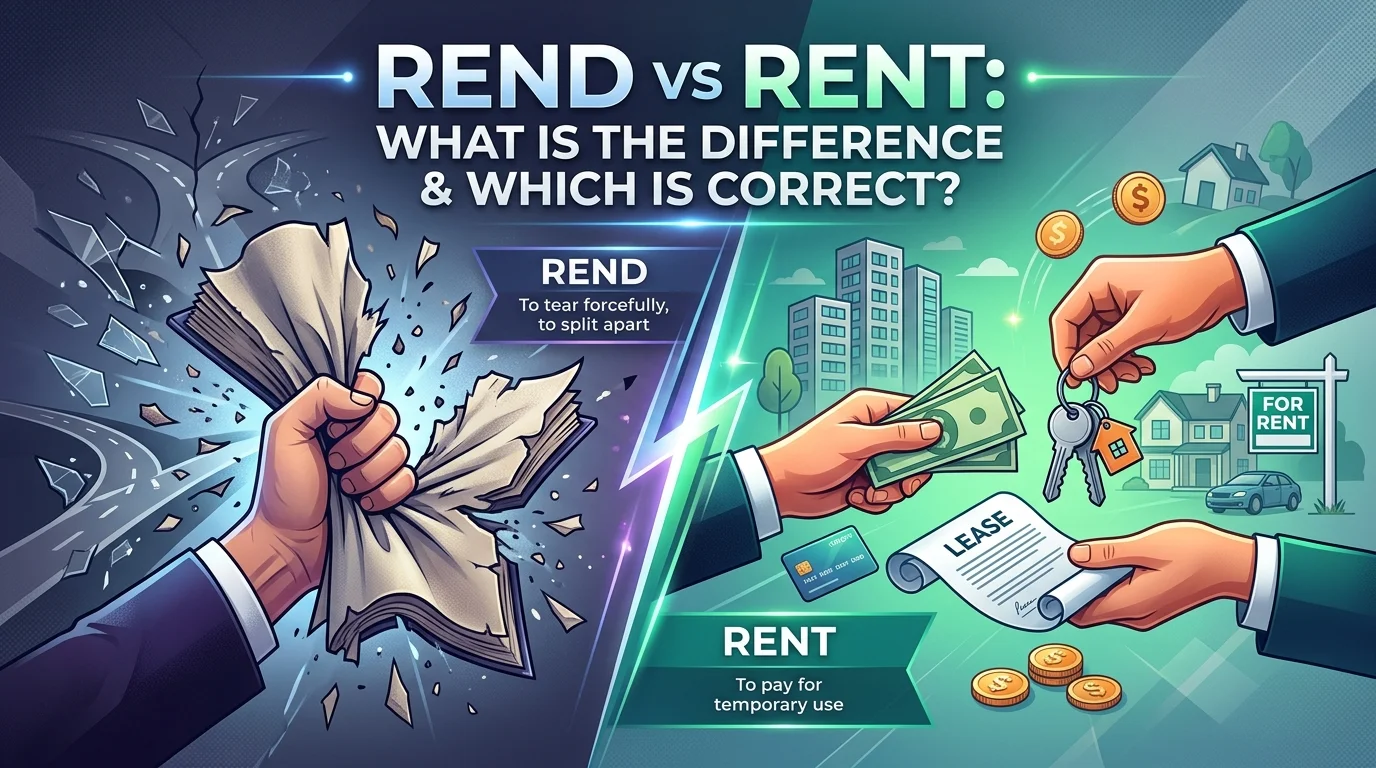
Understanding the difference between “rend” and “rent” is important because these two words sound somewhat similar but have completely different meanings. One refers to tearing something apart, while the other relates to paying for temporary use of property. This guide makes their meanings, usage, and grammar clear so you never confuse them again.
Comparison Overview
“Rend” and “rent” are both English verbs, but they belong to very different contexts. “Rend” is an older, more literary word connected to breaking or tearing something violently. “Rent” is commonly used in everyday life, especially in housing, business, and finance, where it refers to paying for the use of something. Despite similar spelling patterns, their meanings do not overlap.
Definition of Rend
“Rend” means to tear, split, or break something apart with force. It is often used in emotional, dramatic, or descriptive writing rather than everyday speech.
It can describe physical tearing, like fabric or paper, or emotional distress, such as a heart being “rent” with grief in literary expressions.
Definition of Rent
“Rent” has two main meanings. First, it refers to a payment made for the temporary use of property, such as a house, apartment, or vehicle. Second, it can also function as the past tense of “rend” in older or literary English, though this usage is rare today.
In modern usage, “rent” almost always relates to leasing or hiring something for a fee.
Main Differences Between Rend and Rent
The key difference lies in meaning and usage context. “Rend” is about forceful tearing or emotional intensity, while “rent” is mainly about payment and leasing arrangements.
“Rend” appears mostly in literature, poetry, or expressive language. “Rent” is widely used in daily communication, especially in financial and real estate contexts.
In short, “rend” is expressive and dramatic, while “rent” is practical and transactional.
Comparison Table
| Feature | Rend | Rent |
| Meaning | To tear apart | To pay for use or past form of rend |
| Usage | Literary, emotional | Everyday, financial |
| Context | Descriptive writing | Housing, business |
| Frequency | Rare | Very common |
Grammar Guide
“Rend” is a verb that usually appears in formal or literary contexts. Its forms include rend, rent, and rent (past participle in older usage). However, modern English rarely uses its full conjugation.
“Rent” is also a verb and noun. As a verb, it means to lease something. As a noun, it refers to the payment made for that lease.
How each term is used in sentences
“Rend” is used when describing forceful action or emotional intensity. Example pattern: subject + rend + object.
“Rent” is used when describing agreements or payments. Example pattern: subject + rent + object + for amount/time.
Common mistakes learners make
A common mistake is using “rent” instead of “rend” in expressive writing. Another error is assuming both words mean the same thing because of similar spelling. Many learners also forget that “rent” has financial meaning unrelated to tearing.
Simple rules to remember
If the idea involves tearing or strong emotion, use “rend”. If the idea involves paying for use or a lease, use “rent”. This simple split helps avoid confusion.
Quick tips for writing and speaking
Think of “rend” as dramatic language used in stories or poetry. Think of “rent” as practical language used in real life situations like housing or business agreements.
When to Use Each One
Use “rend” when describing destruction, emotional pain, or dramatic actions in writing. Use “rent” when talking about money paid for using something temporarily, especially property or services.
When NOT to Use Each One
Do not use “rend” in financial or rental contexts. It does not describe payments or leasing. Do not use “rent” when describing tearing or breaking something apart, as that creates incorrect meaning.
Which One to Use (Decision Guide)
If your sentence is about breaking, tearing, or emotional intensity, choose “rend”. If your sentence is about paying for use, contracts, or temporary access, choose “rent”. This distinction ensures correct usage in both formal and informal writing.
Real-World Practical Examples
Rend Examples
- The storm seemed to rend the sky with lightning.
- Her grief rent her heart after the loss.
- The loud noise rent the silence of the night.
- The fabric was rent by the sharp metal edge.
- His anger seemed to rend the calm atmosphere of the room.
Rent Examples
- I pay rent for my apartment every month.
- They rent a car when they travel abroad.
- The company rents office space in the city center.
- We decided to rent a movie for the weekend.
- She cannot afford high rent in this neighborhood.
Self-Assessment (Fill in the Blanks)
- I will use ______ when describing tearing something apart.
- The correct word is ______ when talking about paying for a house.
- Her heart was ______ with sadness after the news.
- We need to ______ a car for the trip.
- The cloth was ______ during the accident.
- He pays monthly ______ for his apartment.
- The wind seemed to ______ through the valley.
- They decided to ______ an office downtown.
- The loud sound ______ the silence.
- She cannot afford high ______ in the city.
- The warrior’s cry seemed to ______ the air.
- We usually ______ bikes during vacations.
- His grief ______ his emotions.
- I forgot to pay the ______ this month.
- The explosion seemed to ______ the ground.
- They ______ equipment for the event.
- The pain seemed to ______ her spirit.
- Students often ______ laptops for study.
- The fabric was ______ by sharp glass.
- He struggles with increasing ______ costs.
Answers
- rend
- rent
- rent
- rent
- rent
- rent
- rend
- rent
- rent
- rent
- rend
- rent
- rent
- rent
- rend
- rent
- rend
- rent
- rent
- rent
Final Verdict
“Rend” and “rent” may look similar, but they serve very different purposes in English. “Rend” is a dramatic and literary word used for tearing or emotional intensity, while “rent” is a common everyday word used for payments and leasing. Choosing the correct word depends entirely on context. If you remember that one is emotional or physical destruction and the other is financial or practical usage, you will never confuse them again.
Conclusion About Rend or Rent
Understanding the difference between rend and rent helps you avoid one of the most common English word confusions. Although they look similar, their meanings belong to completely different worlds. Rend is used in expressive or literary contexts to describe tearing, breaking, or emotional intensity. Rent, on the other hand, is part of everyday communication and is mainly associated with paying for the use of property, vehicles, or services. Knowing when to use each word improves both writing accuracy and clarity in speech. Whether you are reading literature or discussing housing costs, choosing the correct term ensures your message is precise and natural. With practice, this distinction becomes easy to remember and apply confidently in real-life situations.
FAQs
What does rend mean in simple words?
Rend means to tear something apart with force or strong emotion. It is often used in literature or descriptive writing rather than everyday conversation. The word can describe physical destruction or emotional pain, such as a heart being torn by grief or a fabric being ripped violently.
What does rent mean in daily usage?
Rent usually means the money paid to use something temporarily, such as a house, apartment, or car. It can also refer to the act of leasing or hiring property. This is the most common meaning used in everyday conversations, business, and real estate contexts.
Is rent ever related to tearing?
Yes, but rarely. In older or literary English, rent can be the past tense of rend, meaning something was torn apart. However, this usage is not common today. In modern English, rent almost always refers to payment for using property or services.
Can rend and rent be used interchangeably?
No, they cannot be used interchangeably. Rend refers to tearing or emotional intensity, while rent refers to payment or leasing. Using one in place of the other changes the meaning completely and can make the sentence incorrect or confusing.
Is rend a common word in spoken English?
Rend is not commonly used in everyday spoken English. It appears more in literature, poetry, or formal writing where dramatic expression is needed. Most speakers prefer simpler words like tear instead of rend in casual conversation.
What is the noun form of rent?
The noun form of rent refers to the amount of money paid regularly for using property or equipment. For example, monthly rent for an apartment. It is widely used in housing, business agreements, and financial discussions.
What is the difference between tear and rend?
Tear is a more common and general word for ripping something. Rend is a stronger, more dramatic version often used in literature. Both mean breaking something apart, but rend carries a more intense and emotional tone compared to tear.
Why do rend and rent confuse learners?
They confuse learners because they look and sound similar but have completely different meanings. One relates to destruction or emotion, while the other relates to money and leasing. Their spelling pattern makes them easy to mix up in writing.
Can rent be used as a verb?
Yes, rent can be used as a verb meaning to pay for or lease something temporarily. For example, you can rent a house, rent a car, or rent equipment. It is one of the most common uses in modern English.
How can I remember rend vs rent easily?
A simple way is to remember that rend involves “ripping or breaking,” while rent involves “returning money for use.” Associating rend with destruction and rent with payment helps you quickly choose the correct word in writing and speaking.