
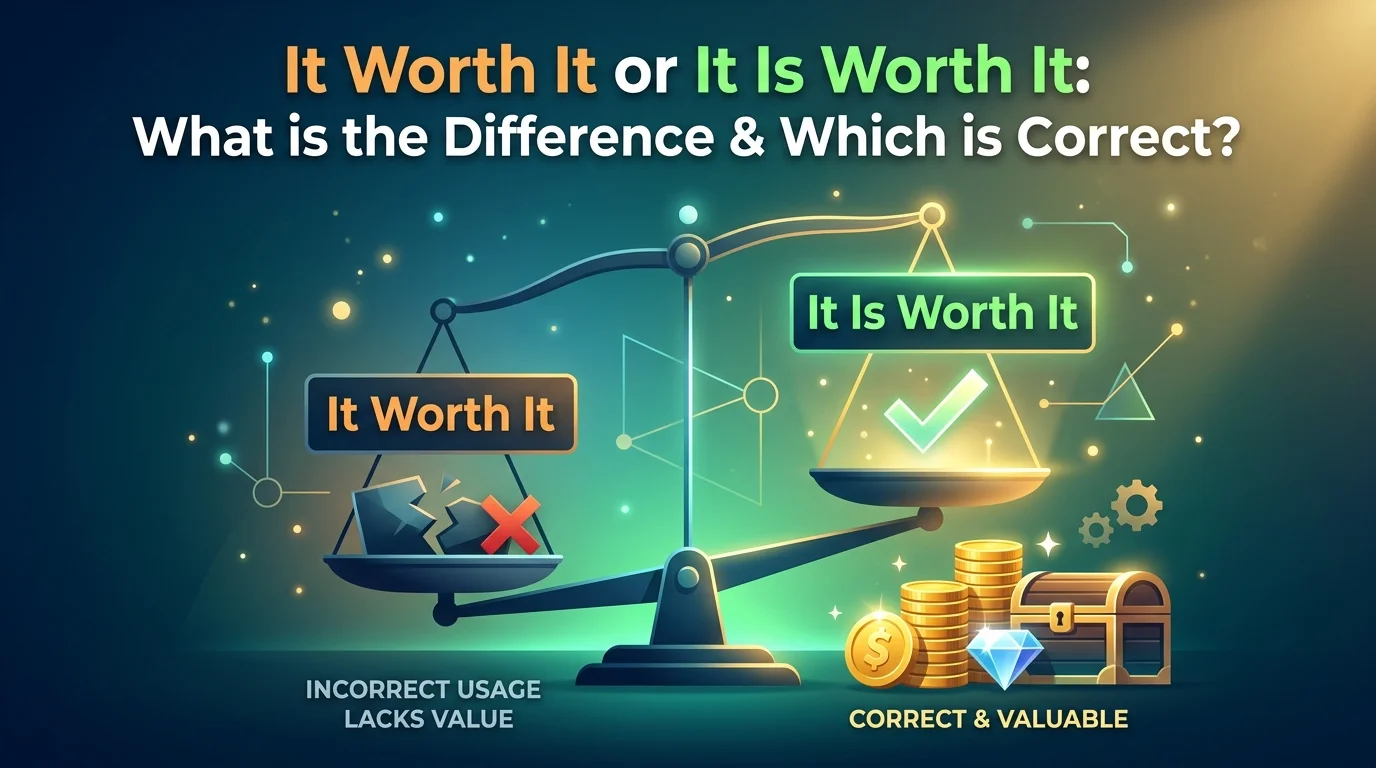
Understanding the difference between “It Worth It” and “It Is Worth It” helps improve your grammar, writing clarity, and speaking confidence. These phrases often confuse learners because they look similar but are not always used in the same way. This guide explains their meaning, usage, and correct forms in simple language.
Comparison Overview
Both expressions are used to talk about value, benefit, or importance of something. However, only one is grammatically complete in standard English. “It Is Worth It” is the correct full structure, while “It Worth It” is an incomplete or informal fragment often seen in casual speech or shorthand writing.
Definition of It Worth It
“It Worth It” is not a complete grammatical sentence in standard English. It appears when speakers drop the verb “is” in informal conversation or quick texting. While it may still be understood, it lacks proper structure and is generally considered incorrect in formal writing.
Definition of It Is Worth It
“It Is Worth It” is a correct and complete English expression. It is used to show that something has value, benefit, or justification compared to its cost, effort, or time. It is widely used in speaking, writing, and formal communication.
Main Differences Between It Worth It and It Is Worth It
The key difference lies in grammar completeness and correctness. “It Is Worth It” includes the linking verb “is,” making it a full sentence structure. “It Worth It” removes the verb, which makes it grammatically incomplete.
In usage, “It Is Worth It” is acceptable in all contexts including academic writing, professional communication, and everyday speech. “It Worth It” is mostly limited to informal texting or quick conversation where grammar rules are relaxed.
| Feature | It Worth It | It Is Worth It |
| Grammar | Incomplete | Complete |
| Formal use | Not recommended | Correct |
| Spoken use | Informal slang | Standard usage |
| Written use | Avoid | Recommended |
| Clarity | Less clear | Clear and natural |
Grammar Guide
The correct structure follows the pattern: subject + linking verb + complement. In this case, “it” is the subject, “is” is the linking verb, and “worth it” is the complement that expresses value or benefit.
How each term is used in sentences
“It Is Worth It” is used to express judgment about value or effort.
Examples:
- It is worth it to study hard for exams.
- This trip is worth it because of the experience.
- The new phone is worth it for its features.
“It Worth It” appears only in informal speech where “is” is dropped.
Examples:
- It worth it going there (informal speech)
- That movie worth it (casual texting)
Common mistakes learners make
Many learners forget to include the verb “is,” especially in fast writing or speech. Another mistake is using “worth” alone without a proper structure, which creates incomplete sentences.
Incorrect examples:
- It worth it to try.
- That effort worth it.
Simple rules to remember
Always include a verb when describing value in a sentence. If you can insert “is” naturally, then the correct form is “It is worth it.”
Quick tips for writing and speaking
In formal writing, always use the full structure. In speech, avoid dropping “is” if you want to sound clear and correct. Think of “worth it” as needing a helper verb to complete the meaning.
When to Use Each One
Use “It Is Worth It” when you are writing essays, emails, reports, or giving advice. It is also the best choice in interviews or presentations.
“It Worth It” may appear in casual chats, texting, or social media where grammar is less strict and speed is more important than correctness.
When NOT to Use Each One
Avoid using “It Worth It” in academic writing, job applications, professional emails, or any formal context. It can make your writing look incomplete or unpolished.
Avoid using either phrase without context. For example, saying just “Worth it” without a subject may confuse readers in formal communication.
Which One to Use (Decision Guide)
If you are unsure, always choose “It Is Worth It.” It is grammatically correct, widely accepted, and appropriate in all situations. Use “It Worth It” only in informal speech when grammar rules are intentionally relaxed.
Real-World Practical Examples
It Worth It Examples
- It worth it going there for fun (informal speech).
- That experience worth it in the end (casual usage).
- It worth it trying again (texting style).
- This effort worth it for success (informal).
- It worth it staying a bit longer (spoken shorthand).
It Is Worth It Examples
- It is worth it to wake up early for success.
- This course is worth it for career growth.
- It is worth it to travel and learn new cultures.
- The effort is worth it when results appear.
- It is worth it to invest time in learning skills.
Self-Assessment (Fill in the Blanks)
- I will use ______ when expressing value in formal writing.
- The correct word is ______ because it includes a verb.
- ______ is often used in informal speech without full grammar.
- I should write ______ in an essay.
- The phrase ______ is grammatically incomplete.
- In professional emails, I should use ______.
- ______ may appear in texting.
- The correct structure is ______ because it is complete.
- I will avoid ______ in academic writing.
- ______ shows correct sentence formation.
- ______ is not standard English grammar.
- I will choose ______ for interviews.
- ______ is acceptable in casual conversation only.
- The proper form is ______ with “is” included.
- ______ should be avoided in formal documents.
- I will use ______ when giving advice formally.
- ______ is a shortened informal version.
- The correct sentence is ______ for clarity.
- ______ is incomplete without a verb.
- I will always prefer ______ in writing.
Answers
- It is worth it
- It is worth it
- It worth it
- It is worth it
- It worth it
- It is worth it
- It worth it
- It is worth it
- It worth it
- It is worth it
- It worth it
- It is worth it
- It worth it
- It is worth it
- It worth it
- It is worth it
- It worth it
- It is worth it
- It worth it
- It is worth it
Final Verdict
The correct and standard expression is “It Is Worth It.” It follows proper English grammar and is suitable for all types of communication. “It Worth It” is only an informal shortcut that removes the necessary verb and should be avoided in formal writing. If you want clarity, correctness, and professionalism, always choose “It Is Worth It.”
Conclusion About It Worth It or It Is Worth It
Choosing between “It Worth It” and “It Is Worth It” mainly comes down to grammar accuracy and clarity in communication. While both phrases aim to express whether something has value or benefit, only one follows standard English structure. “It Is Worth It” is the correct and complete form used in speaking and writing across all contexts, including academic, professional, and everyday communication. On the other hand, “It Worth It” is an informal, shortened version that often appears in casual speech or quick messaging but is not considered grammatically complete. Understanding this difference helps you sound more natural and confident when using English. By consistently using “It Is Worth It,” you ensure your sentences are clear, correct, and easy to understand. This small grammar choice can significantly improve your writing quality and make your communication more polished and professional in any situation.
FAQs
What does It Is Worth It mean?
It Is Worth It means something has enough value or benefit to justify the effort, time, or cost involved. It is commonly used to express that an action or experience is meaningful and rewarding in both spoken and written English.
Is It Worth It grammatically correct?
It Worth It is not grammatically correct in standard English because it lacks a necessary verb. It may appear in casual speech, but in formal writing or proper communication, It Is Worth It should always be used instead.
When should I use It Is Worth It?
You should use It Is Worth It in formal writing, academic work, professional emails, and clear spoken communication. It is the standard expression used to describe value or benefit in a complete and correct sentence form.
Why do people say It Worth It?
People often say It Worth It in casual conversation or texting where grammar is relaxed. It is a shortened form of speech that drops the verb “is,” making it quicker but less grammatically correct.
What is the correct sentence structure?
The correct structure is subject plus linking verb plus complement. In this case, “it” is the subject, “is” is the linking verb, and “worth it” describes value or benefit, forming a complete sentence.
Can Worth It be used alone?
Yes, Worth It can be used alone in informal situations as a short reaction or comment. However, in full sentences, it should be supported by a subject and verb to remain grammatically correct.
Is It Is Worth It used in formal writing?
Yes, It Is Worth It is widely used in formal writing because it is grammatically correct and clearly expresses value or justification in academic, business, and professional contexts.
What mistakes do learners make?
Learners often forget to include the verb “is,” resulting in incomplete sentences like It Worth It. Another mistake is using Worth It without a proper structure, which can reduce clarity in communication.
How can I remember the correct form?
A simple way to remember is to always check if a verb is needed. If you are expressing value or judgment, include “is” to form It Is Worth It as a complete and correct sentence.
Is there a meaning difference between them?
There is no difference in meaning between the two phrases. Both express value or benefit, but only It Is Worth It is grammatically correct, while It Worth It is informal and incomplete.

Ethan Clarke is a language writer who specializes in breaking down similes, word meanings, and commonly confused terms. His work focuses on clear explanations, practical examples, and simple comparisons that help readers understand how English