
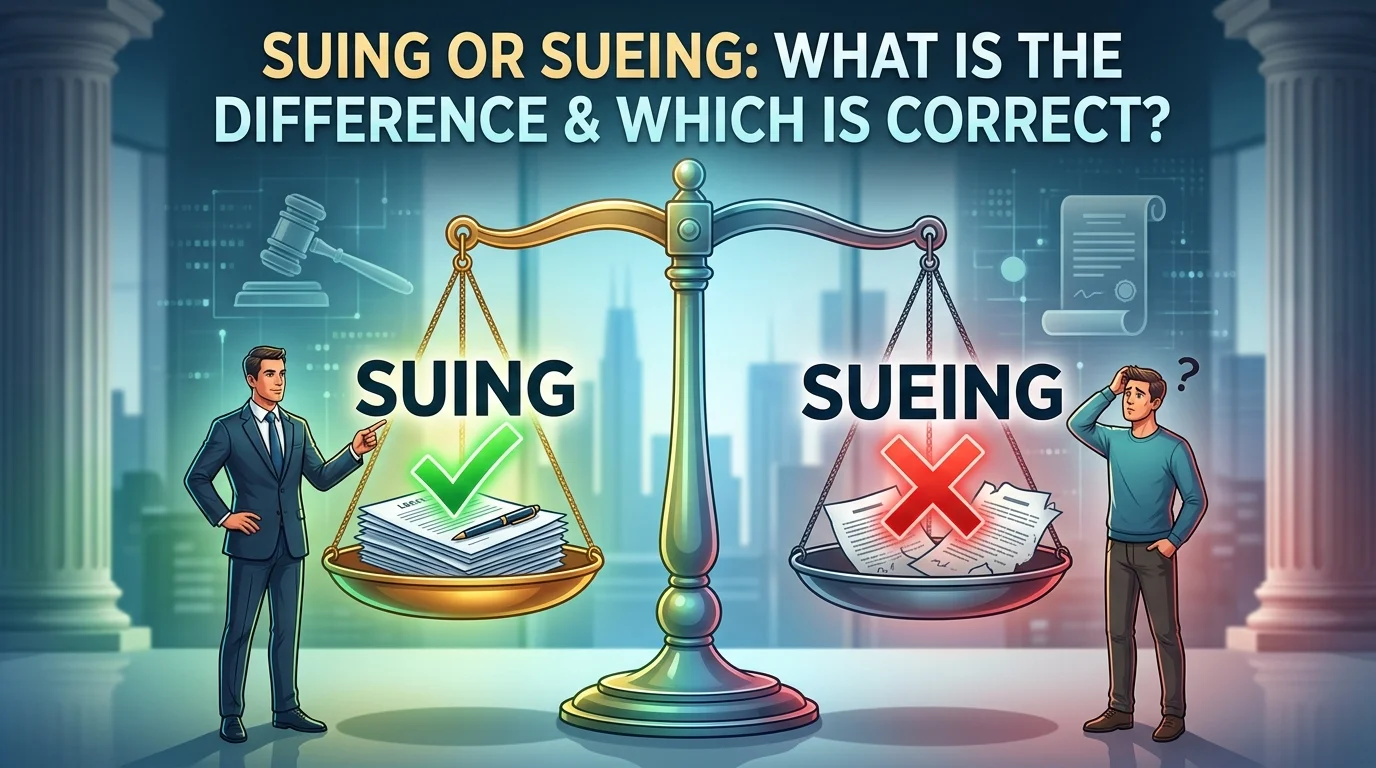
Many people get confused between “suing” and “sueing” when talking about legal action. The difference is simple but important, especially in writing and formal communication. One is the correct spelling, while the other is a common mistake. Understanding this helps you write accurately and avoid grammar errors in legal or everyday contexts.
Comparison Overview
“Suing” and “sueing” are often used when someone is talking about taking legal action against another person or organization. Both appear similar, but only one follows standard English spelling rules. The correct form comes from the verb “to sue,” while the other is an incorrect variation caused by confusion with spelling patterns in English.
Definition of Suing
“Suing” is the correct present participle form of the verb “sue.” It means to take legal action against someone in a court of law to seek compensation, justice, or enforcement of rights. It is widely used in legal writing, news reports, and formal communication.
Definition of Sueing
“Sueing” is an incorrect spelling of the word “suing.” It is a common mistake made by learners or writers who assume the base verb “sue” should follow the pattern of adding “ing” as “sueing.” However, standard English drops the extra “e,” making this form incorrect in formal usage.
Main Differences Between Suing and Sueing
The key difference lies in correctness and standard usage. “Suing” is the accepted grammatical form, while “sueing” is a misspelling.
“Suing” is used in legal, academic, and professional contexts, while “sueing” is not recognized in standard English dictionaries.
In meaning, both attempt to express the same idea, but only one is valid in correct writing.
Comparison Table
| Aspect | Suing | Sueing |
| Correctness | Correct | Incorrect |
| Dictionary recognition | Accepted | Not accepted |
| Usage | Formal and informal writing | Common spelling mistake |
| Grammar rule | Drops silent “e” before “ing” | Incorrect rule application |
Grammar Guide
“Suing” comes from the verb “sue,” which is a regular verb in English when forming its present participle. When a verb ends in a silent “e,” the “e” is usually dropped before adding “ing.”
How each term is used in sentences
“Suing” is used to describe ongoing legal action.
Examples:
The company is suing its competitor for copyright violation.
She is suing the landlord for unsafe living conditions.
They are suing the contractor for breach of contract.
“Sueing” should not be used in correct English writing.
Common mistakes learners make
Many learners mistakenly write “sueing” because they assume the base word remains unchanged when adding “ing.” Others confuse it with similar verbs like “seeing,” which keeps the double vowel pattern.
Simple rules to remember
Drop the final “e” before adding “ing” in the verb “sue.”
Remember: sue becomes suing, not sueing.
If the word ends in a silent “e,” it usually disappears when adding “ing.”
Quick tips for writing and speaking
Always double check spelling in legal terms.
Use spellcheck tools when writing formal documents.
Practice with examples to reinforce correct usage.
When to Use Each One
Use “suing” when referring to legal action currently happening or being discussed. It is correct in all professional, academic, and informal contexts.
Never use “sueing” in formal writing, exams, legal documents, or publications.
When NOT to Use Each One
Do not use “suing” in non-legal contexts unless you are specifically talking about lawsuits.
Avoid “sueing” entirely, as it is not recognized as correct spelling.
Which One to Use (Decision Guide)
If you are describing legal action, always choose “suing.”
If you are unsure about spelling, remember that correct English removes the final “e” before adding “ing.”
If you see “sueing,” treat it as an error and correct it to “suing.”
Real-World Practical Examples
Suing Examples
The celebrity is suing the magazine for defamation.
A worker is suing the company for unpaid wages.
The family is suing the hospital for medical negligence.
The artist is suing for copyright infringement.
The customer is suing the business for false advertising.
Sueing Examples
The term “sueing” is incorrect and should not be used in formal writing.
Students often make the mistake of sueing instead of suing in essays.
Spellcheck tools usually flag sueing as a spelling error.
Writers who use sueing are considered to have incorrect grammar.
Legal documents must never contain the word sueing.
Self-Assessment (Fill in the Blanks)
The correct form is ______ when describing legal action.
Many writers mistakenly write ______ instead of the correct word.
The company is ______ its competitor in court.
I saw the spelling ______ in an online article.
______ is not recognized in standard English.
The lawyer is ______ a major corporation.
The correct spelling drops the letter ______ before adding ing.
People often confuse ______ with seeing.
She is ______ the landlord for damages.
______ should never appear in legal documents.
The verb sue becomes ______ in present participle form.
Incorrect spelling like ______ can affect credibility.
The case involves ______ for breach of contract.
Students corrected the word ______ in their essays.
The judge mentioned the act of ______ in court.
Always avoid writing ______ in formal reports.
The company is currently ______ several parties.
The correct grammatical form is ______.
Writers must learn that ______ is wrong.
The act of ______ requires legal grounds.
Answers
- suing
- sueing
- suing
- sueing
- sueing
- suing
- e
- suing
- suing
- sueing
- suing
- sueing
- suing
- sueing
- suing
- sueing
- suing
- suing
- sueing
- suing
Final Verdict
The correct and only accepted form is “suing.” It follows standard English grammar rules and is used in all legal and professional contexts. “Sueing” is simply a spelling mistake and should be avoided in all writing. Understanding this difference helps improve accuracy, clarity, and credibility in both formal and everyday communication.
Conclusion About Suing or Sueing
Understanding the difference between “suing” and “sueing” helps you write with accuracy and confidence, especially in legal or formal contexts. The correct form, “suing,” comes from the verb “sue” and follows standard English spelling rules where the final silent “e” is dropped before adding “ing.” On the other hand, “sueing” is simply a common spelling mistake that appears due to confusion with other verb patterns. While both may look similar at first glance, only one is accepted in professional writing, court documents, and academic communication. Using the correct form not only improves your grammar but also strengthens your credibility as a writer. Whether you are drafting legal content, reading news articles, or improving your English skills, remembering this small rule makes a big difference. In short, always choose “suing” for correct, clear, and polished communication in every situation where accuracy matters.
FAQs
What does suing mean in simple terms?
Suing means taking legal action against a person, company, or organization in court. It is done to resolve disputes, claim compensation, or enforce rights. It usually involves lawyers and legal procedures where one party files a case against another for justice or damages.
Is sueing ever correct in English writing?
Sueing is not correct in standard English. It is a spelling mistake that often happens when people incorrectly add “ing” to the base word “sue.” The proper form is always suing, which follows accepted grammar rules used in legal and formal writing.
Why do people write sueing instead of suing?
People often write sueing due to confusion with spelling rules in English. Many assume the word keeps the final “e” when adding “ing,” similar to some other verbs. However, in this case, the “e” is dropped, making suing the correct form.
Is suing only used in legal contexts?
Yes, suing is mainly used in legal contexts where someone takes a dispute to court. It appears in news reports, legal documents, and formal discussions about lawsuits. It is not commonly used in casual conversation unless referring to legal matters.
Can suing be used in everyday language?
Yes, suing can be used in everyday language when discussing legal issues in simple terms. People might say someone is suing another person to explain a court case in an easy way. However, it still refers specifically to legal action.
What is the grammar rule behind suing?
The grammar rule is that when a verb ends in a silent “e,” the “e” is dropped before adding “ing.” Since “sue” ends in a silent “e,” it becomes “suing” and not “sueing.” This rule applies to many similar English verbs.
How can I remember the correct spelling?
A simple way to remember is to think: remove the “e” before adding “ing.” So “sue” becomes “suing.” Repeating this rule and practicing with examples helps avoid the common mistake of writing sueing incorrectly.
Is suing used in formal documents?
Yes, suing is commonly used in formal documents such as legal filings, contracts, court records, and official reports. It is the only accepted form in professional writing and must always be spelled correctly to maintain accuracy and credibility.
What mistakes happen when using suing?
A common mistake is writing sueing instead of suing. Another mistake is using it in non-legal contexts where it may not be relevant. Correct usage requires both proper spelling and appropriate context related to legal action.
How is suing different from other similar verbs?
Suing differs from other verbs because it follows the rule of dropping a silent “e” before adding “ing.” Some verbs behave differently, which creates confusion. Understanding this specific rule helps ensure correct usage and prevents common spelling errors.

Sophia Turner is a grammar-focused writer who covers similes, word-versus-word meanings, and correct English usage. Her content is designed for learners who want quick answers, logical explanations, and practical guidance for improving writing accuracy and style.