
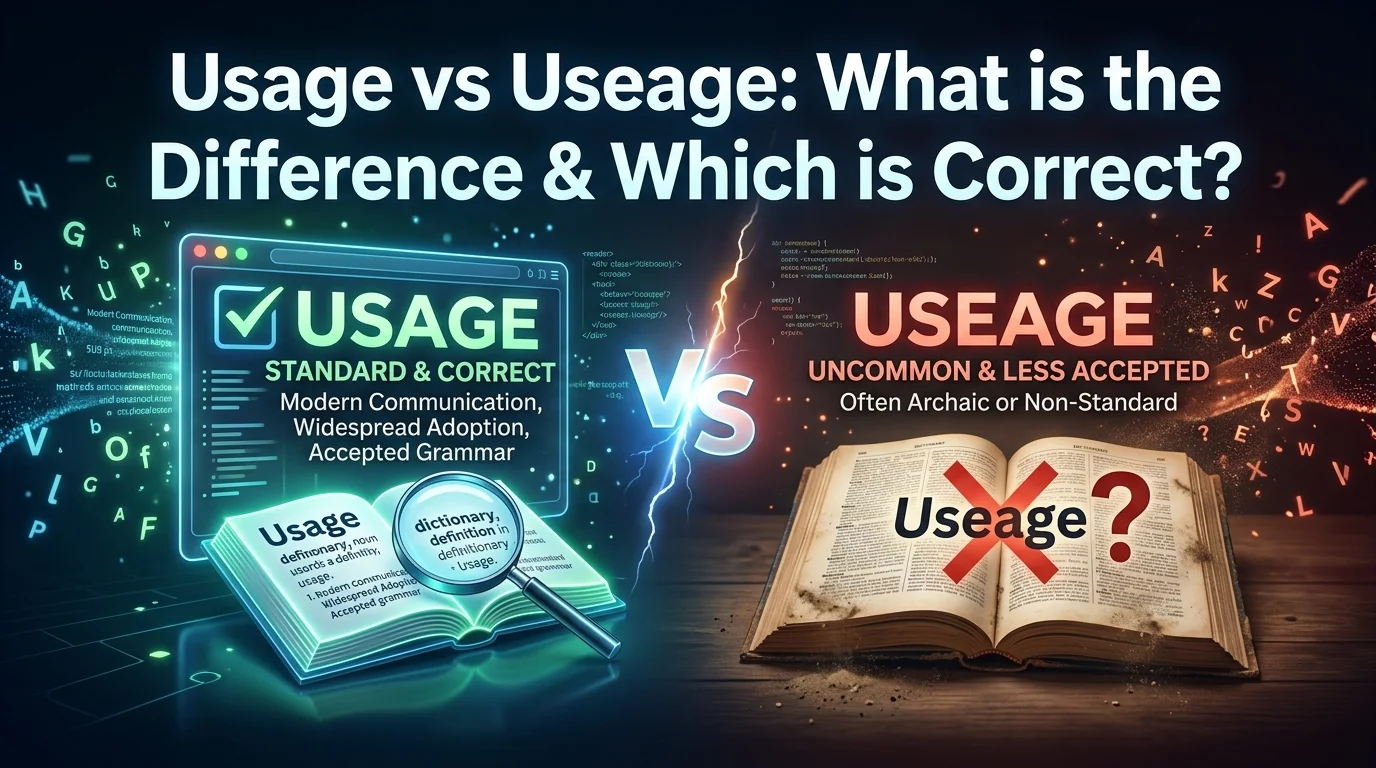
Understanding the difference between “usage” and “useage” is important for clear and correct English writing. Many learners get confused because the words look similar, but only one is actually correct. This guide explains their meanings, differences, and proper usage in simple terms so you can avoid common spelling mistakes.
Comparison Overview
“Usage” and “useage” are often confused due to their similar spelling, but they are not equal in standard English. “Usage” is the correct and widely accepted word used in grammar, writing, and communication. “Useage” is generally considered a spelling error that sometimes appears in informal writing. Both relate to the idea of using something, but only one is grammatically correct.
Definition of Usage
“Usage” is a noun that refers to the way something is used or the frequency and manner in which it is applied. It is commonly used in grammar, language studies, technology, and everyday communication. It can describe habits, customs, or rules related to use.
Definition of Useage
“Useage” is a misspelling of “usage.” It is not recognized as a correct English word in standard dictionaries. Although it may appear in informal writing or typing errors, it should be avoided in formal communication, academic writing, and professional contexts.
Main Differences Between Usage and Useage
The main difference is correctness. “Usage” is the accepted and correct form, while “useage” is incorrect.
| Feature | Usage | Useage |
| Correct spelling | Yes | No |
| Dictionary recognition | Yes | No |
| Formal writing use | Yes | No |
| Meaning clarity | Clear and standard | Incorrect or confusing |
| Acceptance | Universal | Considered an error |
Grammar Guide
“Usage” functions as a noun and is often used to describe behavior, language patterns, or consumption of resources.
How each term is used in sentences
- Correct: The usage of mobile phones has increased.
- Correct: Proper grammar usage improves writing.
- Incorrect: The useage of mobile phones has increased.
Common mistakes learners make
Many learners mistakenly add an extra “e” and write “useage” instead of “usage.” This usually happens because of confusion with words like “usage” and “usage-related forms.”
Simple rules to remember
If you are referring to correct English writing, always use “usage.” Remember that there is no extra “e” in the word.
Quick tips for writing and speaking
Always double-check spelling when writing “usage.” Reading your sentence aloud can also help catch errors naturally.
When to Use Each One
Use “usage” when talking about how something is used, especially in formal, academic, or professional contexts. Do not use “useage” at any time, since it is not correct English.
When NOT to Use Each One
Never use “useage” in essays, reports, emails, or exams. It should also be avoided in digital content, business communication, and grammar-related writing. In all cases where you think “useage” fits, replace it with “usage.”
Which One to Use (Decision Guide)
If you are writing or speaking and referring to the act or manner of using something, choose “usage.” If you are unsure, always check a dictionary or rely on spellcheck tools, which will correct “useage” automatically.
Real-World Practical Examples
Usage Examples
- The usage of electricity increases during summer.
- Proper word usage is important in essays.
- Internet usage has become a part of daily life.
- The usage of medical equipment must be monitored carefully.
- Software usage can be tracked for performance analysis.
Useage Examples
- The useage of this word is incorrect in English.
- Many students mistakenly write useage instead of usage.
- Useage is not found in standard dictionaries.
- The useage in this sentence should be corrected.
- Teachers often highlight useage as a common spelling mistake.
Self-Assessment (Fill in the Blanks)
- I will use ______ when referring to correct word spelling.
- The correct word is ______ because it is accepted in English.
- ______ refers to how something is used.
- “Useage” is considered a ______.
- The ______ of electricity is increasing daily.
- Always check ______ in formal writing.
- ______ is not a standard English word.
- Proper ______ improves communication.
- Many learners confuse usage with ______.
- The ______ of mobile phones is widespread.
- ______ should be avoided in academic writing.
- The ______ of grammar rules is important.
- ______ is found in dictionaries.
- Incorrect spelling includes ______.
- ______ describes how something is applied.
- Teachers correct ______ errors.
- The ______ of tools must be safe.
- ______ is the right spelling choice.
- Avoid writing ______ in exams.
- Correct ______ improves clarity.
Answers
- Usage
- Usage
- Usage
- Error
- Usage
- Usage
- Useage
- Usage
- Useage
- Usage
- Useage
- Usage
- Usage
- Useage
- Usage
- Useage
- Usage
- Usage
- Useage
- Usage
Final Verdict
“Usage” is the correct and standard English word used in all forms of writing and communication. “Useage” is simply a common spelling mistake and should be avoided. If you want to write correctly and professionally, always choose “usage,” as it ensures clarity, accuracy, and proper grammar in every context.
Conclusion About Usage or Useage
Understanding the difference between usage and useage helps you avoid one of the most common spelling mistakes in English writing. The correct form, usage, is used in grammar, daily communication, academic writing, and professional contexts to describe how something is applied or commonly used. The incorrect form, useage, often appears due to confusion but should always be avoided. By remembering this simple rule, you can improve your writing accuracy and sound more confident in both speech and text. Whether you are a student, professional, or casual writer, using the correct spelling strengthens clarity and credibility. In the end, mastering small details like this makes a big difference in effective communication and helps you present yourself as a more polished English user. Paying attention to such differences also supports better exam performance and professional writing success.
FAQs
What is correct spelling usage or useage?
The correct spelling is usage. It is the only accepted form in English dictionaries and is used in writing, speaking, and formal communication. Useage is considered incorrect and should always be replaced with usage to maintain proper grammar and clarity in all types of content.
Why is useage incorrect in English?
Useage is incorrect because it does not follow standard English spelling rules. It is a common typing or learning mistake caused by confusion with similar sounding words. Dictionaries and grammar references do not recognize it, so it should never be used in academic or professional writing.
What does usage mean in English?
Usage refers to the way something is used or how often it is used. It can describe language rules, behavior patterns, or resource consumption. For example, it can relate to grammar usage, internet usage, or general daily life activities where something is applied or utilized.
Where is the word usage commonly used?
The word usage is commonly used in education, grammar studies, business communication, technology discussions, and daily conversations. It helps describe how words, tools, or resources are used in different contexts, making it a versatile and widely applied term in English language.
Is usage considered formal or informal?
Usage is considered both formal and informal depending on context. In academic writing, reports, and professional documents, it is widely used in a formal sense. It is also common in everyday speech when describing how something is used or applied in general situations.
What are common mistakes with usage and useage?
The most common mistake is adding an extra “e” and writing useage instead of usage. Many learners also confuse pronunciation and spelling patterns, leading to errors. The correct form should always be usage, especially in exams, essays, and professional communication.
How can I remember the correct spelling of usage?
You can remember the correct spelling by focusing on the fact that it comes from “use” plus “age” without adding an extra letter. Practicing writing it in sentences and using spellcheck tools can also help reinforce the correct form usage in memory.
Is useage found in dictionaries?
No, useage is not found in standard English dictionaries. It is considered a spelling error rather than a real word. Only usage appears in recognized dictionaries and grammar references, confirming it as the correct and accepted form in English language writing.
What is the difference between usage and useage?
There is no meaning difference because useage is not a valid word. Usage is the correct term that refers to how something is used or applied. Useage is simply a misspelling and should not be used in any form of communication or writing.
Can usage be used in everyday communication?
Yes, usage is commonly used in everyday communication. People use it when talking about habits, language rules, or resource consumption. For example, electricity usage or word usage are common phrases that appear in both casual conversations and formal discussions.

Sophia Turner is a grammar-focused writer who covers similes, word-versus-word meanings, and correct English usage. Her content is designed for learners who want quick answers, logical explanations, and practical guidance for improving writing accuracy and style.