
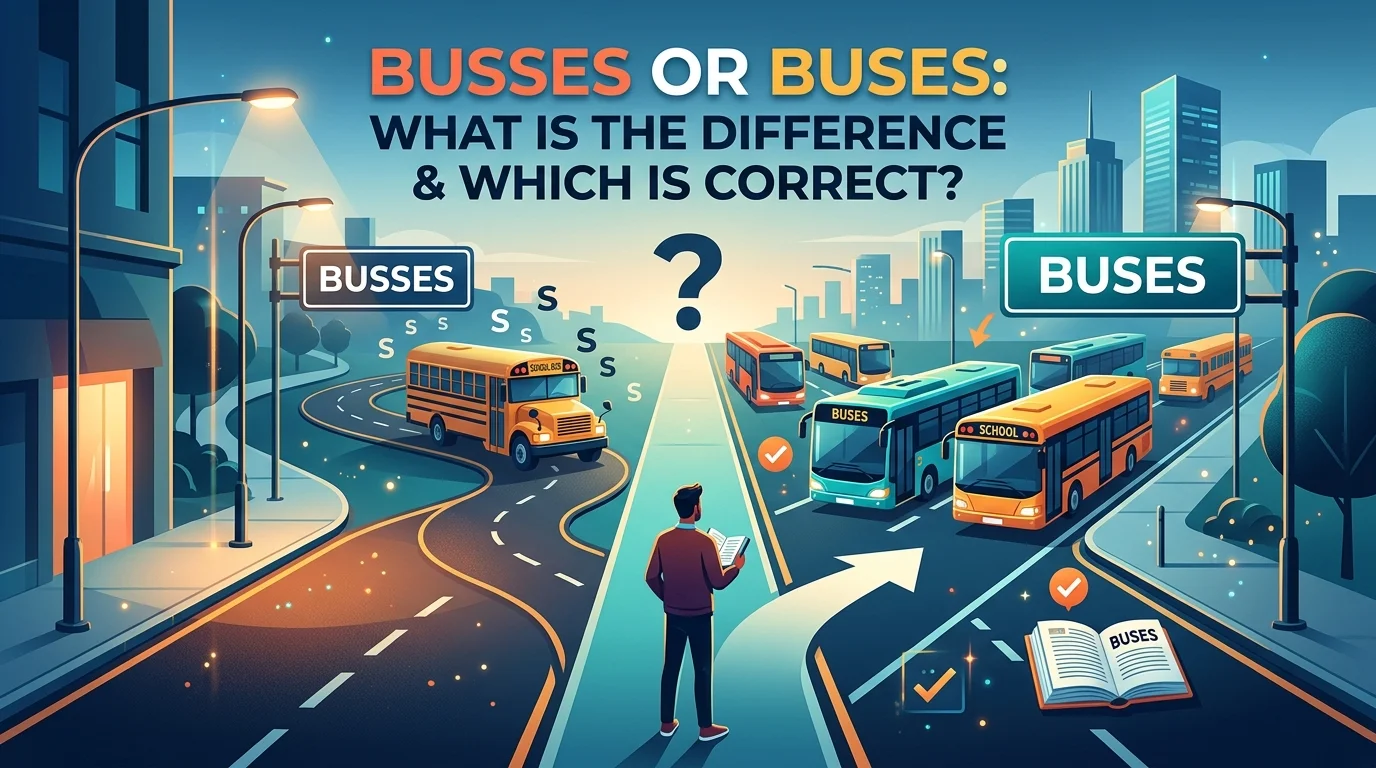
The words “busses” and “buses” often confuse English learners and even native speakers because they look almost the same but are used differently. Understanding the correct form is important for clear writing and communication. This guide explains their meanings, differences, grammar rules, and correct usage in simple terms so you can confidently choose the right word in any situation.
Comparison Overview
“Busses” and “buses” are closely related in spelling but differ in usage and acceptance. In modern English, “buses” is the standard plural form of “bus,” referring to multiple vehicles used for public transportation. “Busses” is less common and is mainly used as a verb form related to kissing or sometimes as an older spelling variation. Understanding this distinction helps avoid grammatical mistakes.
Definition of Busses
“Busses” is primarily a verb form of “buss,” which means to kiss someone briefly or affectionately. It is rarely used in modern everyday English but still appears in literature or older texts. It can also appear as an outdated plural spelling of “bus,” though this usage is now considered incorrect in standard writing.
Definition of Buses
“Buses” is the correct and widely accepted plural form of the noun “bus.” It refers to multiple public transport vehicles that carry passengers from one place to another. This is the standard spelling used in education, writing, media, and everyday communication.
Main Differences Between Busses and Buses
The main difference lies in meaning and usage. “Buses” is used for transportation and represents the plural of bus. “Busses,” on the other hand, is mostly a verb meaning to kiss or an outdated plural form. In modern English, only “buses” is correct when talking about vehicles, while “busses” is rarely used and context-specific.
Comparison Table
| Word | Meaning | Usage Type | Modern Usage |
| Buses | Plural of bus (vehicles) | Noun | Common |
| Busses | To kiss or old plural spelling | Verb/Noun | Rare |
Grammar Guide
Understanding grammar helps avoid confusion between these two words. “Bus” becomes “buses” in plural form following standard English spelling rules. The verb “buss” forms “busses” in third-person present tense.
How each term is used in sentences
“Buses” is used when referring to transport:
- The buses arrived late today.
- We waited for three buses at the station.
“Busses” is used in a verbal or literary sense:
- He busses his child goodnight.
- The lovers busses gently in the scene.
Common mistakes learners make
Many learners mistakenly write “busses” when they mean multiple buses. Another common error is thinking both words are interchangeable. This leads to incorrect writing in academic and professional contexts.
Simple rules to remember
Use “buses” for transportation.
Use “busses” only for the verb “buss” or kissing.
If unsure, choose “buses.”
Quick tips for writing and speaking
Always think of public transport when using “buses.” Avoid “busses” unless reading or writing older literature or describing kissing actions.
When to Use Each One
Use “buses” when talking about transport systems, travel, commuting, or public transportation. Use “busses” only in rare literary or emotional contexts involving kissing. In most daily communication, “buses” is the correct choice.
When NOT to Use Each One
Do not use “busses” when referring to public transportation vehicles. Avoid using it in academic writing, business communication, or exams when you mean more than one bus. This is a common spelling mistake that can reduce writing accuracy.
Which One to Use (Decision Guide)
If you are talking about transport, always use “buses.” If you are referring to kissing in a literary or emotional sense, “busses” may be used. In 99 percent of modern contexts, “buses” is the correct and preferred form.
Real-World Practical Examples
Buses Examples
- The buses are running late due to rain.
- I take two buses to reach my office.
- City buses are cheaper than taxis.
- The buses stop operating after midnight.
- We saw many buses at the terminal.
Busses Examples
- The mother busses her child before bedtime.
- In the story, the hero busses the heroine softly.
- He busses his wife on the forehead.
- The character busses goodbye in the novel.
- They busses each other in a romantic scene.
Self-Assessment (Fill in the Blanks)
- I travel to school using two ______ every day.
- The correct word for multiple transport vehicles is ______.
- He ______ his daughter goodnight in the story.
- City ______ are often crowded in the morning.
- The word ______ is the plural of bus.
- In modern English, we usually write ______ instead of busses.
- The mother ______ her child affectionately.
- We missed three ______ today due to traffic.
- The verb form “buss” becomes ______ in present tense.
- ______ are an important part of public transport.
- She waits for the school ______ every morning.
- He gently ______ his wife on the cheek.
- The station was full of ______ during rush hour.
- The correct spelling for transport plural is ______.
- In literature, people may ______ each other.
- Many learners confuse buses and ______.
- Public ______ are cheaper than private cars.
- He always ______ his children before leaving.
- The city introduced new electric ______.
- The word ______ should not be used for transport in modern English.
Answers
- buses
- buses
- busses
- buses
- buses
- buses
- busses
- buses
- busses
- buses
- buses
- busses
- buses
- buses
- busses
- busses
- buses
- busses
- buses
- busses
Final Verdict
The correct and widely accepted form for multiple public transport vehicles is “buses.” It is used in all modern writing, education, and communication. “Busses” is mostly limited to an older or literary verb meaning to kiss and is not appropriate for transportation contexts. For clear and correct English, “buses” should always be your default choice when referring to vehicles.
Conclusion About Busses or Buses
Understanding Busses or Buses makes it much easier to avoid one of the most common spelling confusions in English. In modern usage, “buses” is the correct and widely accepted plural form used for public transportation vehicles in everyday writing, speaking, and formal communication. It is the standard term you will see in schools, books, news, and travel contexts. On the other hand, “busses” is rarely used today and mainly appears as a verb meaning to kiss or in older literary styles. Knowing this distinction helps improve clarity, accuracy, and confidence in your English. A simple rule to remember is that buses always refer to transport, while busses relates to affection in rare contexts. With consistent practice, this difference becomes natural and helps you communicate more effectively in both academic and real-world situations.
FAQs About Busses or Buses
Which is correct, Busses or Buses?
“Buses” is the correct plural form of bus when referring to public transportation vehicles. It is widely used in modern English across education, media, and daily communication. “Busses” is not used for transport and is mainly a verb meaning to kiss or an outdated spelling. For clarity and correctness, always use “buses” in transport-related contexts.
Why do people confuse Busses and Buses?
People often confuse these words because they look very similar and are pronounced almost the same. The difference lies in meaning and usage. “Buses” refers to multiple transport vehicles, while “busses” relates to a rare verb meaning to kiss. This similarity in spelling causes frequent spelling mistakes among learners.
Is Busses ever correct in modern English?
Yes, but only in very limited contexts. “Busses” is correct when used as a verb form of “buss,” meaning to kiss. However, it is rarely used in modern conversation or writing. For transport-related meanings, “buses” is always the correct and preferred form in standard English usage.
Can I use Busses for transportation?
No, “busses” should not be used when referring to transportation. The correct plural form for vehicles is “buses.” Using “busses” in this context is considered a spelling mistake in modern English and can make writing unclear or incorrect in academic and professional settings.
What is the origin of the word Busses?
The word “busses” comes from the old verb “buss,” which means to kiss. It was more commonly used in earlier forms of English and literature. Over time, its usage declined, and today it is mostly replaced by simpler expressions, while “buses” remains standard for transport.
How do I remember the difference between Buses and Busses?
A simple way to remember is to link “buses” with transportation and travel. Whenever you think of vehicles carrying passengers, use “buses.” For “busses,” associate it with kissing or old literary writing. This mental trick helps avoid confusion in everyday writing.
Is Buses singular or plural?
“Buses” is the plural form of “bus,” which is the singular noun. One vehicle is called a bus, while more than one is referred to as buses. This follows standard English grammar rules for forming plurals of regular nouns ending in s-like sounds.
Are Busses used in American or British English?
Neither American nor British English commonly uses “busses” for transportation. Both varieties use “buses” as the standard plural form. “Busses” is only seen in specific literary or verb contexts and is not considered a standard spelling for vehicles in either version of English.
Can Busses appear in literature?
Yes, “busses” can appear in older literature or poetic writing, usually meaning to kiss. It is used for stylistic or historical effect rather than everyday communication. Modern literature rarely uses it, and most contemporary writers prefer simpler and clearer language.
What is the easiest rule for Busses vs Buses?
The easiest rule is simple: use “buses” for all transport-related meanings and use “busses” only if referring to kissing in a literary sense. In almost all real-world situations, especially travel and communication, “buses” is the correct and safe choice.

Daniel Brooks is an English educator with a passion for explaining similes and word comparisons in plain language. He covers topics like versus meanings, correct usage, and figurative language to help writers avoid common mistakes and improve clarity in everyday writing.