
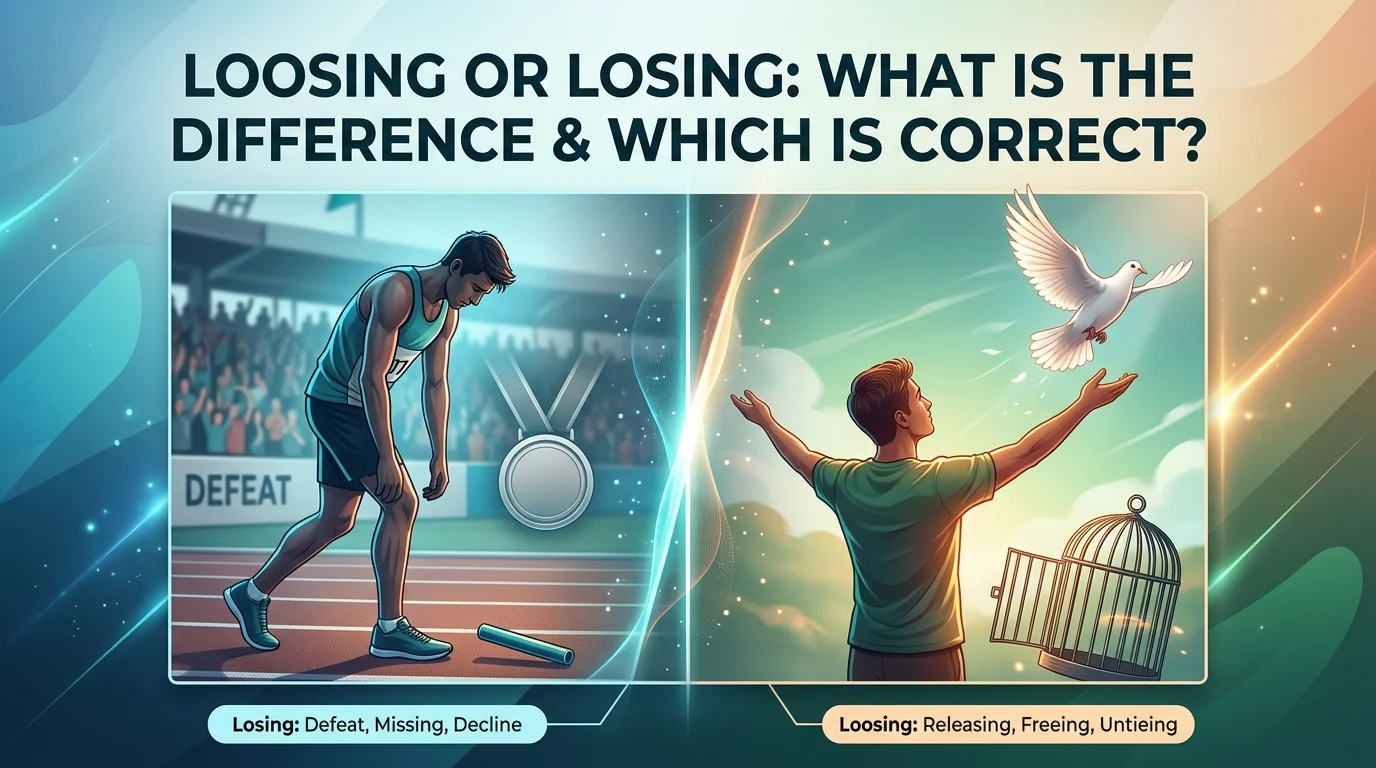
Many people often get confused between “loosing” and “losing” because they look similar and are frequently used in informal writing. However, only one of them is grammatically correct in most contexts. Understanding the difference helps improve spelling accuracy, writing clarity, and overall English communication skills.
Comparison Overview
“Loosing” and “losing” are two forms that appear similar but are not interchangeable in standard English. “Losing” is the correct form related to loss, defeat, or misplacement, while “loosing” comes from a different verb meaning to release or set free. This comparison helps clarify when each word is appropriate and why confusion happens.
Definition of Loosing
“Loosing” is the present participle of the verb “loose,” which means to release, untie, or set something free. It is less commonly used in everyday English but is still grammatically valid in specific contexts such as describing releasing an object, animal, or restraint.
Definition of Losing
“Losing” is the present participle of the verb “lose,” which means to fail to keep something, to be defeated, or to misplace something. It is one of the most commonly used English words in daily communication and writing.
Main Differences Between Loosing and Losing
The main difference lies in meaning and usage. “Loosing” refers to the act of releasing something, while “losing” refers to experiencing loss or failure. “Losing” is widely used in modern English, whereas “loosing” is rare and mostly appears in formal or specific contexts.
| Feature | Loosing | Losing |
| Base verb | Loose | Lose |
| Meaning | To release or set free | To suffer loss or failure |
| Usage frequency | Rare | Very common |
| Context | Physical release | General loss or defeat |
Grammar Guide
How each term is used in sentences
“Loosing” comes from “loose” and is used when something is being released.
Example patterns:
- Subject + is/was + loosing + object
“Losing” comes from “lose” and is used when someone cannot keep or win something.
Example patterns:
- Subject + is/was + losing + object
Common mistakes learners make
Many learners mistakenly use “loosing” instead of “losing” when talking about failure or defeat. This happens because both words look similar, but their meanings are different.
Simple rules to remember
If you mean “to release,” use “loosing.”
If you mean “to fail to keep or win,” use “losing.”
Quick tips for writing and speaking
Always check if the base verb is “lose” or “loose.” Most everyday situations require “losing,” not “loosing.”
When to Use Each One
Use “loosing” when referring to releasing something, such as a rope, animal, or constraint. Use “losing” when talking about defeat, missing items, or emotional or physical loss.
When NOT to Use Each One
Do not use “loosing” when you mean failure, defeat, or misplacement. It is incorrect in those contexts. Do not use “losing” when describing physical release or setting something free.
Which One to Use (Decision Guide)
If the situation involves failure, defeat, or missing something, choose “losing.” If the situation involves freeing or untying something, choose “loosing.” In most writing cases, “losing” is the correct choice.
Real-World Practical Examples
Loosing Examples
- The trainer is loosing the horse into the field.
- The captain is loosing the sails before departure.
- They are loosing the birds after rehabilitation.
- The guard is loosing the chains from the gate.
- She is loosing the rope to let the balloon fly.
Losing Examples
- He is losing his keys every morning.
- They are losing the match in the final minutes.
- She is losing patience with the situation.
- The company is losing money this quarter.
- I am losing focus while studying.
Self-Assessment (Fill in the Blanks)
- I am ______ my phone again today.
- The sailor is ______ the anchor.
- They are ______ the game badly.
- She is ______ her temper.
- The handler is ______ the dogs.
- He is ______ his wallet frequently.
- The team is ______ confidence.
- They are ______ the birds into the sky.
- I keep ______ my notes.
- The farmer is ______ the sheep.
- She is ______ interest in the topic.
- The coach is ______ the players after practice.
- They are ______ the battle.
- He is ______ control of the situation.
- The teacher is ______ students early.
- I am ______ my keys every day.
- The zookeeper is ______ the animals carefully.
- We are ______ the competition.
- She is ______ her balance.
- The fisherman is ______ the nets.
Answers
- losing
- loosing
- losing
- losing
- loosing
- losing
- losing
- loosing
- losing
- loosing
- losing
- loosing
- losing
- losing
- loosing
- losing
- loosing
- losing
- losing
- loosing
Final Verdict
“Losing” is the correct and commonly used word in most situations involving failure, defeat, or misplacement. “Loosing” is a valid but rare word that refers specifically to releasing or freeing something. In everyday writing, “losing” is almost always the right choice, while “loosing” should only be used when describing the act of setting something free.
Conclusion About Loosing or Losing
Understanding the difference between “loosing” and “losing” makes a real difference in how clearly and correctly you communicate in English. Even though the two words look almost identical, they serve completely different purposes. “Losing” is the form you will use in most everyday situations, whether you are talking about failing a game, misplacing an item, or struggling with emotions or confidence. It is one of the most commonly used verbs in modern English. “Loosing,” on the other hand, has a much narrower use and refers to the act of releasing or setting something free. Because of this, many learners mistakenly mix them up in writing and speech. By remembering their root verbs and practicing context-based usage, you can easily avoid confusion. Mastering this small but important distinction will strengthen your grammar, improve clarity, and make your communication sound more natural and accurate in both writing and conversation.
FAQs
Is “loosing” ever correct in modern English?
Yes, “loosing” is grammatically correct, but it is rarely used in everyday English. It comes from the verb “loose,” meaning to release or set free. You may see it in formal writing or descriptive contexts, but it is not commonly used in daily communication compared to “losing.”
Why is “losing” used more often than “loosing”?
“Losing” is more common because it comes from the verb “lose,” which is widely used in daily life for failure, defeat, or misplacement. In contrast, “loosing” comes from “loose,” which has a narrower meaning and fewer everyday applications, making it less frequently used in modern language.
Can “loosing” replace “losing” in sentences?
No, “loosing” cannot replace “losing” because they mean different things. “Losing” refers to failure or misplacing something, while “loosing” means releasing or freeing something. Using them interchangeably leads to grammatical errors and can confuse the reader or listener.
What is the easiest way to remember the difference?
A simple trick is to connect each word to its root verb. “Lose” becomes “losing” for loss-related meanings, while “loose” becomes “loosing” when referring to releasing something. Linking the word to its base form helps avoid confusion in writing and speaking.
Is “losing” only used in competitions or games?
No, “losing” is used in many situations beyond competitions. It can refer to losing objects, time, money, emotions, or opportunities. It is a versatile word that describes any kind of loss, whether physical, emotional, or abstract in everyday communication.
What does “loosing” mean in simple terms?
In simple terms, “loosing” means setting something free or releasing it. For example, loosing animals from a cage or loosing ropes that are tied. It is a less common word in modern usage but still correct in specific contexts where release is involved.
Why do learners confuse these two words?
Learners confuse these words because they look and sound very similar. The difference becomes unclear without understanding their root verbs. Since “losing” is much more common, many assume “loosing” is just a spelling variation, which leads to frequent mistakes.
Is “losing” considered informal language?
No, “losing” is not informal. It is standard English used in both formal and informal writing. It is widely accepted in academic writing, professional communication, and everyday speech, making it one of the most important verbs in English.
Can “loosing” be used in storytelling or literature?
Yes, “loosing” can appear in storytelling or literature, especially when describing actions like releasing something or setting it free. However, it is still less common than “losing,” which dominates most modern writing styles.
What is the biggest mistake people make with these words?
The biggest mistake is using “loosing” instead of “losing” when talking about failure or misplacement. This happens due to their similar spelling. Understanding their meanings and practicing examples helps avoid this common grammar error.

Ethan Clarke is a language writer who specializes in breaking down similes, word meanings, and commonly confused terms. His work focuses on clear explanations, practical examples, and simple comparisons that help readers understand how English
