
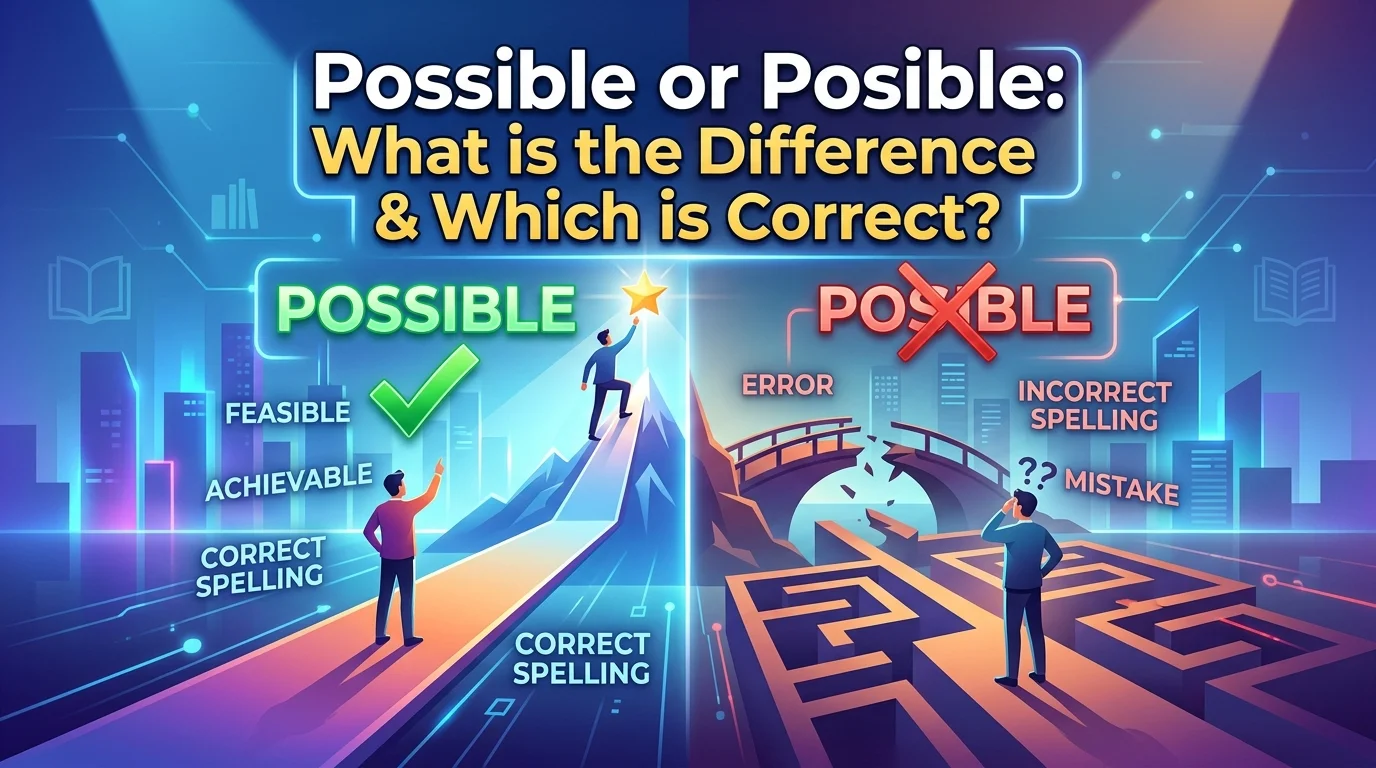
The words “possible” and “posible” often confuse English learners because they look and sound very similar. However, only one is correct in standard English. Understanding the difference helps improve spelling accuracy, writing clarity, and overall communication skills in everyday and academic contexts.
Comparison Overview
“Possible” and “posible” are closely related in appearance, but they are not equal in usage. “Possible” is the correct and standard English spelling used in all formal writing, speaking, and academic contexts. “Posible” is a common spelling mistake influenced by pronunciation patterns or other languages, but it is not accepted in English grammar.
Definition of Possible
“Possible” is an adjective in the English language that means something can be done, achieved, or exists within the limits of ability, rules, or reality. It is widely used in both formal and informal communication.
In simple terms, if something can happen or be true, it is described as possible. It is one of the most commonly used words in everyday English.
Definition of Posible
“Posible” is not a correct English word. It is a spelling error of “possible.” Many learners write it incorrectly due to pronunciation or influence from other languages such as Spanish, where “posible” is correctly spelled and used.
In English writing, “posible” should always be replaced with “possible.”
Main Differences Between Possible and Posible
The main difference between these two terms lies in correctness and usage. “Possible” is the accepted English spelling, while “posible” is incorrect in English grammar and spelling rules.
| Feature | Possible | Posible |
| Correctness | Correct English word | Incorrect spelling in English |
| Usage | Formal and informal writing | Not used in standard English |
| Meaning | Something that can happen or exist | No valid meaning in English |
| Acceptance | Universally accepted | Considered a spelling mistake |
| Language influence | English | Often influenced by Spanish spelling |
Grammar Guide
“Possible” is an adjective used to describe feasibility, likelihood, or capability. It can modify nouns or be used in expressions about chance and ability.
How each term is used in sentences
Correct usage examples:
- It is possible to finish the work today.
- Is it possible to travel without a visa?
- Everything possible was done to help.
- That solution is not possible under current rules.
- We should find a possible answer.
Incorrect usage:
- It is posible to finish the work today. (Incorrect spelling)
Common mistakes learners make
Many learners confuse “possible” with “posible” due to pronunciation. Another mistake is using “possible” where “probable” or “likely” might be more accurate in meaning. Some also drop double letters when writing quickly.
Simple rules to remember
- Always use “ss” in the middle: possible
- Never remove letters to simplify spelling
- If it looks like “posible,” it is incorrect in English
- Think: “If it can happen, it is possible”
Quick tips for writing and speaking
- Slow down when spelling longer words
- Break it into syllables: pos-si-ble
- Use spell-check tools when writing digitally
- Practice writing common sentences daily
When to Use Each One
Use “possible” whenever you are expressing ability, chance, or feasibility in English. It applies in academic writing, business communication, casual conversations, and exams.
“Posible” should never be used in English writing. If you encounter it, treat it as a mistake and correct it immediately.
When NOT to Use Each One
Do not use “possible” when referring to certainty or guaranteed outcomes. For example, if something is definite, words like “certain” or “sure” are more appropriate.
Never use “posible” in English writing, exams, emails, or professional communication. It will be marked as incorrect.
Which One to Use (Decision Guide)
If you are unsure which word to use, follow this simple guide:
- If you are writing in English, always choose “possible”
- If you see “posible,” correct it immediately
- If expressing ability or chance, use “possible”
- If unsure, check a dictionary or grammar tool
Real-World Practical Examples
Possible Examples
- It is possible to learn English in six months with practice.
- Is it possible to meet the manager today?
- Everything possible was done to solve the issue.
- We are exploring all possible solutions.
- It is possible that it will rain tomorrow.
- She made it possible for the project to succeed.
Posible Examples (Incorrect Usage)
- It is posible to finish the assignment today. (Incorrect spelling)
- Is it posible to join the meeting online? (Incorrect spelling)
- We tried every posible solution available. (Incorrect spelling)
- It may be posible to travel next week. (Incorrect spelling)
- Finding a posible answer is difficult. (Incorrect spelling)
Self-Assessment (Fill in the Blanks)
- It is ______ to complete the task on time.
- Is it ______ to learn English quickly?
- We tried every ______ solution.
- Nothing is ______ without effort.
- It may be ______ to travel tomorrow.
- She made it ______ for us to succeed.
- Is it ______ to join the class late?
- We explored all ______ options.
- It is not ______ to finish in one day.
- Finding a ______ answer is important.
- It is ______ that he will arrive early.
- We discussed every ______ idea.
- Is it ______ to fix this issue?
- She created a ______ plan.
- It is ______ to improve your skills.
- They tried a ______ approach.
- Is it ______ to attend remotely?
- We found a ______ method.
- It is ______ to complete this work alone.
- Every ______ step was taken carefully.
Answers
- possible
- possible
- possible
- possible
- possible
- possible
- possible
- possible
- possible
- possible
- possible
- possible
- possible
- possible
- possible
- possible
- possible
- possible
- possible
- possible
Final Verdict
The correct and only acceptable English spelling is “possible.” The form “posible” is a common mistake and should be avoided in all writing and communication. By remembering the correct spelling and practicing its usage, learners can improve both accuracy and confidence in English. Understanding this small difference also strengthens overall spelling skills in the broader study of English grammar and usage within Linguistics.
Conclusion About Possible or Posible
Understanding the difference between “possible” and “posible” is essential for clear and correct English writing. While “possible” is the only standard and accepted form, “posible” is simply a common spelling error influenced by pronunciation or other languages. Mastering this small but important detail helps improve spelling accuracy, writing confidence, and overall communication skills. Whether you are writing essays, emails, or professional content, using the correct form ensures your message looks polished and credible. With regular practice, remembering the correct spelling becomes natural and effortless in everyday usage.
FAQs
Is possible the correct spelling in English?
Yes, “possible” is the correct spelling in English. It is used in all formal, academic, and everyday contexts to express something that can happen, exist, or be achieved. It follows standard English grammar rules and is universally accepted.
Why do people write posible instead of possible?
People often write “posible” due to pronunciation habits or influence from other languages like Spanish. It is a natural spelling mistake, especially for beginners, but it is incorrect in English and should always be corrected to “possible.”
What does possible mean in simple words?
“Possible” means something can happen or be done. It describes situations, actions, or ideas that are achievable or realistic within certain limits. It is commonly used in daily conversation, education, and professional communication.
Is posible ever correct in English writing?
No, “posible” is never correct in English writing. It is always considered a spelling error. The correct and only accepted form in English is “possible,” regardless of context or sentence structure.
How can I remember the correct spelling of possible?
A simple trick is to break the word into syllables: pos-si-ble. Remember that it has a double “s” in the middle. Practicing writing it in sentences also helps strengthen memory and avoid mistakes.
What is the difference between possible and probable?
“Possible” means something can happen, while “probable” means something is likely to happen. Probability is stronger than possibility, making “probable” more specific in indicating higher chances.
Can possible be used in formal writing?
Yes, “possible” is widely used in formal writing such as academic essays, business reports, and professional communication. It is a standard adjective that fits both formal and informal contexts.
Why is spelling possible important in English?
Correct spelling improves clarity, credibility, and communication quality. Using “possible” correctly shows language accuracy and helps avoid misunderstandings, especially in academic and professional settings.
Does possible have different forms in grammar?
Yes, “possible” can be used in different forms like “possibly” (adverb) and “possibility” (noun). Each form changes the word’s function but keeps the same core meaning related to something that can happen.
What is a simple example of possible in a sentence?
A simple example is: “It is possible to learn a new language with practice.” This shows how the word is used to describe something achievable or realistic in everyday situations.

Amelia Wright focuses on making figurative language easy to understand. Her writing explains similes, metaphors, and word meanings using relatable examples. She aims to help readers recognize subtle differences in usage and apply them correctly in both academic and casual writing.