
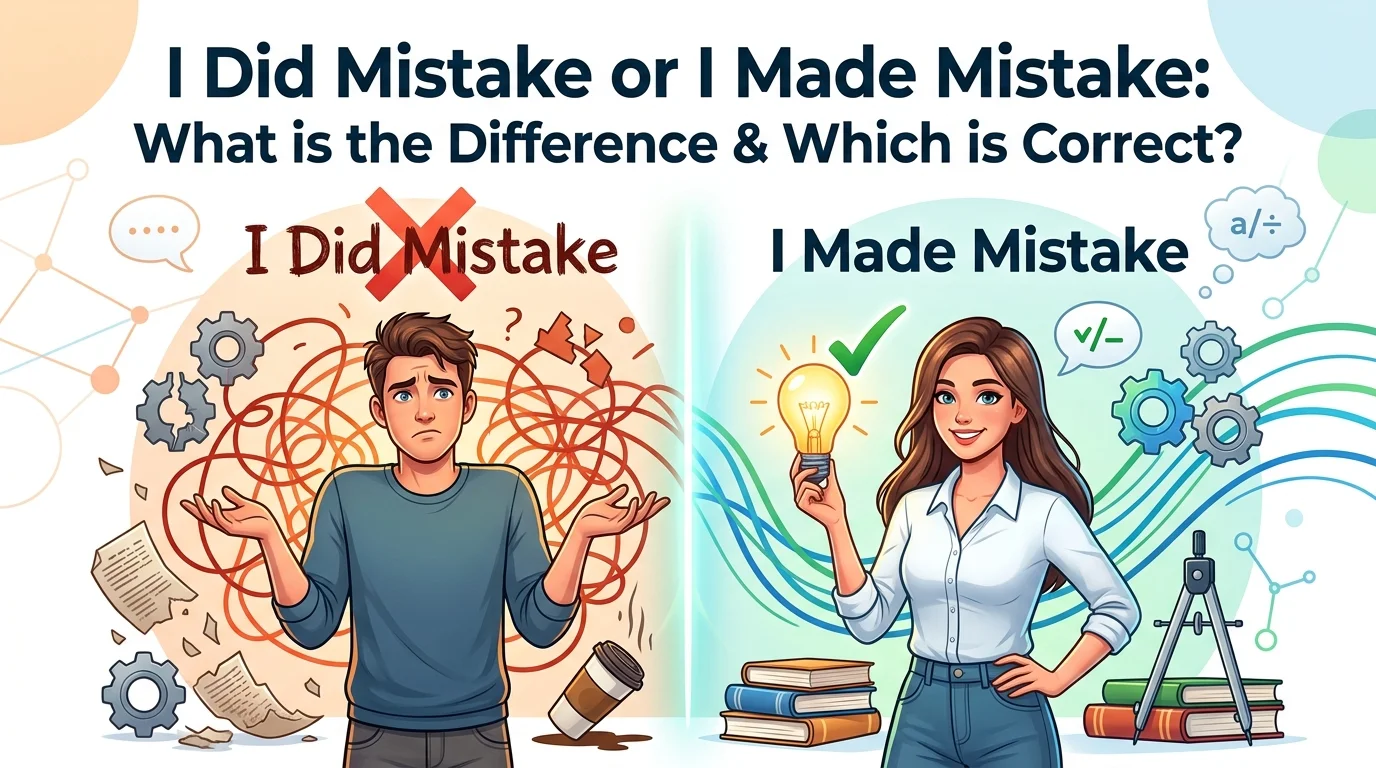
Understanding the difference between “I did mistake” and “I made mistake” is important for speaking and writing correct English. These two phrases often confuse learners because they sound similar, but only one is grammatically accepted in standard English. This guide explains their meanings, differences, and correct usage in a simple way.
Comparison Overview
“I did mistake” and “I made mistake” are both attempts to express that someone committed an error. However, English grammar treats “mistake” as something you “make,” not something you “do.” Because of this rule, one phrase is correct while the other is considered incorrect in standard usage. This comparison helps clarify why only one form is widely accepted.
Definition of I Did Mistake
“I did mistake” is an incorrect English phrase formed by directly translating the idea of committing an error using the verb “do.” In English, “do” is not naturally paired with the noun “mistake.” Although learners sometimes use it in early stages of learning, it is not grammatically correct in formal or standard communication.
Definition of I Made Mistake
“I made mistake” is a grammatically correct phrase, but it is usually used in a complete form as “I made a mistake.” The verb “make” is the correct verb used with “mistake” in English. It expresses that someone has committed an error or done something wrong unintentionally.
Main Differences Between I Did Mistake and I Made Mistake
The key difference lies in grammar and verb usage. “Did” does not collocate with “mistake,” while “make” does. “I did mistake” is incorrect in standard English, while “I made a mistake” is correct and commonly used.
| Feature | I Did Mistake | I Made Mistake |
| Grammar correctness | Incorrect | Correct |
| Verb used | Do | Make |
| Natural usage | Not used by native speakers | Commonly used |
| Meaning clarity | Confusing | Clear and standard |
Grammar Guide
In English, certain nouns naturally pair with specific verbs. These are called collocations. “Mistake” is commonly used with the verb “make,” not “do.” Therefore, the correct structure is “make a mistake.”
How each term is used in sentences
“I did mistake” does not follow natural English patterns and is generally avoided. “I made a mistake” follows standard grammar rules and is widely accepted in speaking and writing.
Common mistakes learners make
Many learners directly translate from their native language and use “do mistake,” which leads to errors like “I did mistake.” Another common mistake is forgetting the article “a,” resulting in “I made mistake” instead of “I made a mistake.”
Simple rules to remember
Use “make” with “mistake.” Always include “a” before “mistake” in standard sentences. Avoid using “do” with “mistake” in any formal or informal context.
Quick tips for writing and speaking
Think of “make” as the action word for errors. Practice replacing “do” with “make” when talking about problems or errors. Reading native English examples regularly can also help reinforce correct usage.
When to Use Each One
“I made a mistake” should be used when admitting or describing an error in any situation such as school, work, or daily conversation. “I did mistake” should be avoided entirely because it is not considered correct English.
When NOT to Use Each One
Do not use “I did mistake” in writing, speaking, exams, or professional communication. It is not accepted in standard English. Also avoid dropping the article in “I made mistake,” as this is still grammatically incomplete.
Which One to Use (Decision Guide)
If you are talking about an error, always choose “made.” If you are unsure, remember that English uses “make a mistake” as a fixed phrase. This makes “I made a mistake” the only correct option in this comparison.
Real-World Practical Examples
I Did Mistake Examples
- I did mistake in the test answers.
- She did mistake while solving the math problem.
- They did mistake during the presentation.
- I did mistake when filling out the form.
- He did mistake in his homework submission.
I Made Mistake Examples
- I made a mistake in my exam paper.
- She made a mistake while cooking dinner.
- They made a mistake in the project report.
- I made a mistake by forgetting the meeting.
- He made a mistake during the interview answer.
Self-Assessment (Fill in the Blanks)
- I will use ______ when talking about an error in English grammar.
- The correct phrase is ______ because it follows standard collocation rules.
- “I did mistake” is ______ in formal English.
- The correct verb with mistake is ______.
- I ______ a mistake in my homework.
- She ______ a mistake in the test.
- We should not use ______ in professional writing.
- The correct structure is ______ a mistake.
- Learners often wrongly use ______ instead of make.
- Native speakers say ______ a mistake.
- “Did mistake” is considered ______.
- The correct article used is ______.
- I ______ a mistake during the interview.
- The wrong verb choice is ______.
- English collocation is make a ______.
- I ______ a mistake in calculation.
- The phrase “I did mistake” is ______ used.
- The standard English form is ______ a mistake.
- Mistakes are usually ______ not done.
- The correct answer is ______ a mistake.
Answers
- I made a mistake
- I made a mistake
- incorrect
- make
- made
- made
- I did mistake
- make
- do
- I made a mistake
- incorrect
- a
- made
- do
- mistake
- made
- not correctly
- make
- made
- I made a mistake
Final Verdict
“I did mistake” is not correct in standard English and should be avoided in all forms of communication. The correct and widely accepted expression is “I made a mistake,” which follows proper English grammar and natural collocation rules. By remembering that mistakes are “made” and not “done,” learners can confidently use the correct form in both speaking and writing.
Conclusion About I Did Mistake or I Made Mistake
To wrap it up, the difference between “I did mistake” and “I made a mistake” is simple but very important for correct English usage. The phrase “I did mistake” is not grammatically accepted in standard English, even though it may appear in early learning or literal translation from other languages. On the other hand, “I made a mistake” is the correct and natural expression used by native speakers in everyday communication. This is because English relies heavily on collocations, and “mistake” naturally pairs with the verb “make.” Learning these fixed patterns helps improve fluency, accuracy, and confidence in both speaking and writing. Once you understand this rule, you can avoid one of the most common grammar errors and express yourself more clearly in academic, professional, and casual situations. With regular practice, correct usage becomes automatic and greatly improves overall communication skills in English.
FAQs
Is “I did mistake” grammatically correct?
No, “I did mistake” is not grammatically correct in standard English. It is commonly produced by learners who directly translate from their native language. In English, the correct structure uses the verb “make,” so the proper form is “I made a mistake.” This is the natural and widely accepted expression in both spoken and written English.
What is the correct way to say I committed an error?
The correct way is “I made a mistake.” This phrase is used to clearly express that someone has done something wrong or incorrect. It works in all contexts including education, business, and daily conversation. English uses the verb “make” with “mistake” as a fixed grammatical combination.
Why is “I made a mistake” correct?
“I made a mistake” is correct because English grammar uses specific verb noun combinations called collocations. “Make” is the standard verb that naturally pairs with “mistake.” This structure is commonly used by native speakers and is considered the only correct form in standard English usage.
Can I say “I did a mistake” instead?
No, “I did a mistake” is also incorrect in English. Even adding “a” does not fix the grammatical issue because the verb “do” does not collocate with “mistake.” The correct and natural expression remains “I made a mistake,” which should be used in all situations.
Is “make a mistake” formal English?
Yes, “make a mistake” is neutral and suitable for both formal and informal English. It can be used in exams, workplace communication, academic writing, and daily conversation. It is a standard expression that clearly and professionally describes an error.
What does collocation mean in English grammar?
Collocation refers to words that naturally go together in a language. For example, English speakers say “make a mistake” instead of “do a mistake.” Learning collocations helps learners sound more fluent and avoid unnatural or incorrect word combinations.
How do I stop saying I did mistake?
To avoid this mistake, practice using “make a mistake” in sentences regularly. Replace “do” with “make” when talking about errors. Reading, listening, and repeating correct examples will help you remember the right form over time and make it a natural habit.
Is it okay to make mistakes while learning English?
Yes, making mistakes is a normal and important part of learning English. Every learner improves by identifying and correcting errors. The key is to learn the correct form, such as “I made a mistake,” and apply it consistently in communication.
Why do learners often say I did mistake?
Learners often say “I did mistake” because they translate directly from their native language structure. In many languages, the verb equivalent of “do” is used with errors. However, English grammar requires “make,” which leads to confusion until collocations are learned properly.
Can native speakers understand I did mistake?
Native speakers may understand the intended meaning, but the phrase sounds incorrect and unnatural. It is not used in real conversations. To communicate clearly and sound fluent, it is always better to use “I made a mistake.”