
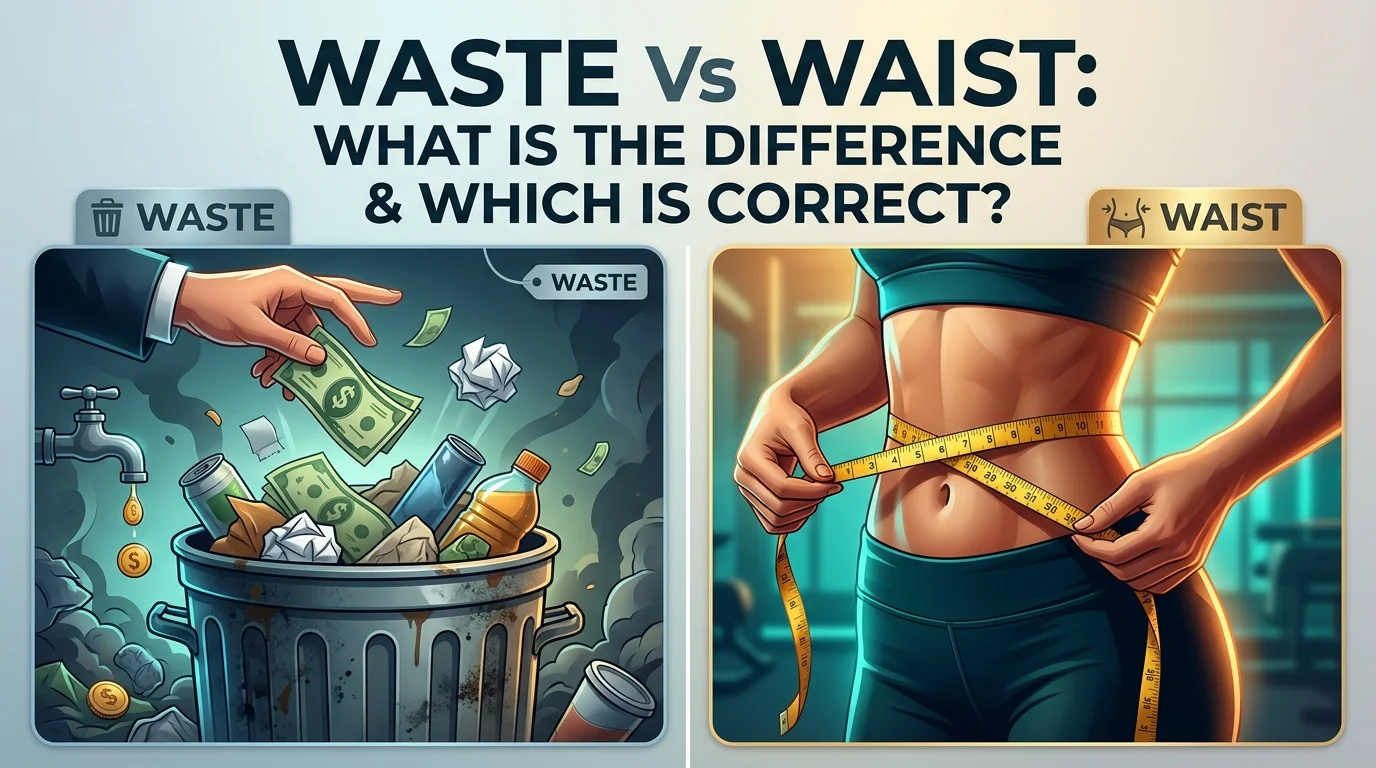
Many English learners confuse waste and waist because they sound almost identical, but they have completely different meanings. Using the wrong word can change the meaning of your sentence entirely. Understanding the difference between waste and waist helps improve your writing, speaking, and grammar accuracy in everyday communication.
Comparison Overview
Waste and waist are classic examples of commonly confused English words. They are homophones, meaning they sound alike but have different spellings and meanings.
Waste usually relates to something being unused, thrown away, or used poorly.
Waist refers to a part of the human body, specifically the middle section between the ribs and hips.
Although they sound the same, their meanings, uses, and contexts are completely different.
Definition of Waste
Waste is a noun or verb used when talking about something that is lost, unused, or used inefficiently.
As a noun, it often means garbage, leftovers, or unnecessary material.
Examples:
- food waste
- industrial waste
- time waste
As a verb, it means to use something carelessly or unnecessarily.
Example:
- Don’t waste your money.
Definition of Waist
Waist is a noun that refers to the middle part of the human body, located between the chest and hips.
It is often used when talking about clothing sizes, health, fitness, and body measurements.
Examples:
- waist size
- waist belt
- slim waist
It only refers to the body and never means “unused” or “garbage.”
Main Differences Between Waste and Waist
| Feature | Waste | Waist |
| Meaning | Something unused, lost, or thrown away | Middle part of the body |
| Part of Speech | Noun or verb | Noun |
| Common Context | Environment, time, money, effort | Clothing, body, health |
| Example | Don’t waste water | My waist is 32 inches |
| Related Words | garbage, misuse, rubbish | hips, belt, body |
The easiest way to remember the difference is this:
Waste = loss or misuse
Waist = body part
Grammar Guide
How each term is used in sentences
Waste as a noun:
- Plastic waste harms oceans.
- Food waste is a global issue.
Waste as a verb:
- Do not waste your energy.
- He wasted his opportunity.
Waist as a noun:
- Her waist measurement is 28 inches.
- This dress fits perfectly around the waist.
Common mistakes learners make
Incorrect:
- My waste size is 34. ❌
Correct:
- My waist size is 34. ✅
Incorrect:
- Don’t waist your time. ❌
Correct:
- Don’t waste your time. ✅
Simple rules to remember
If talking about trash, time, money, or resources, use waste.
If talking about a body measurement or clothing fit, use waist.
Quick tips for writing and speaking
Say this memory trick:
“Waist wears a belt.”
Since belts go around your body, waist must be the body word.
“Waste goes in the bin.”
That helps you remember waste means rubbish or misuse.
When to Use Each One
Use waste when discussing:
- garbage
- pollution
- losing time
- spending money badly
- inefficient use of resources
Use waist when discussing:
- clothing measurements
- fitness
- body shape
- tailoring
- fashion
When NOT to Use Each One
Do not use waste when referring to the body.
Wrong:
- She tied the belt around her waste. ❌
Correct:
- She tied the belt around her waist. ✅
Do not use waist when discussing misuse or rubbish.
Wrong:
- Don’t waist electricity. ❌
Correct:
- Don’t waste electricity. ✅
Which One to Use (Decision Guide)
Ask yourself this simple question:
Are you talking about something being lost, thrown away, or misused?
→ Use waste
Are you talking about the middle part of a person’s body?
→ Use waist
Quick formula:
Loss or rubbish = Waste
Body or clothing = Waist
Real-World Practical Examples
Waste Examples
- Education: Don’t waste your study time on distractions.
- Daily Life: Throw food waste into the compost bin.
- Science: Nuclear waste requires careful storage.
- Business: Poor planning can waste company resources.
- Technology: Old batteries create electronic waste.
Waist Examples
- Education: Students learned how to measure waist circumference in health class.
- Daily Life: My jeans are too tight around the waist.
- Science: Doctors use waist measurements to assess health risks.
- Business: Clothing brands list waist sizes clearly.
- Conversation: Her waist is smaller after months of exercise.
Self-Assessment (Fill in the Blanks)
- Don’t ______ your chances by arriving late.
- My ______ measurement is 30 inches.
- Plastic ______ damages the environment.
- This skirt fits tightly around my ______.
- Never ______ clean water.
- He wrapped the rope around his ______.
- Food ______ should be reduced.
- Her ______ size changed after dieting.
- Don’t ______ your talent.
- The tailor measured my ______ carefully.
- Toxic ______ can harm animals.
- This belt sits above the ______.
- We should not ______ electricity.
- His ______ is wider than mine.
- Factory ______ pollutes rivers.
- She tied the ribbon around her ______.
- It is a ______ of time to argue.
- The pants fit perfectly at the ______.
- Medical experts measure ______ to assess obesity.
- Throw all kitchen ______ in the bin.
Answers
- waste
- waist
- waste
- waist
- waste
- waist
- waste
- waist
- waste
- waist
- waste
- waist
- waste
- waist
- waste
- waist
- waste
- waist
- waist
- waste
Final Verdict
The difference between waste and waist is simple once you know what each word represents. Waste relates to loss, misuse, or rubbish, while waist refers to the middle part of the human body. Even though they sound the same, their meanings are completely unrelated. If you remember “waste goes in the bin” and “waist wears a belt,” you’ll choose the correct word every time.
Conclusion About Waste Vs Waist
Waste Vs Waist is a common English confusion that becomes easy to solve once you clearly understand their meanings. Even though they sound similar, they belong to completely different contexts in language. Waste refers to something that is unused, misused, or thrown away, such as time, money, energy, or materials. In contrast, waist refers to the middle part of the human body, often used in clothing sizes, fitness, and health discussions. Learning this difference helps improve your spelling accuracy and prevents embarrassing mistakes in writing and speaking. With simple memory tricks and regular practice, you can quickly master when to use each word correctly. This small but important distinction strengthens your overall English communication skills and builds confidence in everyday conversations.
FAQs
What is the main difference between Waste Vs Waist
The main difference is that waste refers to loss, misuse, or unwanted material, while waist refers to the middle part of the human body. Waste is used for things like garbage or time loss, whereas waist is used in clothing, body measurements, and health discussions. Understanding this helps avoid common English mistakes.
Why do people confuse Waste Vs Waist
People confuse waste and waist because they sound exactly the same when spoken. This makes them homophones in English. However, their meanings are completely different. Without context or spelling awareness, learners often mix them up in writing, especially in fast communication or exams.
How can I easily remember Waste Vs Waist
A simple trick is to associate waste with trash or loss, and waist with a belt around your body. Since belts go around the waist, it becomes easy to remember. Repeating example sentences and practicing regularly also helps reinforce the correct usage naturally over time.
Is Waste only a noun or also a verb
Waste can be used both as a noun and a verb. As a noun, it refers to garbage or unwanted material. As a verb, it means to use something carelessly or inefficiently. For example, wasting time means not using time properly or productively.
What does Waist mean in clothing terms
In clothing, waist refers to the measurement around the middle part of the body. It is commonly used when describing pants, skirts, belts, and dress sizes. Tailors and fashion brands often use waist size to ensure proper fit and comfort for clothing items.
Can Waste be used for time and money
Yes, waste is often used for both time and money. When someone misuses time or spends money carelessly, it is called wasting. For example, wasting time on unnecessary activities or wasting money on things you do not need are common expressions in English.
Is Waist used in medical or health terms
Yes, waist is frequently used in medical and health contexts. Doctors and health experts measure waist size to assess body fat distribution and health risks. A larger waist size can sometimes indicate health concerns, making it an important measurement in fitness and medical evaluations.
What are some examples of Waste in sentences
Waste can be used in many contexts. For example, do not waste water, he wasted his opportunity, food waste harms the environment, and poor planning can waste resources. These examples show how waste relates to misuse or unnecessary loss in daily life.
What are common mistakes in Waste Vs Waist
A common mistake is using waist instead of waste when talking about time or resources. Another error is spelling waist incorrectly when referring to body measurements. Many learners mix them up due to similar pronunciation, leading to confusion in both writing and speaking.
Which is correct Don’t Waste or Don’t Waist time
The correct phrase is don’t waste time. Waste is used because it refers to misusing time or not using it productively. Waist would be incorrect here because it refers to the human body and has no connection to time or activities.

Amelia Wright focuses on making figurative language easy to understand. Her writing explains similes, metaphors, and word meanings using relatable examples. She aims to help readers recognize subtle differences in usage and apply them correctly in both academic and casual writing.