
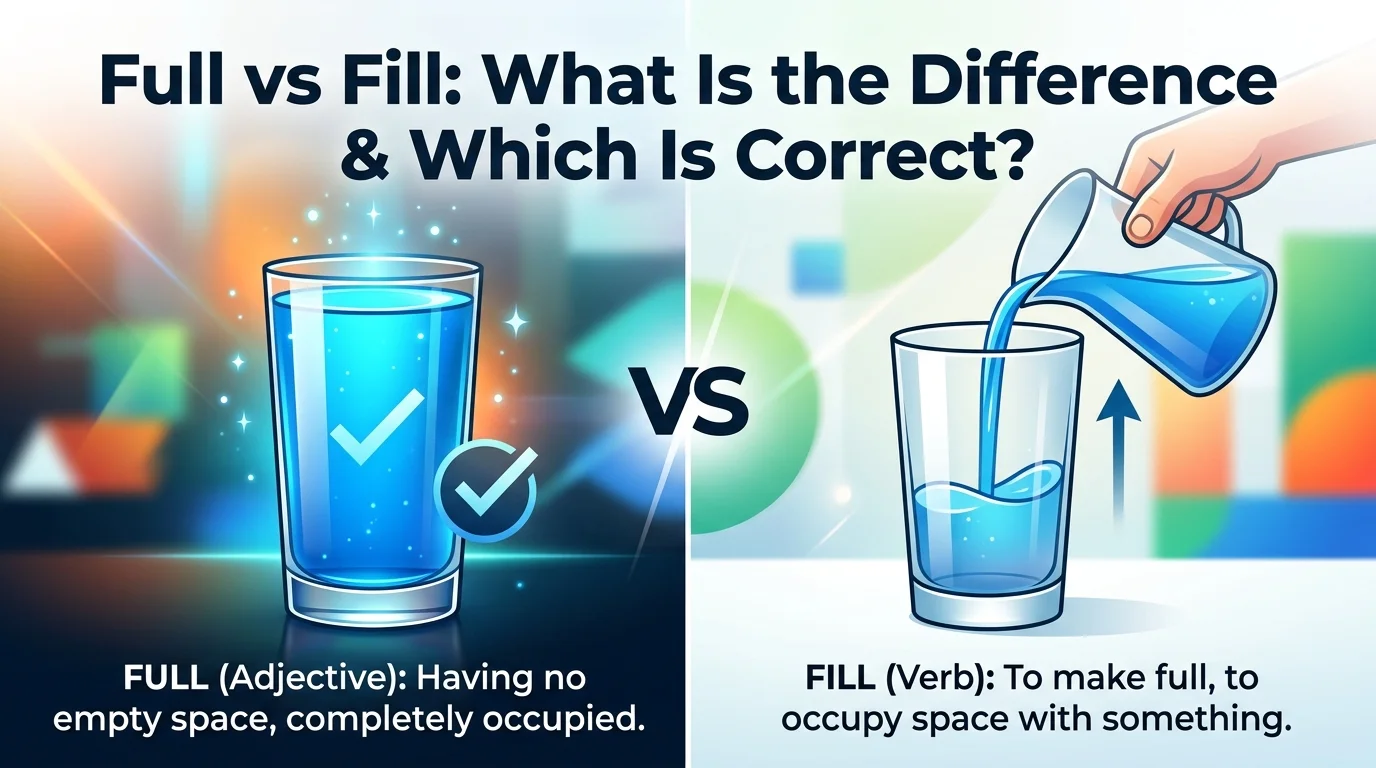
The words “full” and “fill” may look and sound similar, but they have very different meanings and uses in English. This often confuses learners, especially in writing and speaking. Understanding the difference between “full” and “fill” helps you communicate more clearly, avoid grammar mistakes, and use each word correctly in everyday conversations and formal writing.
Comparison Overview
“Full” and “fill” are closely related in meaning because both connect to the idea of something containing or receiving something. However, they play different grammatical roles. “Full” is usually an adjective that describes a state or condition, while “fill” is a verb that describes an action. Knowing whether you need an action or a description helps you choose the correct word.
Definition of Full
“Full” is an adjective used to describe something that contains as much as possible or is complete.
Core meaning:
It means something has reached its limit or capacity.
Purpose:
It describes a condition or state.
Examples:
The glass is full.
My schedule is full today.
She gave a full explanation.
Definition of Fill
“Fill” is a verb used to describe the action of making something full.
Core meaning:
It means to put something into a container or space until it reaches capacity.
Purpose:
It describes an action.
Examples:
Please fill the glass with water.
Can you fill out this form?
The workers fill the boxes daily.
Main Differences Between Full and Fill
The biggest difference between “full” and “fill” is their grammatical role and purpose.
Meaning:
“Full” describes a completed state.
“Fill” describes the act of reaching that state.
Part of speech:
“Full” is usually an adjective.
“Fill” is usually a verb.
Function:
“Full” answers “What is the condition?”
“Fill” answers “What action is happening?”
Examples:
The bottle is full. (state)
Please fill the bottle. (action)
Context:
Use “full” when describing.
Use “fill” when doing.
Grammar Guide
How each term is used in sentences
“Full” sentence patterns:
Subject + be verb + full
Example: The tank is full.
Subject + noun + is/was + full of + noun
Example: The room was full of people.
“Fill” sentence patterns:
Subject + fill + object
Example: Please fill the cup.
Subject + fill + object + with + noun
Example: Fill the basket with apples.
Common mistakes learners make
Using “fill” instead of “full”:
Incorrect: The cup is fill.
Correct: The cup is full.
Using “full” instead of “fill”:
Incorrect: Please full the bottle.
Correct: Please fill the bottle.
Confusing pronunciation and spelling:
“Full” ends with double “l.”
“Fill” contains “i” in the middle.
Simple rules to remember
Use “full” when describing something.
Use “fill” when talking about an action.
If you can replace it with “complete,” use “full.”
If you can replace it with “put into,” use “fill.”
Quick tips for writing and speaking
Ask yourself: Is this an action or a condition?
Action = fill
Condition = full
Remember:
You fill something until it becomes full.
When to Use Each One
Use “full” when:
Describing containers: The jar is full.
Describing schedules: My calendar is full.
Describing information: The report is full of facts.
Describing emotions: She felt full of joy.
Use “fill” when:
Adding liquid: Fill the cup with tea.
Completing documents: Fill out the application.
Occupying space: The audience filled the hall.
Completing time: Reading helps fill spare time.
When NOT to Use Each One
Do not use “full” when an action is needed:
Incorrect: Full the glass.
Correct: Fill the glass.
Do not use “fill” when a description is needed:
Incorrect: The basket is fill.
Correct: The basket is full.
Avoid mixing forms:
Incorrect: I am fulling the form.
Correct: I am filling the form.
Which One to Use (Decision Guide)
Choose “full” if:
You are describing a state.
Example: The plate is full.
Choose “fill” if:
You are describing an action.
Example: Fill the plate.
Quick decision:
Is something already complete? Use “full.”
Is something becoming complete? Use “fill.”
Real-World Practical Examples
Full Examples
Education:
My notebook is full of notes.
Daily life:
The refrigerator is full.
Science:
The container is full of gas.
Business:
The meeting room is full.
Conversation:
Her day was full of surprises.
Fill Examples
Education:
Please fill in the missing answers.
Daily life:
Fill the bottle before leaving.
Science:
Scientists fill test tubes carefully.
Business:
Fill out the job application.
Technology:
Fill the storage drive with data.
Self-Assessment (Fill in the Blanks)
- The water bottle is ______ because it cannot hold more water.
- Please ______ the bottle before you leave.
- The classroom was ______ of students.
- Can you ______ this form for me?
- My bag is ______ of books.
- Please ______ the basket with fruit.
- The train is ______ today.
- Workers ______ the shelves every morning.
- The report is ______ of useful information.
- Please ______ in your personal details.
- The cup is ______ now.
- Can you ______ the tank with fuel?
- The hall was ______ during the event.
- Please ______ the blank spaces.
- Her heart was ______ of happiness.
- We need to ______ the boxes quickly.
- The calendar is ______ this month.
- ______ the jar with sugar.
- The room is ______ of light.
- Please ______ out this survey.
Answers
- full
- fill
- full
- fill
- full
- fill
- full
- fill
- full
- fill
- full
- fill
- full
- fill
- full
- fill
- full
- fill
- full
- fill
Final Verdict
“Full” and “fill” are easy to confuse because they are closely related in meaning, but their grammar is different. Use “full” when describing a condition, state, or completed result. Use “fill” when describing the action of making something complete. A simple way to remember is this: you fill something until it becomes full. Once you understand this relationship, choosing the correct word becomes much easier in writing, speaking, and everyday communication.
Conclusion About Full vs Fill
Understanding Full vs Fill makes English grammar much easier and more natural to use in daily life. Although these two words are closely connected in meaning, they serve completely different roles. Full describes a completed state, while fill explains the action that creates that state. Once you recognize this simple relationship, you can avoid common mistakes and communicate more confidently in both writing and speaking. Whether you are filling a form, filling a bottle, or describing something as full, the key is to focus on whether you are talking about an action or a condition. With practice, choosing between Full vs Fill becomes automatic. Keep this guide in mind whenever you feel confused, and you will quickly improve your grammar accuracy and fluency in real world communication. Regular exposure to examples and usage will strengthen your understanding and help you use both words correctly without hesitation.
FAQs
What is difference between full and fill
Full describes a state where something has reached its maximum capacity or is complete, while fill describes the action of making something reach that state. In simple terms, full is the result and fill is the process. For example, a glass becomes full after you fill it with water. This difference is key in grammar and everyday communication.
Is full an adjective or a verb
Full is mainly an adjective used to describe something that is complete or at maximum capacity. It is not a verb in standard usage. For example, “The box is full” shows a condition. It helps describe states, feelings, or quantities rather than actions, making it useful for expressing results clearly.
Is fill a verb
Fill is a verb that refers to the action of putting something into a space or container until it becomes full. It shows movement or activity. For example, “Please fill the bottle” describes an action. It is commonly used in instructions, daily tasks, and processes where something is being completed.
What are common mistakes with full and fill
A common mistake is using fill in descriptive sentences, such as “The room is fill” instead of “The room is full.” Another mistake is using full as a verb like “full the glass,” which is incorrect. Learners often confuse them due to similar spelling and related meanings.
Can full be used as a verb
Full is not used as a verb in standard English. It functions mainly as an adjective that describes a completed state. The action form related to it is fill, which shows the process of making something full. Understanding this difference helps avoid grammar errors in writing and speaking.
What is the difference between fill and fill out
Fill means to put something into a space or container, while fill out is used for completing forms or documents. For example, you fill a bottle with water, but you fill out an application form. The phrase fill out usually refers to providing required written information.
Can you give examples of full and fill
Full: The jar is full of honey. Fill: Please fill the glass with juice. Full: Her schedule is full today. Fill: Fill the form carefully. Full: The box is full of toys. Fill: Fill the tank before traveling. These examples clearly show the difference between state and action.
How can I remember full vs fill easily
A simple trick is to remember that you fill something until it becomes full. Fill is the action, and full is the result. Another way is to link fill with doing and full with completed. This mental connection helps you choose the correct word quickly in daily communication.
Is full vs fill confusion common in exams
Yes, full vs fill is commonly tested in grammar exams because the words look similar and are related in meaning. Students often confuse them in sentence completion tasks. Knowing that full describes a condition and fill describes an action helps reduce mistakes and improves exam performance.
When should I use full and fill
Use full when describing a completed state, such as something that has reached capacity. Use fill when describing the action of making something complete. For example, a glass is full after you fill it. This simple rule helps you choose the correct word in most situations.

Sophia Turner is a grammar-focused writer who covers similes, word-versus-word meanings, and correct English usage. Her content is designed for learners who want quick answers, logical explanations, and practical guidance for improving writing accuracy and style.