
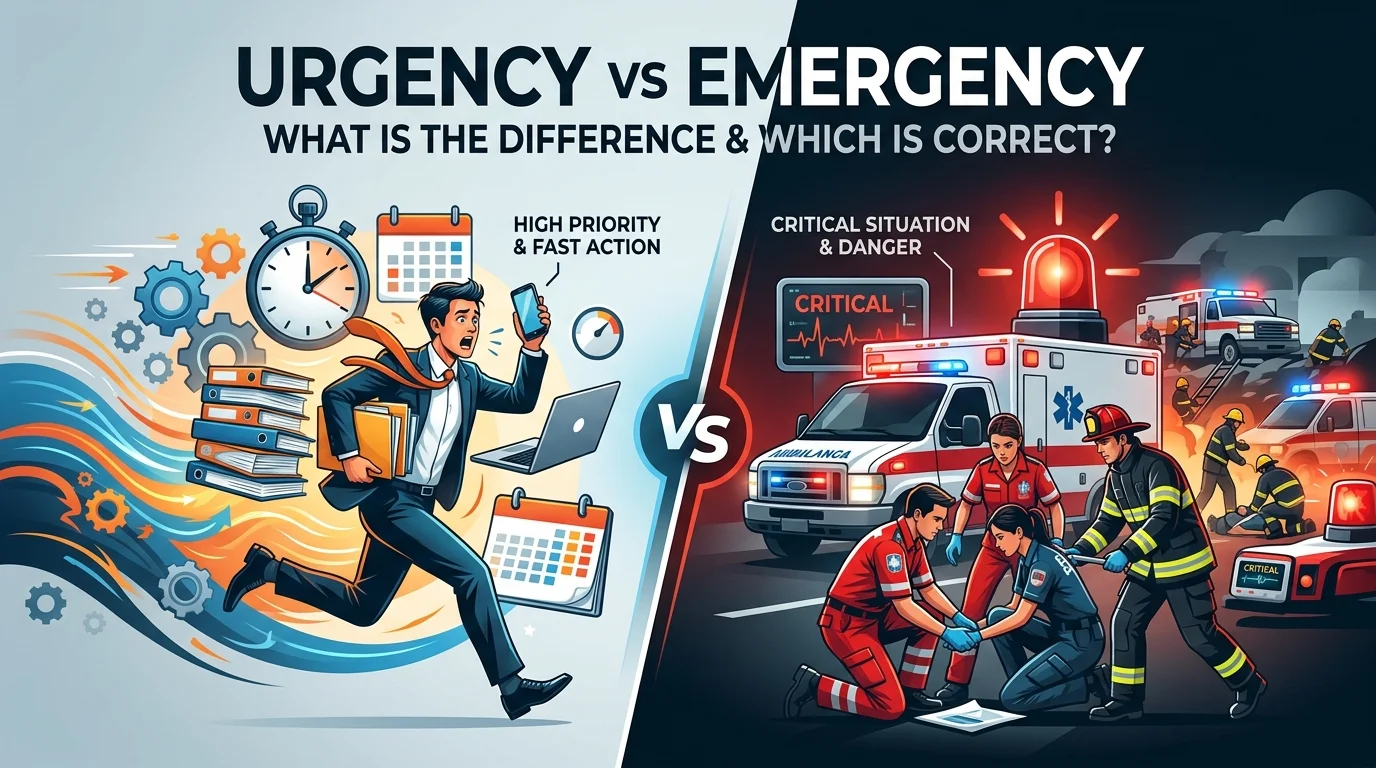
Many people confuse urgency and emergency because both involve situations that need attention. However, they are not the same. Understanding the difference matters in communication, decision-making, healthcare, business, and daily life. This guide explains both words clearly so you can use them correctly in speaking and writing.
Comparison Overview
Urgency and emergency both describe situations requiring action, but the level of seriousness and response speed differs.
Urgency means something needs attention soon, but it may not be life-threatening.
Emergency means immediate action is required because there is serious danger, risk, or harm.
In simple terms: all emergencies are urgent, but not all urgent situations are emergencies.
Definition of Urgency
Urgency refers to a situation or task that requires prompt attention or quick action.
It usually means something is important and should not be delayed, but it does not always involve danger.
Examples:
- replying to an important email
- meeting a project deadline
- visiting a doctor for worsening symptoms
The core idea of urgency is priority and timeliness.
Definition of Emergency
Emergency refers to a sudden, serious situation that requires immediate action to prevent harm, danger, or damage.
It often involves:
- health risks
- safety threats
- unexpected crises
Examples:
- a heart attack
- a fire
- a car accident
The core idea of emergency is immediate danger and critical response.
Main Differences Between Urgency and Emergency
| Feature | Urgency | Emergency |
| Meaning | Needs quick attention | Needs immediate action |
| Danger level | Usually low to moderate | High or life-threatening |
| Time pressure | Soon | Right now |
| Example | Finish assignment today | Call ambulance immediately |
| Emotional impact | Stressful | Critical or alarming |
| Common use | Work, school, health | Medical, safety, disasters |
The key difference is this: urgency is about importance, while emergency is about danger.
Grammar Guide
Both urgency and emergency are nouns.
Examples:
- The urgency of the issue increased.
- This is a medical emergency.
How each term is used in sentences
Urgency
- There is urgency in completing this report.
- She spoke with urgency.
Pattern:
- urgency + of + noun
- with urgency
Emergency
- This is an emergency.
- Emergency services arrived quickly.
Pattern:
- an emergency
- emergency + noun (emergency room, emergency exit)
Common mistakes learners make
- Using emergency for minor problems
Wrong: My homework is an emergency.
Correct: My homework is urgent. - Using urgent instead of emergency in dangerous situations
Wrong: He had an urgent heart attack.
Correct: He had a medical emergency. - Confusing adjective and noun forms
Wrong: This is urgency.
Correct: This is urgent.
Simple rules to remember
- If someone could be harmed, use emergency.
- If something needs quick attention but is not dangerous, use urgency.
- Ask: “Is there danger?” If yes, use emergency.
Quick tips for writing and speaking
- Use urgent for deadlines and tasks.
- Use emergency for accidents and crises.
- In professional writing, choose urgent for emails and notices.
- In healthcare, use emergency only for critical conditions.
When to Use Each One
Use urgency when:
- a deadline is close
- a problem needs quick handling
- something is important but manageable
Use emergency when:
- someone is injured
- safety is at risk
- immediate help is required
When NOT to Use Each One
Do not use urgency when:
- there is life-threatening danger
- immediate rescue is needed
Wrong: There is urgency after the building caught fire.
Do not use emergency when:
- describing normal work deadlines
- talking about minor inconvenience
Wrong: My delayed package is an emergency.
Which One to Use (Decision Guide)
Ask yourself these questions:
- Is someone in danger?
→ Yes = Emergency - Does it need action soon?
→ Yes = Urgency - Can it wait a little?
→ Yes = Urgency - Must action happen immediately?
→ Yes = Emergency
Quick formula:
Danger = Emergency
Priority = Urgency
Real-World Practical Examples
Urgency Examples
- Education: The student felt urgency before the exam deadline.
- Daily life: I need urgent groceries before guests arrive.
- Business: The manager handled the urgent client request.
- Technology: The software bug requires urgent fixing.
- Writing: This article needs urgent editing today.
Emergency Examples
- Healthcare: A patient with chest pain is a medical emergency.
- Daily life: Call emergency services after the accident.
- Science lab: A chemical spill created an emergency.
- Business: A data breach became an emergency.
- Conversation: “Help! This is an emergency!”
Self-Assessment (Fill in the Blanks)
- I will use ______ when referring to a house fire.
- The correct word is ______ because a deadline is near.
- I will use ______ when referring to a heart attack.
- The correct word is ______ because the report must be submitted today.
- I will use ______ when referring to a car crash.
- The correct word is ______ because the email needs a quick reply.
- I will use ______ when referring to a broken leg.
- The correct word is ______ because the task is important but not dangerous.
- I will use ______ when referring to a hospital crisis.
- The correct word is ______ because the assignment is due tomorrow.
- I will use ______ when referring to a fire alarm.
- The correct word is ______ because the meeting must happen soon.
- I will use ______ when referring to severe bleeding.
- The correct word is ______ because the software issue needs quick repair.
- I will use ______ when referring to an ambulance call.
- The correct word is ______ because the customer complaint needs attention.
- I will use ______ when referring to an earthquake.
- The correct word is ______ because the paperwork should be completed quickly.
- I will use ______ when referring to a rescue operation.
- The correct word is ______ because the email cannot wait long.
Answers
- Emergency
- Urgency
- Emergency
- Urgency
- Emergency
- Urgency
- Emergency
- Urgency
- Emergency
- Urgency
- Emergency
- Urgency
- Emergency
- Urgency
- Emergency
- Urgency
- Emergency
- Urgency
- Emergency
- Urgency
Final Verdict
The difference between urgency and emergency is simple once you understand the context. Use urgency when something needs prompt attention but does not involve immediate danger. Use emergency when there is serious risk, harm, or a need for immediate action. Remember this easy rule: urgent means important now, emergency means danger now. Knowing this distinction helps you communicate more clearly and correctly in every situation.
Conclusion About Urgency vs Emergency
Understanding the difference between urgency and emergency helps you respond to situations more effectively in daily life, work, and critical moments. While urgency refers to tasks that need quick attention and timely action, emergency represents serious situations that require immediate response due to danger or risk. Many people mix the two, but using them correctly improves communication and decision-making. Whether you are handling deadlines, health concerns, or unexpected crises, knowing when something is urgent or an emergency ensures better clarity and control. In simple terms, urgency guides priority, while emergency demands action without delay. Mastering this difference makes your language more accurate and your responses more effective in real-world situations.
FAQs
What is the main difference between urgency and emergency?
Urgency refers to something important that needs quick attention, while emergency involves serious danger requiring immediate action. Urgency is about priority and timing, but emergency is about safety and risk. Both require response, but emergencies are more critical and often life-threatening.
Is urgency the same as emergency?
No, urgency and emergency are not the same. Urgency means something should be handled soon, while emergency means immediate action is necessary due to danger or harm. All emergencies are urgent, but not all urgent situations are emergencies.
Can an urgent situation become an emergency?
Yes, an urgent situation can turn into an emergency if it is not handled in time. For example, a minor health issue may become serious if ignored. Timely action is important to prevent urgent problems from escalating into emergencies.
How do hospitals define urgency and emergency?
Hospitals classify emergency cases as life-threatening conditions requiring immediate care. Urgent cases are serious but not immediately life-threatening. Emergency patients are treated first, while urgent patients may wait depending on severity and medical priority.
What are examples of urgency in daily life?
Common urgency examples include meeting deadlines, replying to important emails, or finishing assignments on time. These tasks need quick attention but are not dangerous. They are important for productivity and should not be delayed unnecessarily.
What are examples of emergencies?
Examples of emergencies include car accidents, heart attacks, fires, or severe injuries. These situations require immediate action to prevent harm or save lives. Emergency services are often needed without delay.
Why is it important to understand urgency and emergency?
Understanding the difference helps people respond correctly in different situations. It improves communication, reduces confusion, and ensures proper action is taken. It is especially important in healthcare, business, and safety-related decisions.
Can urgency be used in medical terms?
Yes, urgency is used in medicine for conditions that require quick attention but are not life-threatening. For example, urgent care cases need treatment soon but do not require emergency intervention.
What happens if you ignore an emergency?
Ignoring an emergency can lead to serious harm, worsening conditions, or even loss of life. Emergencies require immediate response, so delaying action can make the situation much more dangerous.
How can I remember urgency vs emergency easily?
A simple way is to remember: urgency means important now, emergency means danger now. If there is risk to life or safety, it is an emergency. If it just needs quick attention, it is urgency.

Sarah Mitchell is an experienced writer and grammar teacher with over 10 years of expertise in English language education. She helps learners improve their grammar, writing, and communication skills through clear explanations and practical examples. Sarah creates learner-friendly content focused on real-life English, making language learning simple, effective, and confidence-building.