
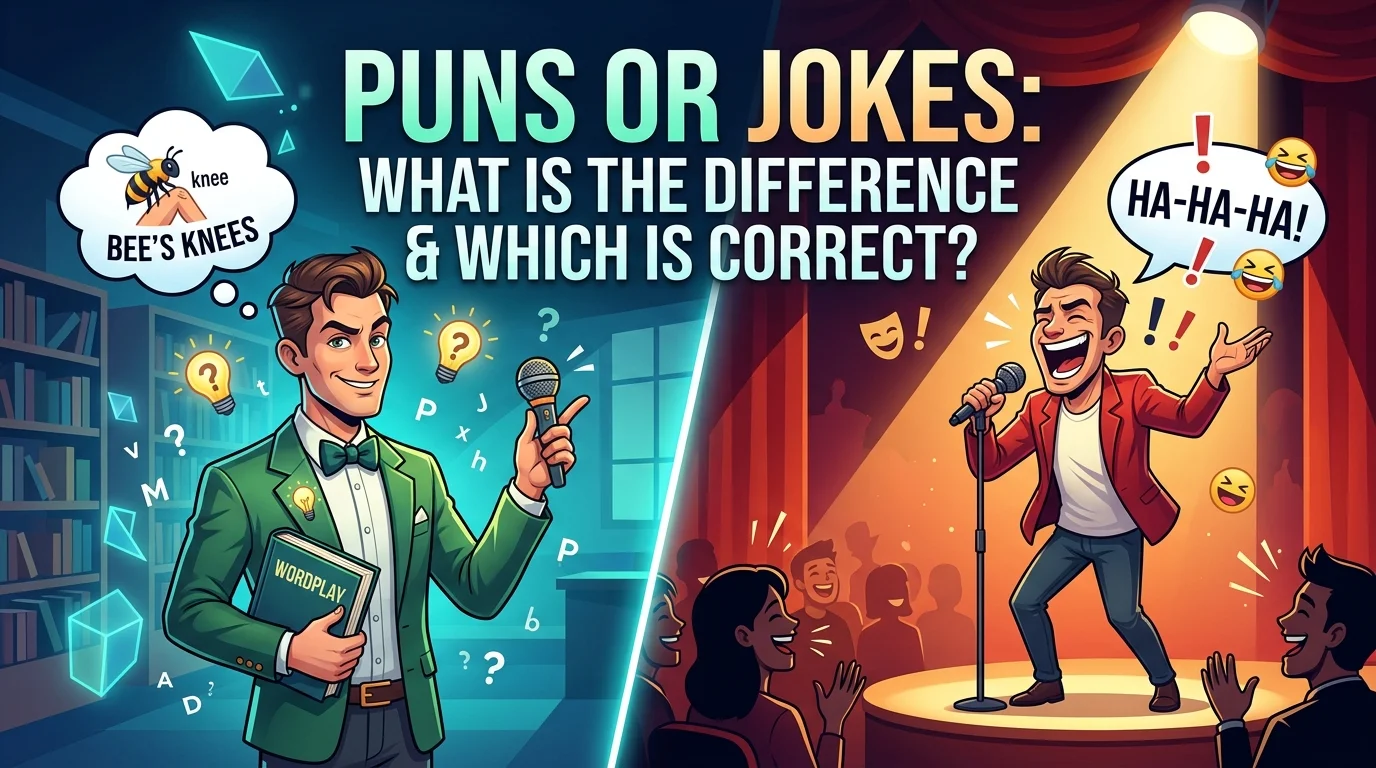
Many people use puns and jokes as if they mean the same thing, but they are not exactly identical. Both are forms of humor, but they work in different ways. Understanding the difference between puns and jokes helps you use humor more effectively in writing, speaking, and everyday conversation.
Comparison Overview
Puns and jokes are both tools for making people laugh, but they create humor differently. A pun usually relies on wordplay, often using words with double meanings or similar sounds. A joke is a broader form of humor that can include stories, situations, observations, or wordplay. In simple terms, a pun is one type of joke, but not all jokes are puns.
Definition of Puns
A pun is a form of humor based on wordplay. It often uses words that sound alike or have more than one meaning to create a funny effect.
Purpose of a pun:
• To create quick humor through clever language
• To make writing or conversation more playful
• To entertain using double meanings
Example:
“I used to be a baker, but I couldn’t make enough dough.”
Here, “dough” means both bread mixture and money.
Definition of Jokes
A joke is any humorous statement, story, or situation intended to make people laugh.
Purpose of a joke:
• To entertain an audience
• To lighten conversation
• To express humor in many different forms
Example:
“Why don’t skeletons fight each other? Because they don’t have the guts.”
This is a joke because it creates humor through setup and punchline.
Main Differences Between Puns and Jokes
| Feature | Puns | Jokes |
| Meaning | Wordplay humor | General humor |
| Structure | Usually short | Can be short or long |
| Focus | Language tricks | Story, setup, or observation |
| Purpose | Cleverness | Laughter/entertainment |
| Example | “Time flies like an arrow” | “Knock knock” jokes |
Key difference: Every pun is a kind of joke, but not every joke is a pun.
Grammar Guide
How each term is used in sentences
Pun
• He made a clever pun about apples.
• That sentence contains a funny pun.
Joke
• She told a hilarious joke.
• His joke made everyone laugh.
Sentence patterns:
• “That is a pun about _____.”
• “That joke was about _____.”
Common mistakes learners make
- Calling every funny sentence a pun.
Not all humor is wordplay. - Using “pun” when describing a story joke.
A story-based laugh is usually a joke, not a pun. - Thinking jokes must be verbal.
Jokes can also be visual or situational.
Simple rules to remember
• If humor depends on words, it is usually a pun.
• If humor depends on a setup and punchline, it is usually a joke.
• Puns are narrower; jokes are broader.
Quick tips for writing and speaking
• Use puns in headlines and social media for quick humor.
• Use jokes in speeches and conversations for stronger audience engagement.
• Avoid too many puns in formal writing.
When to Use Each One
Use pun when:
• Talking about wordplay
• Writing funny titles
• Creating witty captions
• Teaching language concepts
Use joke when:
• Telling a funny story
• Describing humor generally
• Entertaining a group
• Writing comedy content
When NOT to Use Each One
Do not use pun:
• For non-wordplay humor
• For physical comedy
• For story-based humor without language tricks
Do not use joke:
• When specifically discussing wordplay mechanics
• If you need to identify a pun precisely
Incorrect: “That pun about the chicken crossing the road was funny.”
Better: “That joke about the chicken crossing the road was funny.”
Which One to Use (Decision Guide)
Ask yourself:
- Is the humor based on word meaning or sound?
→ Use pun - Is it a funny story, setup, or punchline?
→ Use joke - Are you speaking generally about humor?
→ Use joke - Are you analyzing clever language?
→ Use pun
Real-World Practical Examples
Puns Examples
- Education: “The math teacher has too many problems.”
- Daily life: “I’m reading a book on anti-gravity. It’s impossible to put down.”
- Business: “Our bakery business is on a roll.”
- Technology: “The computer caught a virus and needed a byte.”
- Conversation: “I’m friends with all electricians because they are very grounded.”
Jokes Examples
- Education: “Why was the textbook sad? It had too many problems.”
- Daily life: “I told my wife she was drawing her eyebrows too high. She looked surprised.”
- Science: “Why can’t you trust atoms? They make up everything.”
- Business: “Why did the employee bring a ladder? To reach the next level.”
- Technology: “Why did the smartphone need glasses? It lost its contacts.”
Self-Assessment (Fill in the Blanks)
- A funny play on words is called a ______.
- A humorous story is usually a ______.
- “Lettuce celebrate” is a ______.
- A knock-knock is a ______.
- Humor based on double meaning is a ______.
- A stand-up comedian tells ______.
- Clever word humor is called a ______.
- A long funny story is a ______.
- “Orange you glad?” is a ______.
- A humorous punchline belongs to a ______.
- Wordplay belongs to a ______.
- General humor is a ______.
- A one-line word trick is a ______.
- Story-based humor is a ______.
- A language joke using similar sounds is a ______.
- A comedian usually tells a ______.
- A witty caption often uses a ______.
- A comedy show contains many ______.
- Double meanings create a ______.
- Most puns are also a type of ______.
Answers
- Pun
- Joke
- Pun
- Joke
- Pun
- Jokes
- Pun
- Joke
- Pun
- Joke
- Pun
- Joke
- Pun
- Joke
- Pun
- Joke
- Pun
- Jokes
- Pun
- Joke
Final Verdict
The difference between puns and jokes is simple: a pun is a specific type of humor built on wordplay, while a joke is a broader term for anything designed to make people laugh. If the humor depends on clever words, choose pun. If it involves a funny setup, story, or punchline, choose joke. Remember: all puns are jokes, but not all jokes are puns. Understanding this distinction will make your communication clearer and your humor sharper.
Conclusion About Puns or Jokes
Puns and jokes both bring humor into our daily lives, but they do it in different ways. Puns rely on clever wordplay and double meanings, while jokes use storytelling, punchlines, or situations to create laughter. Understanding the difference helps you choose the right form of humor in conversations, writing, and entertainment. Whether you enjoy a smart pun that makes you think or a classic joke that makes you laugh instantly, both add fun and creativity to communication. In the end, the best choice depends on context, audience, and style. Using them correctly can make your language more engaging and enjoyable.
FAQs
What is the main difference between puns and jokes
Puns are based on wordplay and double meanings, while jokes are broader and can include stories, situations, or punchlines. A pun is usually short and clever, but a joke can be long or short. Both aim to create humor, but they use different techniques to make people laugh.
Are puns a type of joke
Yes, puns are a type of joke. However, not all jokes are puns. Puns specifically rely on language tricks and word meanings, while jokes can include many forms of humor such as storytelling, irony, or situational comedy. So, puns are a smaller category within jokes.
Why are puns considered clever humor
Puns are considered clever because they play with language in unexpected ways. They often use words that sound alike or have double meanings. This requires the listener to think a little more to understand the humor, which makes puns feel smart and witty compared to simple jokes.
When should I use puns instead of jokes
Use puns when you want quick, clever humor based on language, such as in captions, titles, or light conversation. Use jokes when you want to tell a story or make a broader humorous point. Puns work best in short, creative, and playful communication.
Can jokes exist without wordplay
Yes, many jokes do not use wordplay at all. They can be based on situations, stories, irony, or exaggeration. For example, knock-knock jokes or observational humor do not rely on language tricks. This makes jokes more flexible than puns in different contexts.
Are puns difficult to understand
Some puns can be difficult at first because they rely on double meanings or similar sounds. However, once you understand the trick behind them, they become easier to enjoy. Puns often require a bit of thinking, which is part of their charm and humor.
Why do people enjoy jokes more than puns
Many people find jokes easier to understand because they are more direct and often include a clear setup and punchline. Puns require interpretation of wordplay, which may not always be immediately obvious. However, both types of humor have their own audience and appeal.
Where are puns commonly used
Puns are commonly used in advertising, social media captions, headlines, and casual conversation. They are popular because they are short, catchy, and memorable. Businesses often use puns to grab attention and make their messages more engaging and creative.
Can children understand puns and jokes equally
Children usually understand simple jokes more easily than puns because puns require language awareness and multiple meanings. As vocabulary and language skills develop, children gradually begin to understand and enjoy puns as well. Both help improve language learning in fun ways.
Which is better for communication, puns or jokes
Neither is strictly better; it depends on context. Puns are great for creativity and wordplay, while jokes are better for storytelling and general humor. Using both appropriately can make communication more engaging, entertaining, and effective in different situations.

Sophia Turner is a grammar-focused writer who covers similes, word-versus-word meanings, and correct English usage. Her content is designed for learners who want quick answers, logical explanations, and practical guidance for improving writing accuracy and style.