
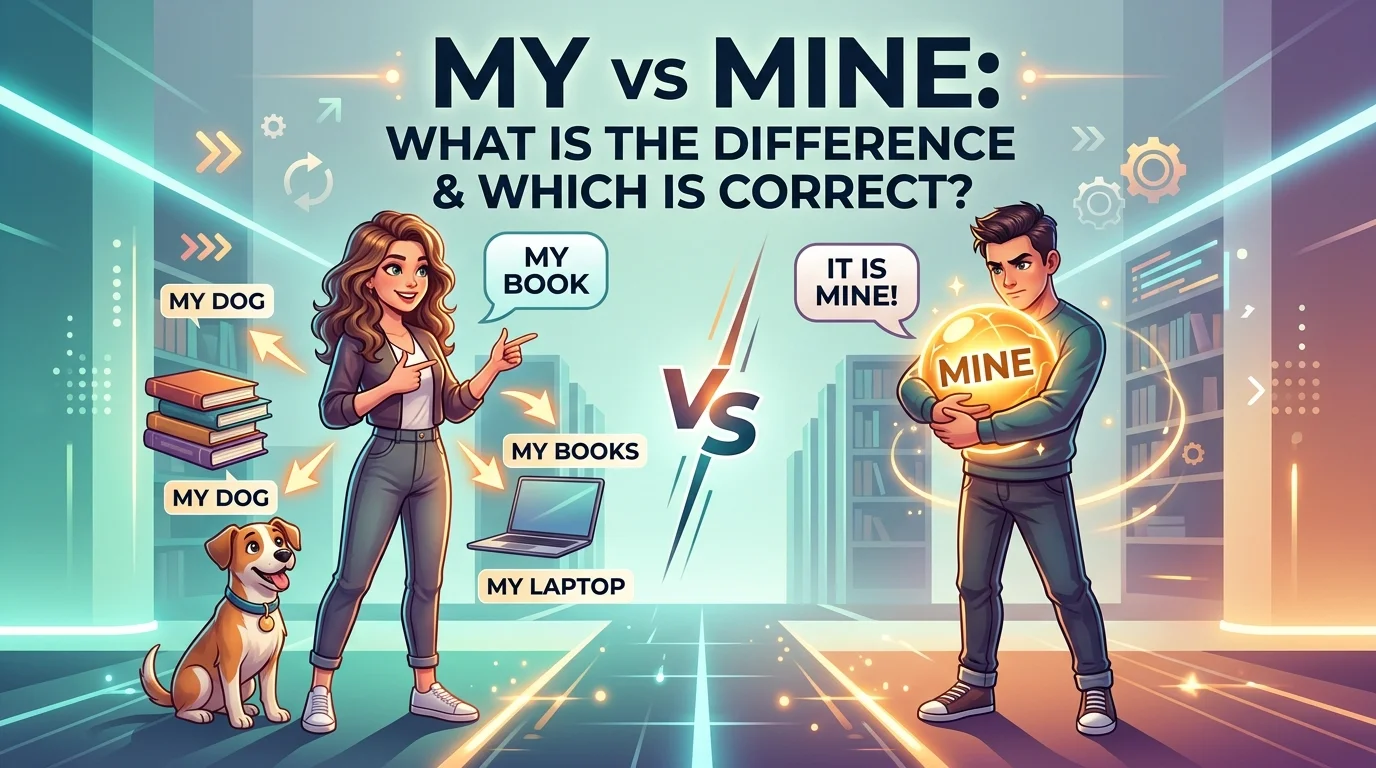
“My” and “mine” are both possessive words in English, but they are used differently in sentences. Many learners confuse them because both show ownership. Understanding the difference between “my” and “mine” helps you write and speak more naturally and correctly in everyday English.
Comparison Overview
“My” and “mine” both show possession, which means they tell us something belongs to someone. In this case, they both refer to something belonging to “me.” The key difference is how they function in a sentence. “My” always comes before a noun, while “mine” usually replaces the noun entirely.
| Feature | My | Mine |
| Word Type | Possessive adjective | Possessive pronoun |
| Used Before Noun? | Yes | No |
| Shows Ownership? | Yes | Yes |
| Example | My book | The book is mine |
Definition of My
“My” is a possessive adjective. It is used before a noun to show that something belongs to the speaker.
Examples:
• My phone is on the table.
• My idea was accepted.
• My shoes are new.
Purpose:
“My” modifies a noun and tells us who owns it.
Definition of Mine
“Mine” is a possessive pronoun. It replaces a noun phrase so you do not need to repeat the noun.
Examples:
• That phone is mine.
• The idea was mine.
• Those shoes are mine.
Purpose:
“Mine” stands alone and shows ownership without needing another noun after it.
Main Differences Between My and Mine
The main difference is grammar and sentence position.
| Point | My | Mine |
| Grammar Role | Adjective | Pronoun |
| Needs a noun after it | Yes | No |
| Position in sentence | Before noun | Usually after verb |
| Example | My bag | The bag is mine |
Meaning:
Both mean ownership.
Usage:
“My” introduces the object.
“Mine” replaces the object.
Function:
“My” describes.
“Mine” stands alone.
Context:
Use “my” when naming the object.
Use “mine” when the object is already understood.
Why Do People Confuse My and Mine?
People confuse these words because both show possession and refer to the same owner. The mistake usually happens when learners use “mine” before a noun or “my” without a noun.
Incorrect:
• Mine book is here.
• This pen is my.
Correct:
• My book is here.
• This pen is mine.
Grammar Guide
How Each Term Is Used in Sentences
“My” pattern:
My + noun
Examples:
• My car
• My teacher
• My homework
“Mine” pattern:
Subject + be verb + mine
Examples:
• The car is mine.
• That teacher is mine.
• The homework is mine.
Common Mistakes Learners Make
Using “mine” before a noun:
❌ Mine jacket is blue.
✔ My jacket is blue.
Using “my” alone:
❌ That jacket is my.
✔ That jacket is mine.
Repeating both:
❌ This is my book and it is my.
✔ This is my book and it is mine.
Simple Rules to Remember
Use “my” before a noun.
Use “mine” without a noun.
Easy memory trick:
“My needs company. Mine stands alone.”
Quick Tips for Writing and Speaking
Check if a noun follows the word.
If yes, use “my.”
If no noun follows, use “mine.”
Read your sentence aloud to hear what sounds natural.
When to Use Each One
Use “my” when introducing something you own:
• My laptop is fast.
• My room is clean.
Use “mine” when ownership is already clear:
• That laptop is mine.
• The room is mine.
When NOT to Use Each One
Do not use “my” at the end of a sentence:
❌ This bag is my.
Do not use “mine” before a noun:
❌ Mine bag is heavy.
Do not mix them:
❌ Mine dog is mine best friend.
Correct:
✔ My dog is my best friend.
Which One to Use (Decision Guide)
Ask yourself:
- Is a noun coming next?
Yes → Use “my”
Example:
My pen
- Is the noun already known or repeated?
Yes → Use “mine”
Example:
The pen is mine.
Quick formula:
Before noun = My
No noun = Mine
Real-World Practical Examples
My Examples
- Education: My teacher gave homework.
- Daily life: My breakfast was delicious.
- Science: My experiment succeeded.
- Business: My manager approved the plan.
- Technology: My laptop needs charging.
Mine Examples
- Education: That notebook is mine.
- Daily life: The blue cup is mine.
- Science: That discovery was mine.
- Business: The final decision was mine.
- Technology: That charger is mine.
Self-Assessment (Fill in the Blanks)
- This is ______ book.
- That book is ______.
- ______ phone is ringing.
- The phone is ______.
- Is this ______ pen?
- No, it is ______.
- ______ car is parked outside.
- That red car is ______.
- ______ homework is finished.
- The homework is ______.
- I forgot ______ keys.
- Those keys are ______.
- ______ jacket looks new.
- The jacket is ______.
- ______ idea was helpful.
- That great idea was ______.
- ______ computer is slow today.
- That computer is ______.
- ______ answer is correct.
- The correct answer is ______.
Answers
- my
- mine
- my
- mine
- my
- mine
- my
- mine
- my
- mine
- my
- mine
- my
- mine
- my
- mine
- my
- mine
- my
- mine
Final Verdict
“My” and “mine” both show possession, but they are not interchangeable. Use “my” before a noun, such as “my book” or “my phone.” Use “mine” when the noun is already understood, such as “the book is mine” or “the phone is mine.” The easiest way to remember is this: “my” needs a noun, but “mine” works alone. Once you understand this simple rule, choosing the correct word becomes easy and your English becomes more accurate and natural.
Conclusion About My vs Mine
Understanding “my” vs “mine” is essential for speaking and writing correct English with confidence. Both words show possession, but they work in different ways depending on sentence structure. “My” is used before a noun, while “mine” replaces the noun completely when ownership is already clear. Once you recognize this simple pattern, choosing between them becomes effortless in daily communication. Whether you are writing essays, speaking in conversations, or improving grammar skills, using these words correctly helps your English sound more natural, accurate, and fluent in both formal and informal contexts.
FAQs About My vs Mine
What is the main difference between my and mine?
“My” is used before a noun to show ownership, while “mine” replaces the noun and stands alone in a sentence. Both indicate possession, but their placement and grammatical roles differ. “My” needs a noun after it, while “mine” does not require any noun to complete the meaning.
Can my and mine be used interchangeably?
No, they cannot be used interchangeably. “My” must always be followed by a noun, such as “my book.” “Mine” is used independently, such as “the book is mine.” Using them incorrectly can lead to grammatical errors and confusion in both spoken and written English.
Why is my used before a noun?
“My” is a possessive adjective that modifies a noun. It helps identify ownership directly before naming the object. For example, in “my car,” the word “my” shows who owns the car. It always works with a noun to complete the meaning of the sentence clearly.
When should I use mine instead of my?
Use “mine” when the noun is already understood or mentioned earlier in the sentence. For example, instead of repeating “my book,” you can say “the book is mine.” It avoids repetition and makes sentences smoother and more natural in conversation or writing.
Is mine formal or informal English?
“Mine” is used in both formal and informal English. It is grammatically correct in all contexts. Whether you are writing essays, emails, or speaking casually, “mine” is acceptable as long as it is used correctly in place of a noun phrase.
Can my be used without a noun?
No, “my” cannot stand alone. It always requires a noun after it, such as “my phone” or “my idea.” If no noun follows, the sentence is incomplete or incorrect. In such cases, “mine” should be used instead to replace the noun.
What are examples of mine in a sentence?
Examples include “That bag is mine,” “The decision is mine,” and “This house is mine.” In each case, “mine” replaces the noun and clearly shows ownership without needing any additional words to complete the sentence structure.
Why do learners confuse my and mine?
Learners often confuse them because both express ownership. The main challenge is understanding structure. “My” always needs a noun, while “mine” does not. Without practice, students may mix them up, especially when translating directly from their native language.
Can mine come before a noun?
No, “mine” cannot be used before a noun. Saying “mine book” is incorrect. Instead, you should say “my book.” “Mine” is only used when the noun is not stated, such as “the book is mine.”
How can I easily remember the difference?
A simple trick is: “my” always needs a companion (noun), while “mine” stands alone. If you see a noun coming next, use “my.” If the noun is already known or missing, use “mine.” This rule makes usage quick and easy to remember.

Amelia Wright focuses on making figurative language easy to understand. Her writing explains similes, metaphors, and word meanings using relatable examples. She aims to help readers recognize subtle differences in usage and apply them correctly in both academic and casual writing.